
 Worksheets
Dynamic Ecosystems Test 1
Total questions: 25
Worksheet time: 13mins
Name
Class
Date
1.
First Name
4 lines
2.
Last Name
4 lines
3.
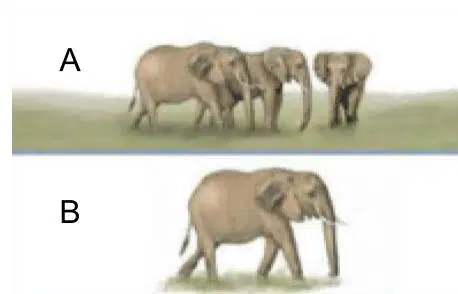
Hope claims that illustration A is an example of populations. What makes illustration (A) a good example of populations?
a)
It has several organisms.
b)
It shows multiple organisms of the same species.
c)
It does not include abiotic factors like rocks and water.
d)
It shows how different biomes make up Earth .
4.
As you move up the energy pyramid, the amount of energy ___________________.
a)
increase
b)
decreases
c)
stays the same
5.
Food webs consist of multiple ____________________.
a)
food chains
b)
energy pyramids
c)
carnivores
d)
herbivores
6.
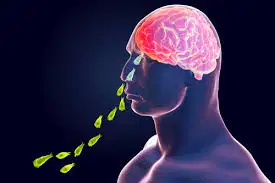
Naegleria fowleri is an amoeba that lives in warm water and enters through the nose of a person. Once in the body, it eats the brain. It causes the brain to swell (inflammation) resulting in rapid death of the person. How does the rapid death of the host effect this parasite?
a)
It kills the parasite quickly as well, so it's not beneficial for the amoeba.
b)
It kills the parasite quickly as well, so it's beneficial for the amoeba.
c)
The death of the host does not effect the parasite.
7.
All food chains and food webs must start with a ________________________.
a)
Producer
b)
Herbivore
c)
Carnivore
d)
Apex Predator
8.
Which would be the best energy model to choose if you wanted to show multiple feeding relationships in the environment?
a)
Food chain
b)
Food web
c)
Food Pyramid
d)
None of these
9.
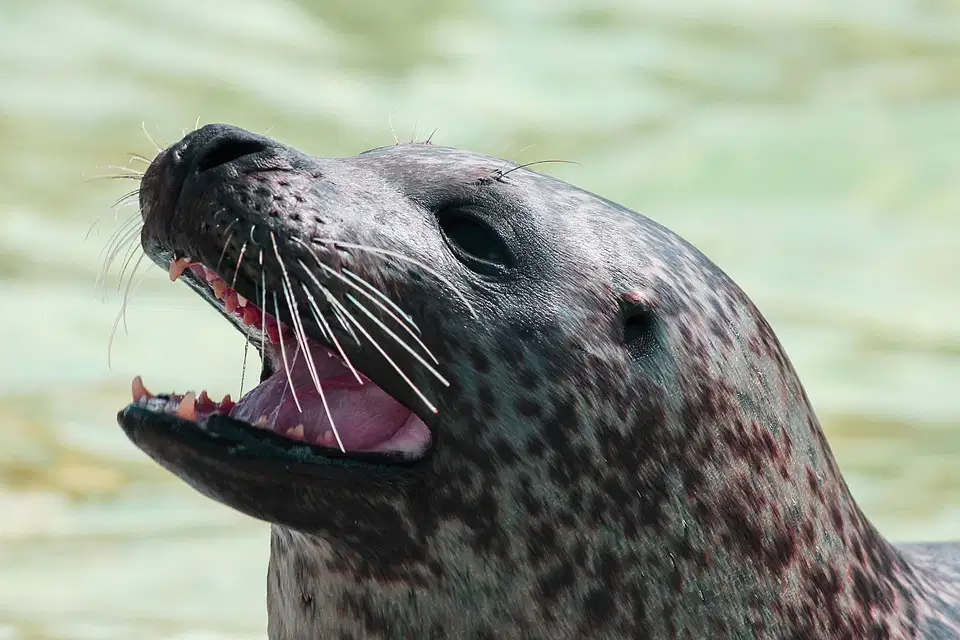
Which of the following would best describe the type of consumer pictured below? (Seal)
a)
Herbivore
b)
Carnivore
c)
Omnivore
d)
Detritivore
10.
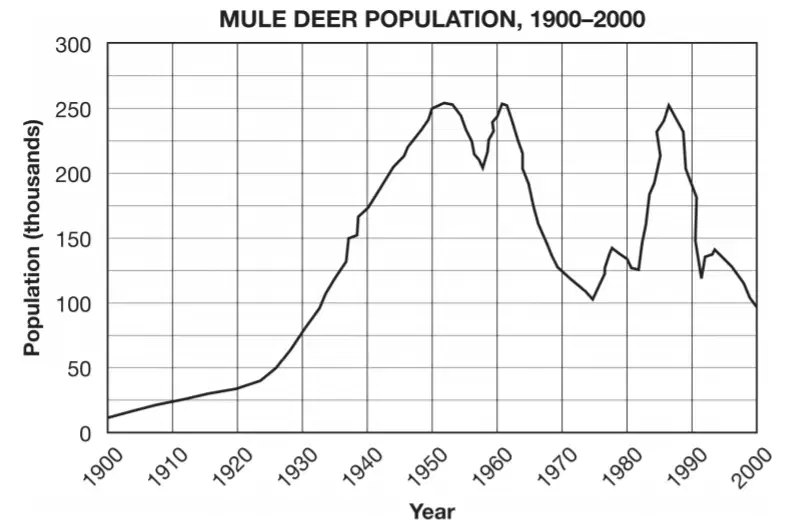
The graph below shows the mule deer population between 1900-2000. During what years did the mule population most likely experience the greatest amount of competition for resources?
a)
1930-1950
b)
1956-1960
c)
1960-1970
d)
1976-1980
11.
A male peacock showing his feathers to attract a female peacock is an example of what type of ecological relationship?
a)
Predator-Prey Relationship
b)
Competitive Relationship
c)
Cooperative Relationship
d)
Mutualistic Relationship
12.
A herd of elephants surrounding their young to shield them from predators is an example of what type of ecological relationship?
a)
Predator-Prey Relationship
b)
Competitive Relationship
c)
Cooperative Relationship
d)
Mutualistic Relationship
13.
A(n) __________________ is a collection of all of the abiotic and biotic factors in an entire region.
a)
habitat
b)
community
c)
population
d)
ecosystem
14.
What is the biggest difference between an ecosystem and a community?
a)
A community includes only one type of organism and an ecosystem includes many types.
b)
An ecosystem includes only living organisms and a community includes both living and nonliving parts.
c)
A community does not include nonliving parts and an ecosystem includes both living and nonliving parts.
d)
An ecosystem includes only one type of organism and a community includes many types.
15.
What is defined as all of the members of a single species that live in a particular area?
a)
organisms
b)
ecosystems
c)
populations
d)
community
16.
All of the squirrels, grass, oak trees, and turtles in a forest would be considered a ___________.
a)
community
b)
habitat
c)
population
d)
species
17.
Ticks, fleas, and tapeworms are examples of which type of symbiosis?
a)
Parasitism
b)
Mutualism
c)
Commensalism
d)
Cooperative
18.
Ecosystems grouped together by climate, plants, and adaptations are called ______.
a)
populations
b)
biome
c)
communities
d)
species
19.
A grizzly bear catching salmon out of the river is an example of what type of ecological relationship?
a)
Predator-Prey Relationship
b)
Competitive Relationship
c)
Cooperative Relationship
d)
Mutualistic Relationship
20.
Which relationship is an example of mutualism?
a)
An insect that lives and feeds on the body of an alligator
b)
An ant that lives on a plant and defends the plant from other insects
c)
A bird that migrates to follow the movements of the butterflies that it eats
d)
A deer that eats one kind of plant that grows along the edge of the forest
21.
Which term refers to an environmental factor that prevents a population from increasing?
a)
carrying capacity
b)
biotic potential
c)
immigration
d)
limiting factor
22.
Which of the following would be an example of a limiting factor decreasing a population's size?
a)
An early winter frost kills all the tomato plants in a garden.
b)
The prevention of hunting Bengal tigers and the population's death rate decreases.
c)
Developers want to build a subdivision, but are prevented from doing that to protect owls in that area.
23.
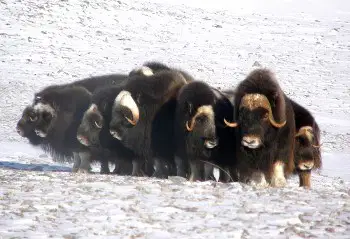
Buffalo and other such animals group together (herd). This makes it more difficult for predators to attack a single buffalo. The buffalo depend on each other for survival. What kind of behavior is this demonstrating?
a)
Commensalism
b)
Parasitism
c)
Cooperative
d)
Competition
24.
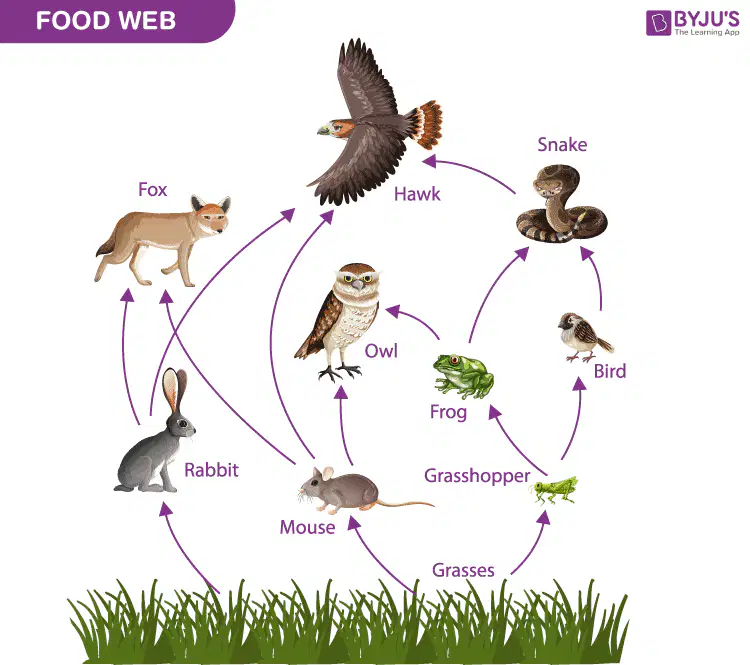
Select ALL of the primary consumers in the following food web.
a)
Rabbit
b)
Mouse
c)
Grasshopper
d)
Grasses
e)
Frog
25.
Which of the following is the correct order of the levels of the environment?
a)
organism, population, community, ecosystem, biosphere
b)
organism, community, population, ecosystem, biosphere
c)
population, community, organism, ecosystem, biosphere
d)
organism, population, community, biosphere, ecosystem
100 %

