wayground logo

Free Printable Worksheets

NEW

Font size

S
M
L
XL
Worksheets

Diagnostic Test Spring 2025

Total questions: 75

Worksheet time: 4hrs 40mins

Name
Class
Date
1.
   6m2 + 16m
a)
2(3m2 + 8m)
b)
2m(3m + 8)
c)
2m(3m - 8m)
d)
not factorable
2.
Factor:
x+ 7x - 30
a)
(x + 10)(x - 7)
b)
(x - 10)(x + 3)
c)
(x + 10)(x + 3)
d)
(x + 10)(x - 3)
3.
Factor:
v2 + 3v - 88
a)
(v + 11)(v - 8)
b)
(v + 22)(v - 4)
c)
(v + 8)(v - 11)
d)
(v - 22)(v + 4)
4.
Factor completely: 
3x2 + 18x +15
Hint: Factor GCF first.
a)
3(x2 + 6x + 5)
b)
(x + 5)(x + 1)
c)
3(x + 5)(x + 1)
d)
Prime
5.

Which of the following is equivalent to:
2x213x702x^2-13x-70  

a)

(2x7)(x+10)\left(2x-7\right)\left(x+10\right)  

b)

(7x+5)(x+2)\left(7x+5\right)\left(x+2\right)  

c)

(2x+7)(x10)\left(2x+7\right)\left(x-10\right)

d)

2(x7)(x+10)2\left(x-7\right)\left(x+10\right)  

6.
Factor Completely:
x2 - 36
a)
(x + 9)(x - 4)
b)
(x - 6)(x - 6)
c)
(x - 9)(x + 4)
d)
(x + 6)(x - 6)
7.

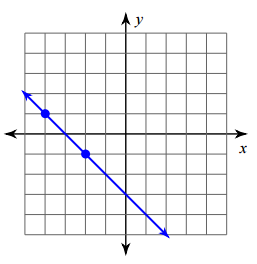
Find the slope-intercept equation

a)

y = 4x + 6

b)

y = -4x - 6

c)

y = 1/4x - 6

d)

y = -1/4x + 6

8.

Find the graph of the standard form equation: 2x - 5y = -20

a)
b)
c)
d)
9.
a)

y = 2x + 3

b)

y = -2x + 3

c)

y = -2x + 11

d)

y = -2x - 11

10.
a)

y = 1/2 x

b)

y = -1/2 x

c)

y = 2x - 10

d)

y = -2x + 6

11.

What is the slope of this line?

a)

m = 0

b)

m = undefined

c)

m = 3

d)

m = 1/3

12.

What is the slope of this line?

a)

m = 0

b)

m = undefined

c)

m = 5

d)

m = 1/5

13.

What is the solution to the system of equations below?


2x+y=72x+y=7  
3x+2y=163x+2y=16  

a)

(2,5)

b)

(2,11)

c)

(-2,-11)

d)

(-2,11)

14.
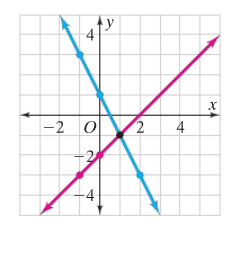
What is the solution?
a)
(1, -1)
b)
(-1, 1)
c)
(0, -2)
d)
(0, 1)
15.
√36x³y⁴
a)
6y²x√x
b)
3y²√2x
c)
3y√x
d)
6x√3y
16.
√45x⁴y⁷
a)
3x²y³√5
b)
9x²y³√5y
c)
3x²y³√5y
d)
3x⁴y⁷
17.
a)
x = 49
b)
x = 53
c)
x = 45
d)
x = 18
18.
Solve and check your solution(s).
a)
x = 2, 3
b)
x = -2, -3
c)
x = -1, -6
d)
No solution
19.
Simplify
a)
√5
b)
-3√6
c)
√6
d)
6
20.
Simplify
 
2√27+3√3
a)
15√30
b)
5√3
c)
9√3
d)
9√8
21.

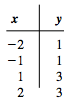
Given the following table of values, construct the function that represents the sequence.

a)

y = 3(4)x

b)

y = 3x + 4

c)

y = 4(3)x

d)

y = 4x + 3

22.
Which graph does NOT pass the vertical line test?
a)
Graph 1
b)
Graph 2
c)
Graph 3
d)
Graph 4
23.
Which is the graph of y= -x + 2?
a)
A
b)
B
c)
C
d)
D
24.

The table shows the price of a cup of yogurt with up to 5 toppings. What is the rate of change in price with respect to the number of toppings?

a)

$0.89 per topping

b)

$2.99 per topping

c)

$3.88 per topping

d)

$1.24 per topping

25.

What is the equation of the graph?

a)

y = -5

b)

y = 5

c)

x = -5

d)

x = 5

26.

Identify the x-intercept of the graph.

a)

(-4, 0)

b)

(0, -2)

c)

(0, -4)

d)

(-2, 0)

27.
What is another name for the x-intercepts of a quadratic?
a)
y-intercept
b)
Zeros
c)
x-axis
d)
They don't have another name
28.

What is the solution?

a)

No solution

b)

(0, 2)

c)

(0, -4)

d)

(3, -3)

29.

What is the graph of the function 

y=52xy=5\cdot2^x  

a)
b)
c)
d)
30.

What was the maximum height of the water?

a)

0 feet

b)

2 feet

c)

10 feet

d)

3.85 feet

31.
-7(w-4)+3w - 27
a)
10w + 21
b)
-4w + 1
c)
3w + 5
d)
2w -  5
32.

Simplify:

1y - 2x - 3y + 4x

a)

-2y + 2x

b)

-2y - 2x

c)

-4y - 6x

d)

2y - 2x

33.

Solve 2x - 3 = 1

a)

3

b)

2

c)

1

d)

-2

34.

Solve:

5x + 4 = 5x − 3

a)

x = 4

b)

x = -3

c)

infinitely many solutions

d)

no solutions

35.

Solve:

3(x − 2) = 3x − 6

a)

x = 6

b)

x = -6

c)

infinitely many solutions

d)

no solutions

36.

What is the Range of this function?

a)

1 ≤ f(x) ≤ 7

b)

1 ≤ x ≤ 7

c)

-3 ≤ f(x) ≤ 3

d)

-3 ≤ x ≤ 3

37.

What is the Domain of this function?

a)

All Real Numbers

b)

-1 ≤ x ≤ 1

c)

-1 ≤ f(x) ≤ 1

d)

1 ≥ x

38.
What would be the best first step to solving the equation in one step?
a)
multiply both sides by 3
b)
multiply both sides by -3
c)
divide both sides by -3
d)
add 3 to each side
39.
-5(x-6)=15
a)
x=-2
b)
x=-3
c)
x=-9
d)
x=3
40.

What is the RANGE of this graph?

a)

y < -3

b)

y ≤ -3

c)

y > 1

d)

y ≥ 1

41.

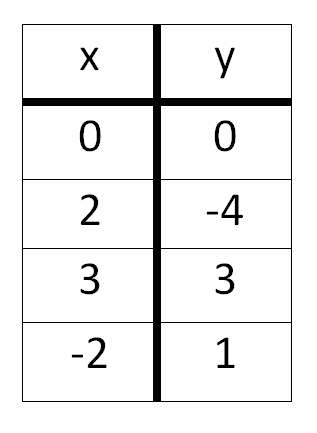
What is the range of the table?

a)

{-4, 0, 1, 3}

b)

{-2, 0, 2, 3}

c)

{-4, -2, 0, 1, 2, 3}

d)

{ (0, 0), (2, -4), (3, 3), (-2, 1) }

42.

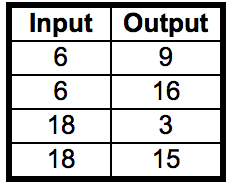
What is the domain of the relation shown in the table?

a)

{12}

b)

{6, 18}

c)

{3, 9, 15, 16}

d)

{13}

43.
Discrete or Continuous?
a)
Discrete
b)
Continuous
44.
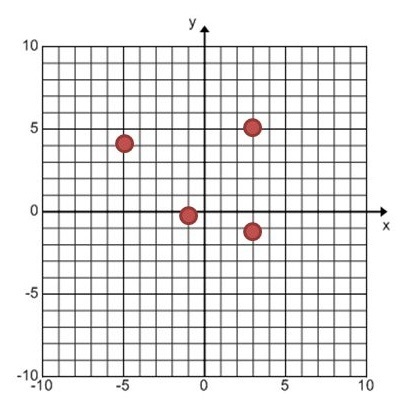
Is the graph pictured discrete or continuous?
a)
Discrete
b)
Continuous
45.
The following ordered pairs represent a relation.
{(1,3) , (5,15) , (2,6), (4,12) , (3,9)}
What are the range values from least to greatest!
a)
{1, 5, 2, 4, 3}
b)
{3, 15, 6, 12, 9}
c)
{3}
d)
{3, 6, 9, 12, 15}
46.
The table of values are shown. What is the range of the relation? From least to greatest. 
a)
(-4,-8,-3)
b)
(-3,2,6)
c)
(-8,-4,4)
d)
(6,2,-3)
47.
Is the relation a function? Why.
a)
Yes, because the x-value 11 has two y-values pair with it.
b)
Yes, because each x-value has only one y-value paired with it.
c)
No, because the x-value 11 has two y-values pair with it.
d)
No, because each x-value has only one y-value paired with it.
48.
Does the graph represent a function?
a)
Yes, because the vertical line test shows there are no repeating input values
b)
No, because the vertical line test shows there are repeating input values
49.
Does this table represent a function?
a)
Yes 
b)
No
50.
For the function f(x) = -3(x-1) find f(0).
a)
0
b)
-3
c)
3
d)
-1
51.
The function h(t) represents the height in inches of a plant after t weeks. What does the notation h(4) = 5 mean?
a)
After 5 week the plant is 4 inches tall
b)
The plant grows at a rate of 5/4 inch per week
c)
After 4 weeks the plant is 5 inches tall
d)
The plant grows at a rate of 1 inch per week
52.
Find the slope of the line.
a)
-5/4
b)
5/4
c)
-4/5
d)
4/5
53.

What is the slope of the line with the equation
 y = 32x + 4y\ =\ -\frac{3}{2}x\ +\ 4  

a)

 32-\frac{3}{2}  

b)

 32\frac{3}{2}  

c)

 44  

d)

 4-4  

54.

Are these two lines parallel, perpendicular or neither?

y = 7/3x - 5

y = 7/3x + 2

a)

Parallel

b)

Perpendicular

c)

Neither

55.

Write the equation of a line PERPENDICULAR to y = -1/3x + 5 and passes through the point (6,4)

a)

y=13x+14y=-\frac{1}{3}x+14

b)

y=3x+22y=3x+22

c)

y=13x10y=-\frac{1}{3}x-10

d)

y=3x14y=3x-14

56.
Determine the slope and y-intercept.   y = 3/2x + 3
a)
slope: 5   y-intercept:  (0,3) 
b)
slope: 3/2   y-intercept:  (0,3) 
c)
slope:  4  y-intercept:  (0,3/2)
d)
slope: 1/5   y-intercept:  (0,5) 
57.

Write equation of a line in point slope form that passes through (3,8) and has a slope of 5?

a)

y-8=5(x-3)

b)

y=5x+8

c)

y-3=5(x-8)

d)

y-y1= m(x-x1)

58.

If x1 is 3 and x2 is 2, how would use the numbers in the slope formula?

a)

2*3

b)

3+2

c)

3-2

d)

2-3

59.
Find the slope of the line.
a)
-2
b)
2
c)
-1
d)
1
60.
Find the slope of the line that passes through:
(-4, 7) and (-6, -4)
a)
2/11
b)
13/2
c)
3/10
d)
11/2
61.
What is the x-intercept shown on the graph?
a)
(4, -2)
b)
(0, -2)
c)
(4, 0)
d)
(0, 4)
62.
What is the y-intercept shown on the graph?
a)
(0, -2)
b)
(4, -2)
c)
(4, 0)
d)
(0, 4)
63.
Given the list of ordered pairs, what is the x-intercept?
(8,10),  (3, -4),  (0, 8), (4, -3), (9, 0)
a)
(8,10)
b)
8, 3, 0, 4, 9
c)
(0,8)
d)
(9,0)
64.
Write the equation of the line.
a)
y = -2/3x + 4
b)
y = 2/3x + 4
c)
y = 3/2x + 4
d)
y = -3/2x + 4
65.

Write the slope-intercept form of the equation of each line.

a)


y=x+4y=-x+4

b)

y=4x1y=-4x-1

c)

y=5x+4y=5x+4

d)

y=4x1y=4x-1

66.
What is the equation of this line?
a)
0
b)
undefined 
c)
y = -2
d)
x = -2
67.
Graph. y = -4
a)
a
b)
b
c)
c
d)
d
68.
Vertical or horizontal?
Slope of 0
a)
vertical
b)
horizontal
c)
neither
69.
What is the solution to this system?
a)
(1, -1)
b)
(-1, 1)
c)
(0, -2)
d)
(2, 0)
70.
Simplify by combining like terms:
5a + 2b - 3a + 4
a)
8a + 2b + 4
b)
2a + 2b + 4
c)
8ab
d)
4ab + 4
71.
n -10 +9n -3=
a)
-3
b)
9n-3
c)
n
d)
10n -13
72.
Combine like terms
3x + 2x + 3y - 7y
a)
5x + 10y
b)
5x + 4y
c)
5x - 4y
d)
5x -10y
73.
Simplify the expression:
n -10 +9n -3
a)
-3
b)
9n-3
c)
n
d)
10n -13
74.
Solve for n:
2m - n = 8
a)
n = 2m - 8
b)
n = -2m - 8
c)
n = 2m + 8
d)
n = -2m + 8
75.
Solve:
C = 2πr, for r
a)
C/(2π) = r
b)
C + 2π = r
c)
C - 2π = r
d)
2πC = r