
 Worksheets
Unit 4 - Chemical Interactions - Atoms and Elements
Total questions: 83
Worksheet time: 58mins
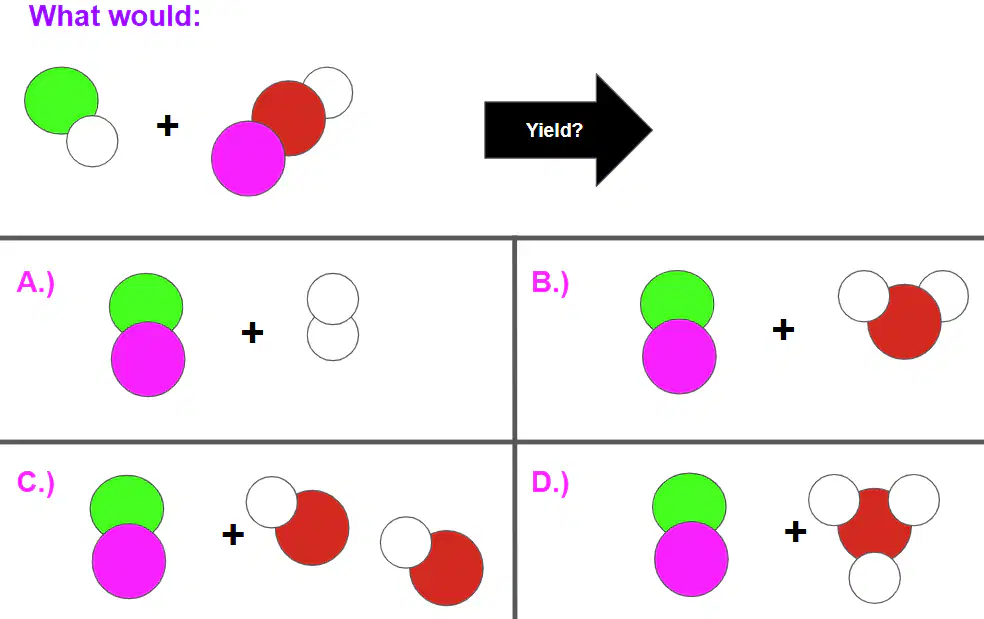
Using your knowledge of the Law of Conservation of Mass, what would the reactants of original chemical equation yield?
Model A.
Model B.
Model C.
Model D.

Using your knowledge of the Law of Conservation of Mass, what would the reactants of original chemical equation yield?
Model A.
Model B.
Model C.
Model D.
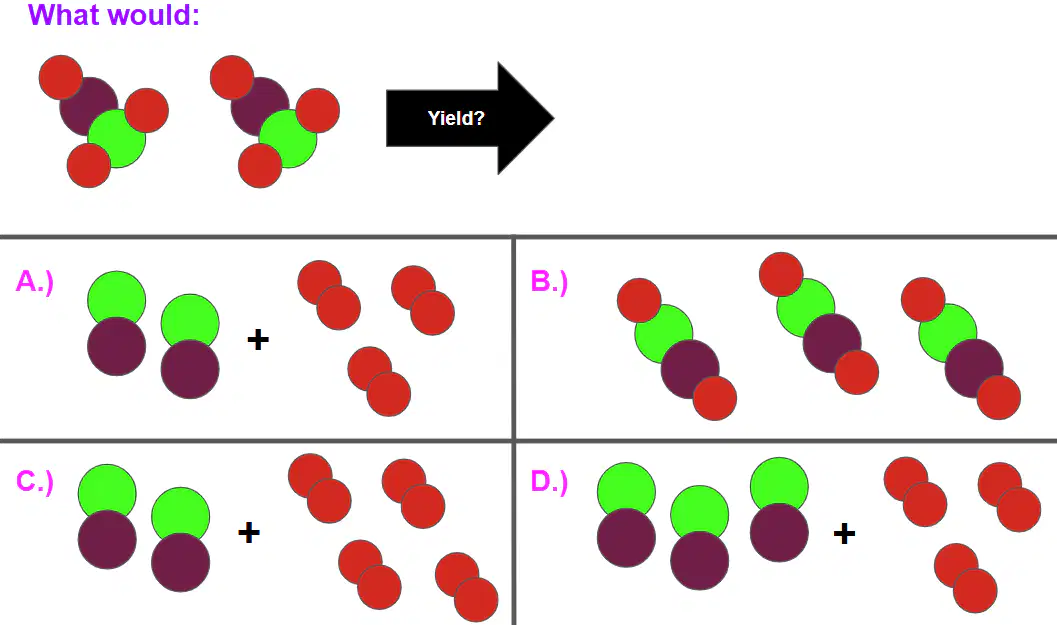
Using your knowledge of the Law of Conservation of Mass, what would the reactants of original chemical equation yield?
Model A.
Model B.
Model C.
Model D.
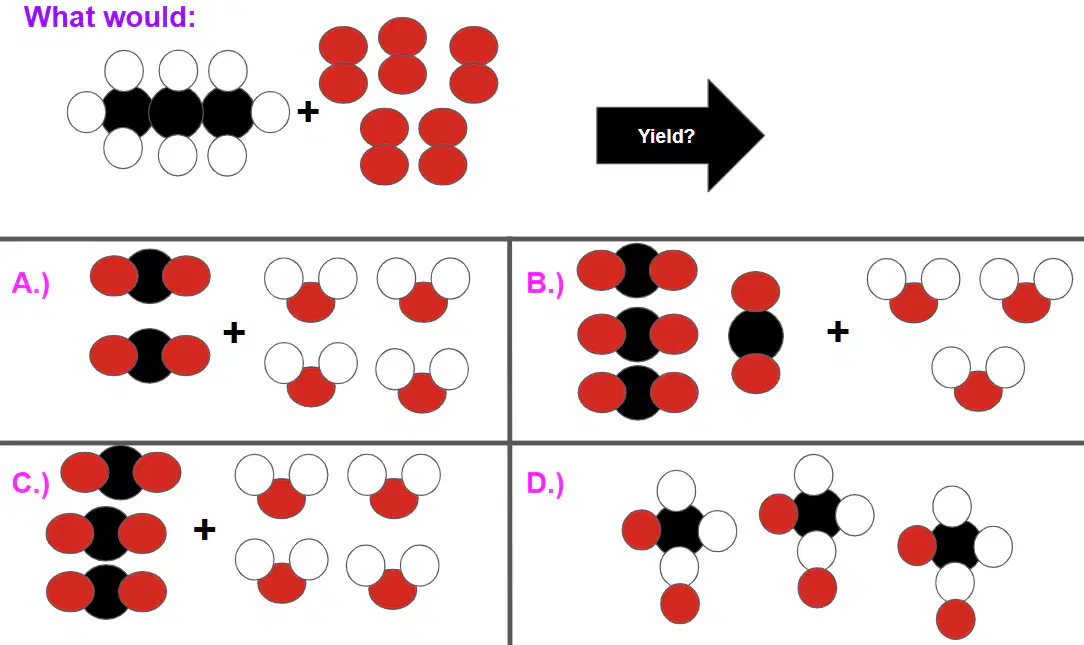
Using your knowledge of the Law of Conservation of Mass, what would the reactants of original chemical equation yield?
Model A.
Model B.
Model C.
Model D.

Using your knowledge of the Law of Conservation of Mass, what would the reactants of original chemical equation yield?
Model A.
Model B.
Model C.
Model D.
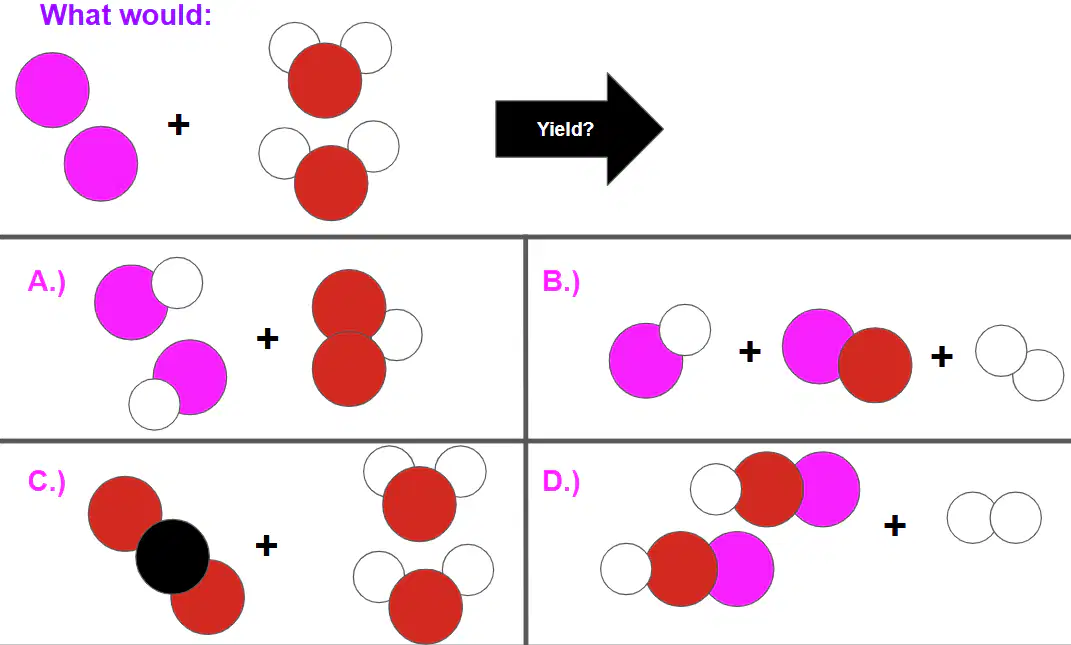
Using your knowledge of the Law of Conservation of Mass, what would the reactants of original chemical equation yield?
Model A.
Model B.
Model C.
Model D.
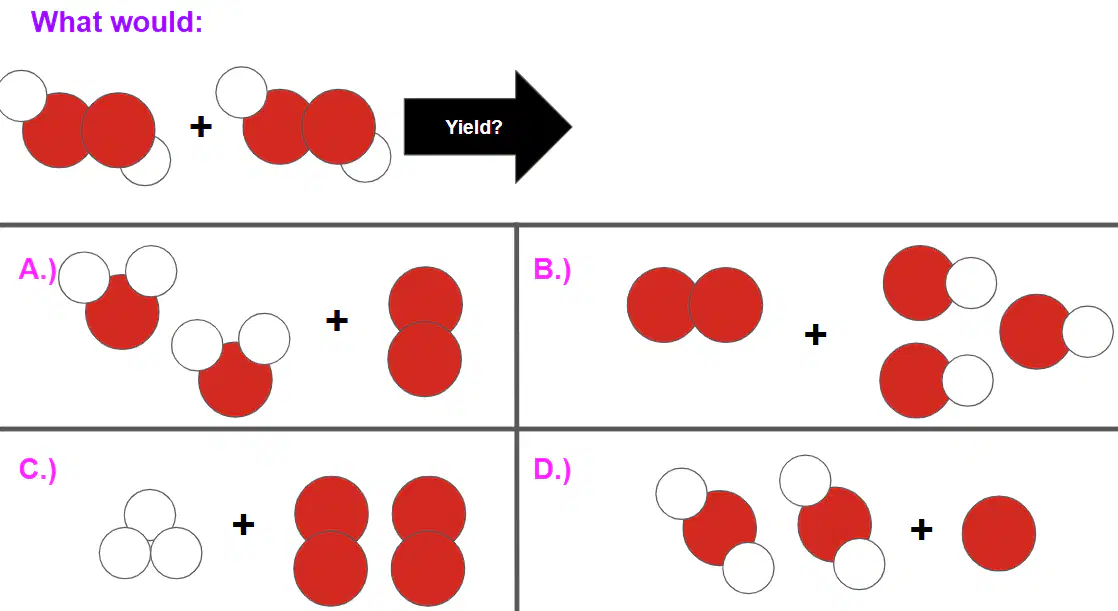
Using your knowledge of the Law of Conservation of Mass, what would the reactants of original chemical equation yield?
Model A.
Model B.
Model C.
Model D.

Using your knowledge of the Law of Conservation of Mass, what would the reactants of original chemical equation yield?
Model A.
Model B.
Model C.
Model D.
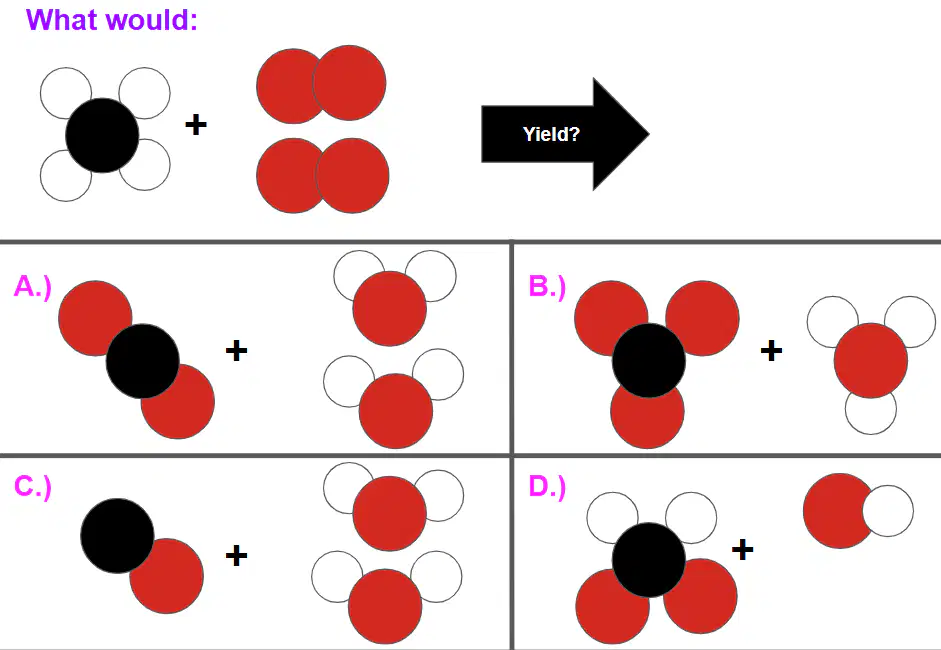
Using your knowledge of the Law of Conservation of Mass, what would the reactants of original chemical equation yield?
Model A.
Model B.
Model C.
Model D.

The number of what identifies the element the atom belongs to.
neutrons
Protons
electrons

At the yield arrow, what happens to the bonds in the molecules of the reactants?
they break
they strengthen
they explode
they don't do anything
What happens to the properties of the reactants when they change into a product during a chemical reaction?
The properties of the reactants stay exactly the same.
The reactants keep some of their old properties and gain a few new ones.
The properties of the reactants change completely to form new substances with new properties.
The reactants disappear without forming any new substances.

What is the element symbol for the element with the atomic number 29 - Copper.
Cu
C
Co
Cr

Which atom model below best represents Hydrogen?

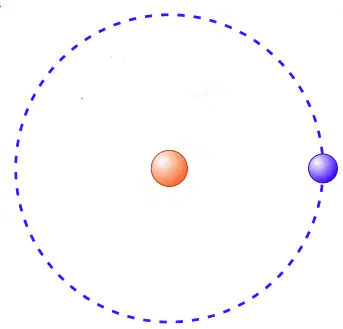
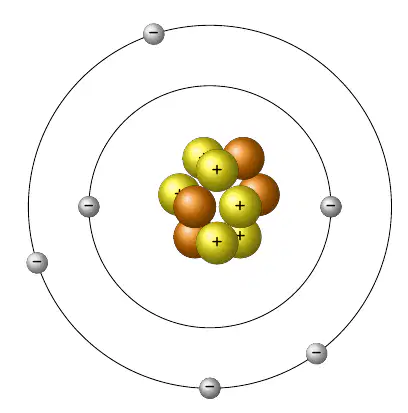

Which atom model below best represents Helium?
Which atom model below best represents Carbon?
Which atom model below best represents Oxygen?
The materials we start with in a reaction are known as __________________ and are found on the left side of a chemical equation.
chemicals
reactants
products
creations
The materials we end with in a reaction are known as __________________ and they are found on the right side of the chemical equation.
chemicals
reactants
products
creations

What is the coefficient in the chemical formula?
2
N
H
3
What is the subscript in the formula for H?
2
N
H
3
Which part of an equation means YIELDS?
plus signs
chemical fomulas
reactants
products
arrow
three hydrogen (H)
one sulfur (S)
four oxygen (O)
In the equation, 2Mg + O2 ---> 2MgO, which are the reactants?
2Mg and O2
2MgO
Mg and MgO
O and MgO

What does the C represent?
atomic mass
atomic number
element name
chemical symbol

What does the 6 represent?
atomic mass
atomic number
element name
chemical symbol

What does 12.011 represent?
atomic mass
atomic number
element name
chemical symbol
This number tells how many molecules are in a chemical equation.

How many Hydrogen atoms are present?

How many H2O molecules are present?


Which colored particle is the electron?
blue
red
yellow
red and yellow
NaCl is the chemical formula of
Water
Table Salt
Oxygen gas
Nitrogen gas
The H2O is the chemical formula of
Water
Table Salt
Oxygen Gas
Nitrogen Gas
Identify the chemical formula for carbon dioxide
CO2
H2O
N2
C6H12O6
Identify the chemical formula for nitrogen gas
O2
CO2
N2
NaCl
Identify the chemical formula for oxygen gas
O
O2
CO2
CO


How many electrons are in the atomic model shown?
2
5
7

Which of the models of a chemical reaction best represents the Law of Conservation of Mass?
A
B
C
D

Which of the models of a chemical reaction best represents the Law of Conservation of Mass?
A
B
C
D

Which of the models of a chemical reaction best represents the Law of Conservation of Mass?
A
B
C
D

Which of the models of a chemical reaction best represents the Law of Conservation of Mass?
A
B
C
D

Which of the models of a chemical reaction best represents the Law of Conservation of Mass?
A
B
C
D

Which of the models of a chemical reaction best represents the Law of Conservation of Mass?
A
B
C
D
Label the parts of the reaction.
Reactants
Products
Label the parts of the reaction.
Reactants
Products
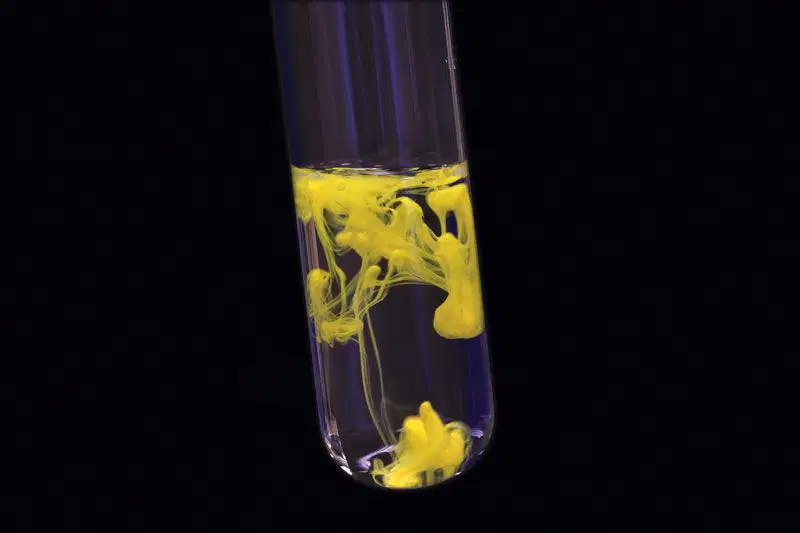
The teacher performs a demonstation as seen in the picture. He mixes two clear liquids. How can we tell that a chemical reaction is occurring?
There is a precipitate (precipitation) forming.
There are bubbles (gas) being given off.
The temperature of the liquids are changing.
There is light being given off.


Timothy is doing an experiment. He places a brand new iron nail into a test tube. Fourteen days later he observes an orange powdery substance had formed on a nail submerged in salt water. Has a chemical reaction happened? How does he know (choose the best option below).
No. There is no chemical reaction.
He can conclude that his little sister probably removed the nail and painted it orange.
Yes, there is light and heat produced, a sign of a chemical reaction.
Yes, there has been an obvious color change, a sign of a chemical reaction.
In which state of matter are the particles the moving the fastest?
solid
liquid
gas
H2 + O → H2O
How are chemical reactions different from a physical change?
physical changes create a new substance, chemical reactions do not
chemical reactions create a new substance, physical changes do not
chemical reactions happen more, physical changes happen less
physical changes happen more, chemical reactions happen less
What happens at the molecular level during a chemical change in matter?
Chemical changes do not involve any rearrangement of atoms
Atoms are rearranged and chemical bonds are broken and formed
Molecules stay the same but change color
Atoms disappear and reappear in a different form
Explain the concept of chemical reactions in matter.
Chemical reactions occur when substances do not interact and remain the same
Chemical reactions happen only in living organisms
Chemical reactions occur when substances interact to form new substances with the same properties
Chemical reactions occur when substances interact to form new substances with different properties.
Which picture below shows the arrangement of atoms for one nitrogen atom bonded to three hydrogen atoms?


A substance produced by a chemical reaction is called ...
reactant
product
atom
element
Which of the following is NOT an example of a chemical change?
Burning a piece of paper
Baking a cake
Digesting food
Melting a metal can

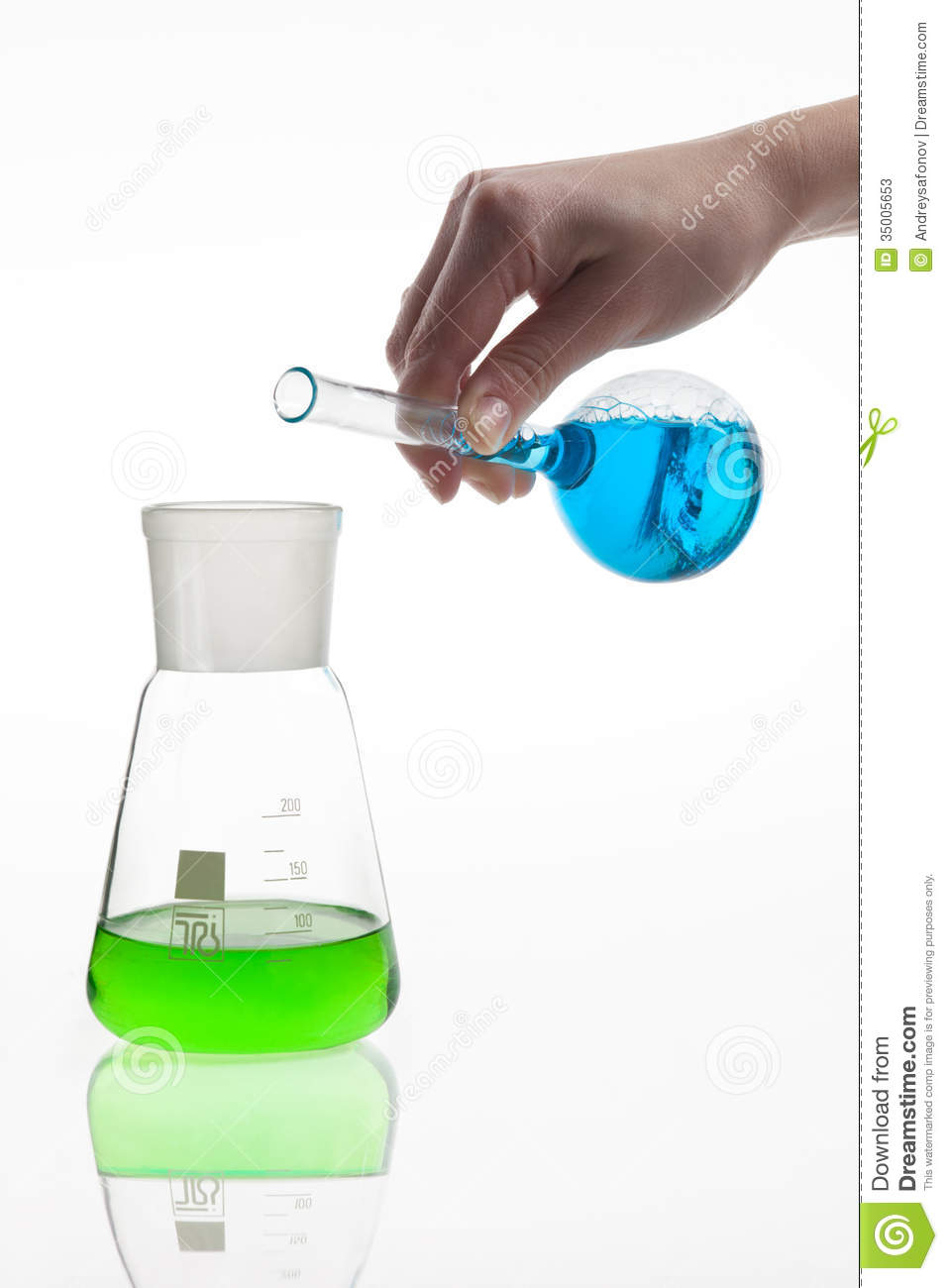
Is a chemical reaction happening in the picture? If so, what best describes how you can tell.
No. There is no cheical reaction.
Yes, they are adding a clear liquid to another clear liquid and a precipitate is being formed (a solid).
Yes, they are adding a liquid to another clear liquid and bubbles are forming, showing the production of a gas.
Yes, they are adding a liquid to another clear liquid and an endothermic reaction is occurring.

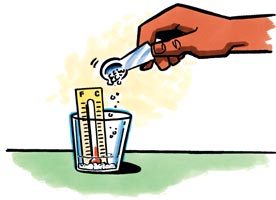
taken in or absorbed (gets colder)
given out or released (gets hotter)
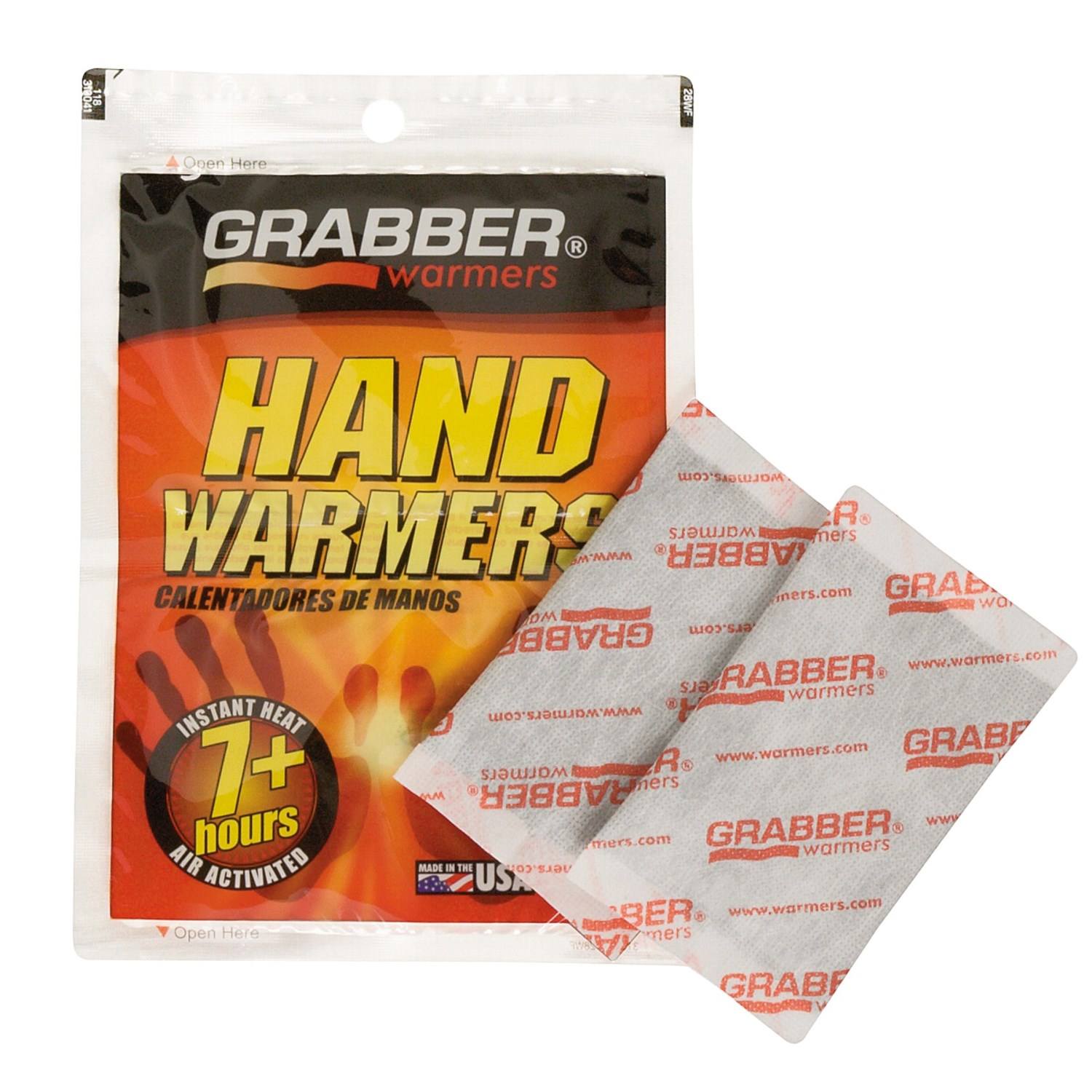

It was a cryothermic reaction.
It was a hypothermic reaction.
A student mixed two chemicals to allow them to react. The temperature before the reaction was 25 ° C. The temperature after the reaction was 30° C. Which of the following is true?
It was a cryothermic reaction.
It was a hypothermic reaction.

