
 Worksheets
Climate and Weather Quiz
Total questions: 20
Worksheet time: 3600secs
Which phrase BEST describes climate?
number of floods in a year
amount of rain in one month
type of weather over many years
where an area is located on Earth
Which weather is most likely in a tropical climate near the equator?
dry and hot
dry and cold
rainy and hot
rainy and cold
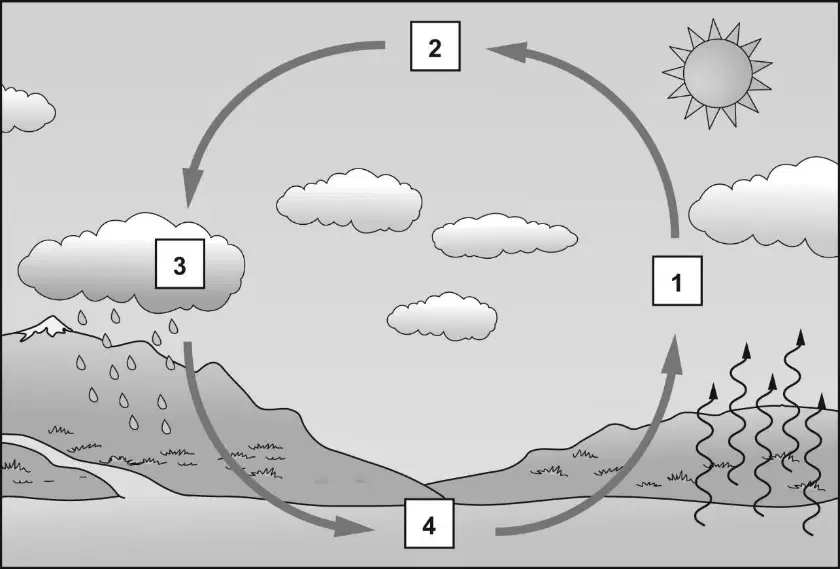
Which statement BEST describes label 1 in the water cycle model?
Precipitation falls to Earth.
Water condenses in the atmosphere.
All parts of the water cycle depend upon the sun’s energy. Warmth from the sun causes water to evaporate.
Water collects on the surface of Earth until it evaporates.
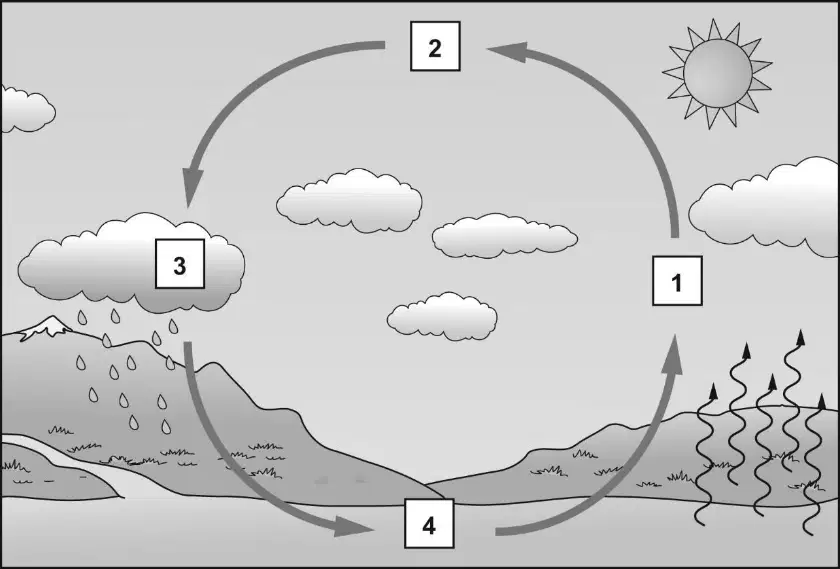
Which statement BEST describes label 2 in the water cycle model?
Precipitation falls to Earth.
Water condenses in the atmosphere.
All parts of the water cycle depend upon the sun’s energy. Warmth from the sun causes water to evaporate.
Water collects on the surface of Earth until it evaporates.
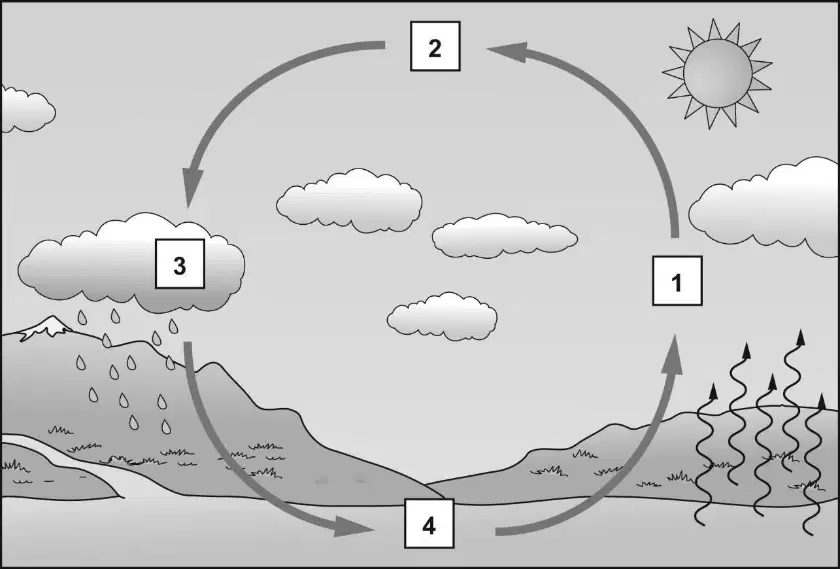
Which statement BEST describes label 3 in the water cycle model?
Precipitation falls to Earth.
Water condenses in the atmosphere.
All parts of the water cycle depend upon the sun’s energy. Warmth from the sun causes water to evaporate.
Water collects on the surface of Earth until it evaporates.
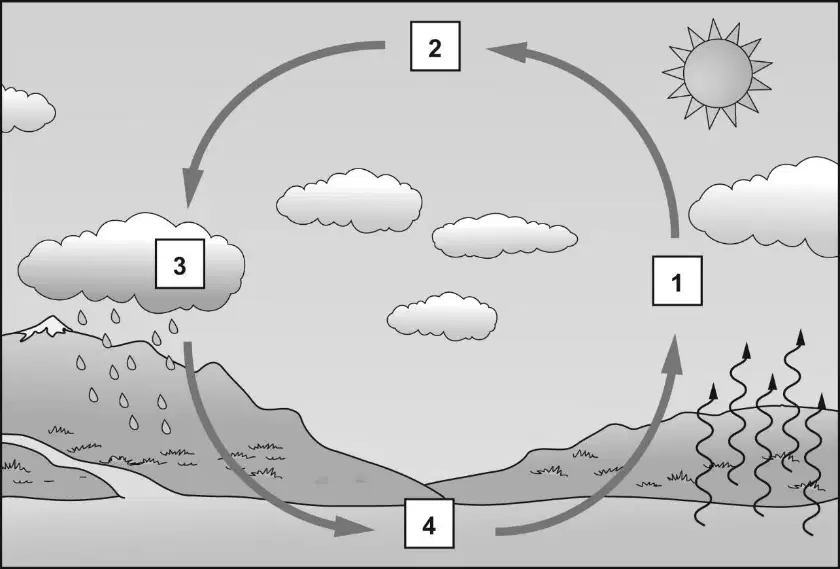
Which statement BEST describes label 4 in the water cycle model?
Precipitation falls to Earth.
Water condenses in the atmosphere.
All parts of the water cycle depend upon the sun’s energy. Warmth from the sun causes water to evaporate.
Water collects on the surface of Earth until it evaporates.
What should Shyla draw to describe how the sun’s energy flows on and above Earth’s surface? Circle THREE correct answers.
moving water on a lake becoming still
water pooling underground in an aquifer
solar rays heating the puddles on the ground
pools of water turning to vapor and entering the atmosphere
snow melting and running down mountains to collect in lakes
What is the role of the sun’s energy in the water cycle?
It makes water freeze.
It evaporates water.
It turns water into ice.
It makes water flow underground.
What happens when snow melts and runs down mountains?
It turns into ice.
It collects in lakes.
It evaporates immediately.
It stays on the mountain.
What might you use to investigate how water cycles through the water cycle?
A book
A computer model
A telescope
A microscope
What is the definition of "climate"?
Daily temperature and precipitation activity
Conditions in the atmosphere over a short period of time
Conditions in the atmosphere over a long period of time
A specific weather event
What part of the water cycle would be rain or snow falling to the Earth?
Condensation
Precipitation
Runoff
Evaporation
Dominic records the following information in his science journal:
10 a.m. — temperature: 60 °F, wind speed: 7.5 km/h, air pressure: 752 mm Hg.
11 p.m. — temperature: 62 °F, wind speed: 7 km/h, air pressure: 754 mm Hg.
What is this recording showing?
Climate
Patterns
Weather
Josh is looking at what is happening in the Earth's atmosphere at a certain place and time. What is Josh looking at?
Climate
Patterns
Weather
Climate Zone
Sarah is a scientist who is looking at 30 years of data like wind speed, air pressure, temperature, and precipitation for San Antonio, Texas. What is Sarah looking at for San Antonio, Texas?
Climate
Patterns
Weather
Climate Zone
Look at this Water Cycle. Draw the letter in the boxes to match the steps in the cycle.
A for runoff
B for evaporation
C for precipitation
D for condensation

What is a "warm front"?
A process followed to find an answer to a problem
Transition zone where a warm air mass is replacing a cold air mass
Transition zone where cold air mass is replacing a warm air mass
Prediction about the weather in the future
What is a "cold front"?
Transition zone where a warm air mass is replacing a cold air mass
Transition zone where cold air mass is replacing a warm air mass
Prediction about the weather in the future
A process followed to find an answer to a problem

