
Font size
 Worksheets
Regulations Quiz
Total questions: 62
Worksheet time: 31mins
Which regulation is part of the 'Six Pack Regulations' and was established in 1992 to address display screen equipment?
Personal Protective Equipment Regulations
Health and Safety (display screen equipment) Regulations
Management of Health and Safety at Work Regulations
Manual Handling Operations Regulations
Which regulation focuses on the management of health and safety at work and was introduced in 1999?
Workplace Health, Safety and Welfare Regulations
Manual Handling Operations Regulations
Management of Health and Safety at Work Regulations
Personal Protective Equipment Regulations
What is one of the main duties of employers under the Management of Health and Safety at Work Regulations 1999?
Providing free meals to employees
Making assessments of risk to health and safety
Offering flexible working hours
Ensuring employees have a gym membership
According to the Workplace (Health, Safety and Welfare) Regulations 1992, what must employers provide to prevent slipping and tripping hazards?
Safety helmets
Safe passageways
Fire extinguishers
First aid kits
What are employers required to provide under the Workplace (Health, Safety and Welfare) Regulations 1992?
Free transportation
Adequate lighting, heating, ventilation, and workspace
Personal laptops
Monthly bonuses
What is one of the requirements for employers under the Health and Safety (Display Screen Equipment) Regulations 1992?
Provide free meals
Offer gym memberships
Provide regular eyesight tests
Supply free transportation
According to the Health and Safety (Display Screen Equipment) Regulations 1992, what should employers provide to reduce risks associated with DSE work?
Adjustable furniture
Free internet access
Company cars
Daily exercise classes
What is a key aspect of the Health and Safety (Display Screen Equipment) Regulations 1992 regarding breaks?
Ensure DSE users take 'adequate breaks'
Ensure DSE users work overtime
Ensure DSE users skip breaks
Ensure DSE users work continuously
What type of injury do the Health and Safety (Display Screen Equipment) Regulations 1992 aim to prevent?
Fractures
Repetitive strain injury (RSI)
Burns
Allergies
According to the Personal Protective Equipment at Work Regulations 1992, what must employers provide free of charge?
Office supplies
Personal Protective Equipment (PPE)
Transportation
Meals
What is one of the requirements for PPE under the Personal Protective Equipment at Work Regulations 1992?
It must be fashionable
It must be suitable for the risk in question
It must be colorful
It must be lightweight
Which of the following is NOT mentioned as part of the PPE in the regulations?
Safety helmets
Ear defenders
Protective footwear
Uniforms
What additional responsibility do employers have regarding PPE according to the regulations?
Provide free meals
Offer information, training, and instruction on its use
Ensure it is replaced monthly
Allow employees to choose their own PPE
What is one of the main provisions of the Manual Handling Operations Regulations 1992 for employers?
To increase the workload of employees
To avoid the need for employees to undertake manual handling activities involving risk of injury
To ensure employees work longer hours
To reduce employee benefits
According to the Manual Handling Operations Regulations 1992, what should employers assess to reduce the risk of injury?
The employee's salary
The company's profit margins
The task, the load, and the individual's personal characteristics
The number of employees
What information must employers provide to workers under the Manual Handling Operations Regulations 1992?
The company's annual report
The weight of each load
The employee's personal data
The company's marketing strategy
What is one of the main provisions of the Provision and Use of Work Equipment Regulations 1998?
Ensure the equipment is used only by supervisors
Maintain equipment only if it is new
Provide information, instruction, and training on the use of equipment
Allow employees to use any equipment they choose
According to the Provision and Use of Work Equipment Regulations 1998, what must employers do to protect employees?
Allow employees to repair equipment themselves
Protect employees from dangerous parts of machinery
Ensure employees work overtime
Provide free meals to employees
What is required regarding the maintenance of equipment under the Provision and Use of Work Equipment Regulations 1998?
Maintain equipment only during inspections
Properly maintain the equipment, irrespective of how old it is
Replace equipment every year
Maintain equipment only if it is malfunctioning
Under the Reporting of Injuries, Diseases and Dangerous Occurrences Regulations 1995, to whom must employers report work-related incidents?
The local police department
The Health and Safety Executive (HSE)
The fire department
The Department of Transportation
What must be recorded in an accident book according to the regulations?
The weather conditions
The date and time of the incident, details of the person(s) affected, the nature of their injury or condition, their occupation, the place where the event occurred, and a brief note on what happened
The cost of the damage
The names of all employees present
Which of the following injuries must be reported under the regulations?
Minor cuts and bruises
The death of any person
Headaches
Muscle soreness
What is considered an 'over-seven-day' injury?
An injury that heals within a week
An injury that involves relieving someone of their normal work for more than seven days
An injury that requires a week of medication
An injury that occurs over a holiday
Which of the following is a reportable occupational disease involving hand-held vibrating tools?
Cramp of the hand or forearm
Carpal tunnel syndrome
Occupational asthma
Occupational dermatitis
What is hand-arm vibration syndrome (HAVS) associated with?
Repetitive movement
Use of vibrating tools
Exposure to chemicals
Poor posture
Which condition is described as a type of tendon injury?
Occupational asthma
Tendonitis or tenosynovitis
Carpal tunnel syndrome
Occupational dermatitis
What are 'near misses' described as in the Regulations?
Occupational diseases
Dangerous occurrences
Safety protocols
Health guidelines
Which of the following is a safe working procedure when dealing with electricity?
Ignoring cable conditions
Earthing
Using non-portable equipment
Increasing voltage
What is a potential hazard when working with electricity in damp atmospheres?
Reduced voltage
Increased safety
Risk of electric shock
Improved conductivity
Why is it important to check plugs and cables for condition in an engineering environment?
To ensure they are aesthetically pleasing
To prevent electrical hazards
To increase power output
To reduce noise levels
What is the purpose of using voltage reduction to 110 volts in safe working practices?
To increase power efficiency
To enhance equipment performance
To reduce the risk of electric shock
To improve lighting quality
What factor related to temperature affects the choice of PPE?
Noise level
Eye protection
Temperature extremes
Electrical safety
Which factor is NOT typically considered when selecting PPE?
Fume exposure
Crush resistance
Fashion trends
Radiation protection
Why is noise considered when choosing PPE?
It affects the color of PPE
It determines the size of PPE
It requires hearing protection
It influences the weight of PPE
Which of the following is a common cause of fire?
Electrical faults
Water leaks
Low temperatures
High humidity
What type of fire extinguisher is used for electrical fires?
Water
Foam
CO2
Dry powder
Which class of fire involves flammable liquids?
Class A
Class B
Class C
Class D
What is the first step in evacuation procedures during a fire?
Call emergency services
Gather personal belongings
Use the elevator
Identify the nearest exit
What should fire procedure notices include?
Weather updates
Emergency contact numbers
Daily schedules
Personal achievements
Why is escape route identification important in fire safety?
To find shortcuts
To ensure a safe exit
To avoid traffic
To locate restrooms
What are the three elements of the fire triangle?
Fuel, Heat, Water
Fuel, Heat, Oxygen
Fuel, Light, Oxygen
Heat, Water, Oxygen
What method is used to reduce the heat in the fire triangle?
Starving
Cooling
Smothering
Igniting
Which process involves reducing the oxygen in the fire triangle?
Starving
Cooling
Smothering
Heating
How can you reduce the fuel in the fire triangle?
Smothering
Cooling
Starving
Igniting

Which type of fire extinguisher should be used on electrical fires?
Water
Foam
CO2 Carbon Dioxide
Wet Chemical
What type of fire is a foam extinguisher NOT suitable for?
Wood, Paper, or Textile fires
Flammable Liquid fires
Electrical fires
Metal fires
Which fire extinguisher is recommended for use on cooking oils and deep fat fires?
Water
Foam
Dry Powder
Wet Chemical
What is a key precaution when using a CO2 fire extinguisher?
Do not use on electrical fires
Ventilate area after use
Use on metal fires
Hold horn when operating
Which type of fire extinguisher should be used on flammable liquids?
Water
CO2
AFFF Foam
Vapourising Liquids
What types of fire should a water extinguisher not be used on?
Wood, Paper, and Textiles
Flammable Liquids
Live Electrical Equipment
Which extinguisher is suitable for use on live electrical equipment?
Water
Dry Powder
AFFF Foam
Vapourising Liquids
What type of fires are wet chemical fire extinguishers ideal for?
Class A fires
Class B fires
Class F fires
Electrical fires
What is the effect of the mist produced by wet chemical extinguishers?
It increases the fire
It cools the flame front
It evaporates quickly
It creates sparks
Why should the entire content of the wet chemical extinguisher be emptied onto the oil/fat?
To save the extinguisher for future use
To prevent re-ignition
To increase the fire
To create more smoke
What is the first step in using the P50-FOAM fire extinguisher?
Squeeze handles
Rotate pin to break seal
Aim at base of fire
Operate no closer than 2 meters
At what distance should the P50-FOAM fire extinguisher be operated?
No closer than 1 meter
No closer than 2 meters
No closer than 3 meters
No closer than 4 meters
What color are fire exit signs typically?
Red with white letters
Blue with yellow letters
Green with white letters
Yellow with black letters
What does a red prohibition sign indicate?
You must not
Caution
Safe way
You must
What is the meaning of a yellow warning sign?
Safe way
Caution
You must
Fire equipment location
Which color is associated with information safety signs?
Red
Yellow
Green
Blue
What does a blue mandatory sign mean?
You must
Do not
Hazard ahead
Fire equipment type
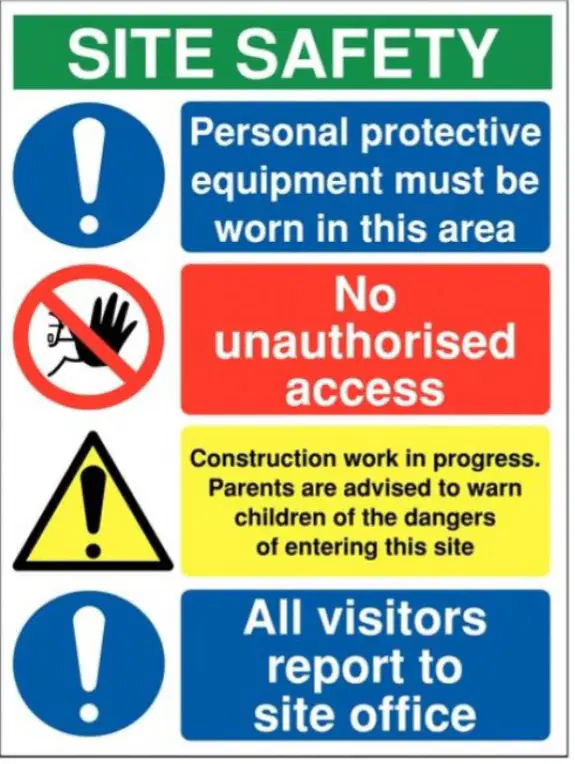
What must be worn in the area according to the site safety sign?
Casual clothing
Personal protective equipment
Formal attire
Sports gear

