
 Worksheets
7th Grade Midterm Review 2024
Total questions: 26
Worksheet time: 13mins
Which of the following statements are true?
a. All organisms are microscopic.
b. Bacteria are the only organisms that are microscopic.
c. There are many different types of organisms that are microscopic.
d. All of the above statements are true.
Which of the following is an example of an independent variable in an experiment?
a. The result of the experiment
b. The factor being changed or manipulated
c. The factor being measured or observed
d. The control group
A student hypothesizes that plants grow taller in sunlight rather than in shade. What would be the independent variable in this experiment?
a. The height of the plants
b. The amount of water given
c. The type of soil used
d. The amount of light received
Which of the following ideas is not true about cells?
a. All cells come from pre-existing cells.
b. All living things are made up of the same type of cells.
c. The cell is the basic unit of all living things.
d. The size of an organism is directly related to how many cells it is made of.
Some problems with the digestive system make it very difficult for the body to digest enough food. Why would it be harder to exercise when you have a digestion problem like this?
a. You would not be able to sleep, which would make you too tired to exercise.
b. Your cells would have molecules from air, but would not get enough molecules from food.
c. You would need to breathe in a lot more air because your body would have fewer molecules from food.
d. You would not get any of the molecules your cells need to exercise.
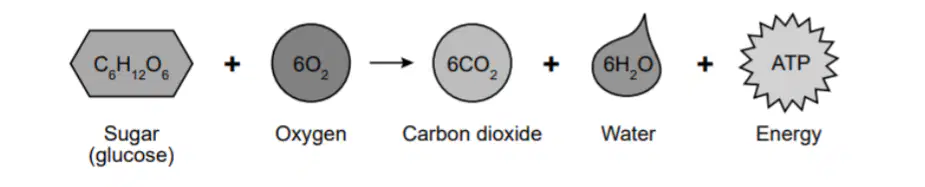
In order for athletes to run, bike, or hike long distances, more oxygen needs to be delivered to their cells. Athletes also need energy from food. Foods high in carbohydrates, such as sugar, provide this energy when the sugar and oxygen react to produce carbon dioxide, water, and energy during cellular respiration. The chemical reaction for this process is modeled below. Identify the molecule that is formed that provides the cell with usable energy when a sugar molecule is rearranged during cellular respiration.
Glucose
Oxygen
Carbon dioxide
ATP
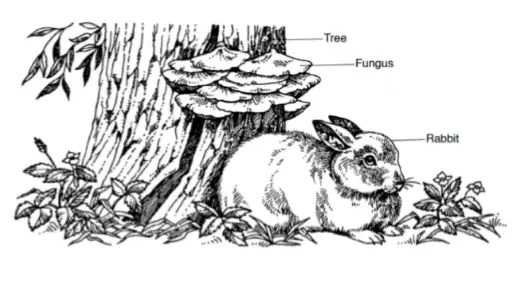
Three living organisms are labeled in the diagram below. What do the rabbit, fungus, and tree have in common?
They are all producers.
They all belong to the same kingdom.
They are all omnivores.
They are all multicellular organisms.
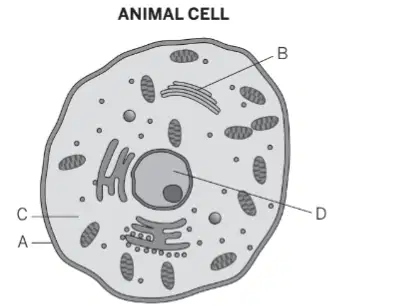
A biologist is looking at an animal cell under a microscope, and noticed there is something wrong with the way it is functioning. It is not allowing water into the cell. Look at the diagram below and identify the location in the cell where this problem is most likely occurring.
Location A
Location B
Location C
Location D
A student viewing a cell with a microscope observes a cell wall, a cell membrane, and a nucleus. The presence of these structures indicates that they are looking at a cell from a:
rabbit
carrot
worm
fly

What was Gerald’s hypothesis? Use the information and chart below and your knowledge of science to answer this question.
Gerald thinks that more prokaryotic organisms live on the classroom door handle.
Gerald thinks that they will see a yellowish substance on each petri dish.
Gerald thinks that eukaryotic organisms live on the door handle.
Gerald thinks that they will see a bluish substance on each petri dish.
Was Gerald’s hypothesis correct? Yes or No. Use the information and chart below and your knowledge of science to answer this question.
Yes, Gerald’s hypothesis was correct.
No, Gerald’s hypothesis was not correct.
There is no way of knowing if Gerald’s hypothesis was correct or incorrect, with the information given.
Which of the following can be considered as a piece of evidence that supports Gerald’s hypothesis?
The cells that made up the yellow dots in Sample B had DNA clumped up in the cytoplasm.
The cells that made up the yellow dots in Sample A had its DNA held in a nucleus.
There were more dots in sample A’s dish.
There were more dots in Sample B’s dish.
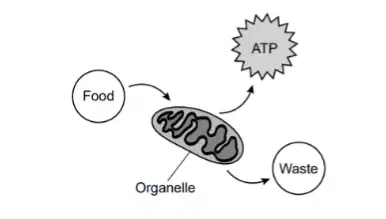
The model below represents cellular respiration taking place in an organelle within a body cell. Which organelle is represented in the model and is correctly paired with its function for the cell as a whole?
nucleus; control center of the cell
chloroplast; captures energy to make food
mitochondria; releases energy from food
cell membrane; allows food to enter and wastes to leave the cell
Cellular Respiration is the process by which the mitochondria creates energy, using glucose and oxygen. Mr. Graham has sleep apnea, which means that while he sleeps he can sometimes stop breathing. Because of this, less oxygen will enter his respiratory system and his cells will receive less oxygen. Which of the following symptoms could be an outcome of this cellular function issue?
Mr. Graham is hyper often.
Mr. Graham has trouble breathing while exercising.
Mr. Graham is tired often.
Mr. Graham is never tired.
Fernando is looking at a cell under a microscope, and he thinks it is a plant cell. Which of the following questions could he ask to determine whether or not it is a plant cell?
Does the cell have organelles that make proteins?
Does the cell have a gel-like substance that holds the organelles in place?
Does the cell have an organelle that carries out photosynthesis?
Does the cell have an outer membrane that monitors what enters and exits the cell?
What word means “the relatively constant state maintained by the body”?
cellular respiration
photosynthesis
inhalation
homeostasis
Alonzo went hiking up a local mountain. The lack of oxygen at such a high altitude on the mountain caused his body to respond. Which of the following accurately describes how Alonzo’s systems worked to maintain homeostasis at such a high altitude?
He breathed faster, which allowed more oxygen into the lungs, and through the bloodstream, where it is delivered to the cells.
He breathed faster, which allowed less oxygen into the lungs, and through the bloodstream, where it is delivered to the cells.
He breathed slower, which allowed more oxygen into the lungs, and through the bloodstream, where it is delivered to the cells.
He breathed slower, which allowed less oxygen into the lungs, and through the bloodstream, where it is delivered to the cells.
Being outside in extremely cold temperatures can upset the body’s temperature regulation. What is one result of the body trying to regain homeostasis?
shivering
hot, red skin
decreased breathing rate
decreased blood pressure
Bones are connected to each other by:
nephrons
neurons
ligaments
tendons
Which two systems work together to provide cells with oxygen and remove carbon dioxide from them?
nervous and excretory
nervous and circulatory
respiratory and excretory
respiratory and circulatory
Which body system protects some of the internal organs, such as the heart and lungs, from physical injury?
muscular
skeletal
digestive
nervous
The function of the respiratory system is to:
bring carbon dioxide into the body and remove oxygen.
bring food into the body and digest it.
bring oxygen into the body and remove carbon dioxide.
transport blood from the heart to all the cells of the body.
Which system breaks down food into nutrients that can be absorbed into the body?
circulatory
respiratory
digestive
muscular
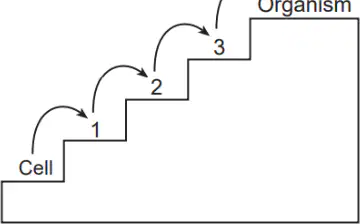
The numbers 1, 2, and 3 in the diagram below represent the different levels of organization in a multicellular organism. Which chart correctly identifies the levels of organization of 1, 2, and 3?
1: tissue, 2: organ, 3: organ system
1: organ system, 2: organ, 3: tissue
1: organ, 2: tissue, 3: organ system
1: tissue, 2: organ system, 3: organ
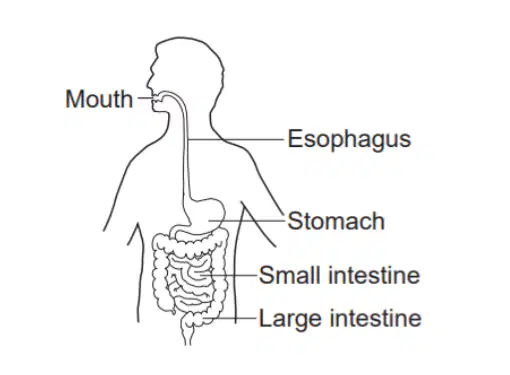
The diagram below represents parts of a human organ system. Which pair correctly matches this human organ system with its function?
Respiratory system: transport nutrients to cells
Respiratory system: mechanical and chemical breakdown of food
Digestive system: transport of nutrients to cells
Digestive system: mechanical and chemical breakdown of food
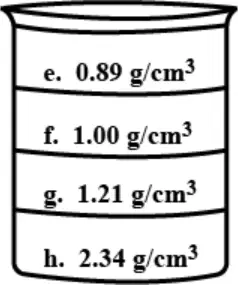
The diagram below shows a tall beaker with four different liquids and their densities. If a ball that has a density of 1.73 g/cm³ is placed in the beaker, where will the ball come to rest?
On top of liquid E
Between liquids G and H
Between liquids F and H
On the bottom of the beaker

