
 Worksheets
Unit 3 Lesson 13: Latin America Review
Total questions: 17
Worksheet time: 9mins
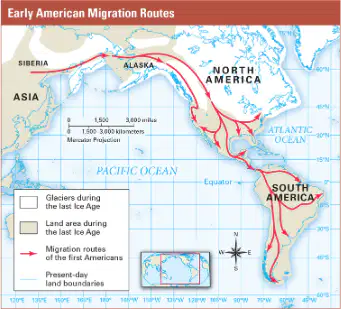
What does the map below show about migration routes?
A. People spread out from North America in all directions.
B. People moved from South America northward.
C. People moved from Asia into the Americas.
D. People moved from North America to Asia.
Which statement is true of our understanding and knowledge of the first migrants to North America?
A. It remains largely unchanged as scholars are critical of new evidence.
B. It changes continually to reflect new findings.
C. It is mostly theoretical because of a lack of hard evidence.
D. It comes from oral histories passed down over centuries.
How did people in climates that prevented the development of agricultural settlements survive?
A. They depended on the sea for food.
B. They migrated to find food.
C. They migrated to different climates over time.
D. They traded with groups to obtain goods.
Indigenous traditions provide a plan for
A. identifying places to migrate.
B. selecting agricultural practices.
C. assigning strict gender roles.
D. governing the community.
European views of Indigenous cultures have affected modern understanding of these cultures because European records
A. documented few cultural traditions.
B. misinterpreted the purpose and meaning of traditions.
C. reflected prejudice toward Indigenous cultures.
D. included little evidence about Indigenous cultures.
In which present-day country or region did the Olmec civilization flourish?
Mexico
Central America
Peru
the United States

Scholars believe that large carved heads created by the Olmec depict
important warriors.
spirits.
gods.
important rulers.
What enabled the Olmec population to grow and, thus, their civilization to expand?
social stratification
large-scale agriculture
expansive trade networks
government by consensus
Olmec society was considered stratified because it
had multiple social classes.
permitted slavery.
abandoned migration for settlements.
worshipped multiple gods.
The Olmec civilization is believed to have influenced later civilizations, particularly
the Mississippian civilization.
the Caral civilization.
the Maya civilization.
the Inca civilization.
The Maya civilization was united by
the shared power of the city-states.
a single leader.
common enemies.
a shared culture and belief system.
The lack of pottery at Caral indicated that the civilization
was older than pottery.
existed fairly recently.
had little need for pottery.
lacked artisans.
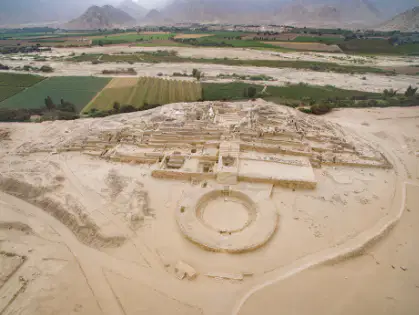
Why do historians believe that the Caral civilization was built in the desert?
to be far from the stormy coastal region
to limit attacks from outsiders
to serve as a trading center
to farm foods that grew in dry regions
Which statement describes the leadership of the Mississippian civilization?
The society had a single ruler.
Each group was governed by consensus.
Each group had its own ruler.
Representatives formed a leadership committee.
How did new Mississippian leaders show their power?
They built their home on top of the homes of previous leaders.
They chose new people to form the social elites.
They moved their group to a new location for settlement.
They built new mounds to symbolize a fresh start.
Mississippians were able to specialize in different trades because of
their extensive trade network.
their access to goods imported from Europe.
their access to many natural resources.
their success growing corn and other crops.
How did Native Americans arrive in America?
They swam across the Pacific
They were brought over by Europeans
They came across a land bridge
They were just there

