
 Worksheets
Unit 5 Quiz Classical
Total questions: 50
Worksheet time: 1hrs 10mins
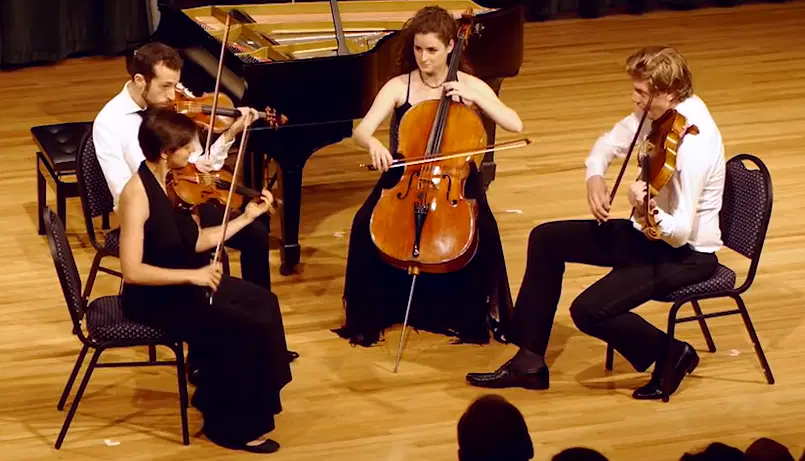
What form of music is shown?
Symphony
Sonata
Chamber Music
Concerto
2.
Answer the questions below after watching the video
Name the form:
Symphony
Sonata
Chamber Music
Concerto
3.
Answer the questions below after watching the video
Name the form:
Symphony
Sonata
Chamber Music
Concerto
4.
Answer the questions below after watching the video
Name the form:
Symphony
Sonata
Chamber Music
Concerto
5.
Answer the questions below after watching the video
Name the form:
Symphony
Sonata
Chamber Music
Concerto
6.
Answer the questions below after watching the video
Who composed this:
Haydn
Mozart
Beethoven
7.
Answer the questions below after watching the video
Who composed this?
Haydn
Mozart
Beethoven
8.
Answer the questions below after watching the video
Who composed this?
Haydn
Mozart
Beethoven
9.
Answer the questions below after watching the video
What instrument family does this belong to?
Keyboard/Organ
Woodwind
Brass
String
Percussion
10.
Answer the questions below after watching the video
What instrument family does this solo instrument belong to?
Keyboard/Organ
Woodwind
Brass
String
Percussion
Which social class gained more access to concerts during the Classical Era?
Lower
Middle
Upper
Royalty
All of the following are Classical Era composers, except:
Haydn
Bach
Mozart
Beethoven
All of the following are true about symphonies, except:
Symphonies are large pieces of music for an orchestra
First movements of symphonies are often in sonata form
Second movements of symphonies are often slow
Symphonies are typically in 5 different movements
This Classical Era composer popularized chamber music and the symphony, and often wrote jokes into his music:
Haydn
Mozart
Beethoven
What is the correct order of sonata form sections?
Development, Exposition, Recapitulation
Exposition, Development, Recapitulation
Recapitulation, Development, Exposition
Exposition, Recapitulation, Development
How many subjects (melodies) are introduced in the exposition of sonata form?
1
2
3
4
Sonata form is a "form-within-a-form" and is found in all the following, except:
Symphony
Concerto
Fugue
Sonata
A sonata is:
An extended work for a solo instrument with piano accompaniment
An extended work for a solo instrument with orchestral accompaniment
Which instrument is the one exception to the sonata definition?
Flute
Piano
Trumpet
Saxophone
A sonata is very similar to THIS form of music:
Symphony
Concerto
Chamber Music
Oratorio
Baroque or Classical: Name comes from Greek architecture
Baroque
Classical
Baroque or Classical: Composers could work for both nobility and the church
Baroque
Classical
Baroque or Classical: Inspired by the symmetry & simple designs of Greek & Roman architecture
Baroque
Classical
Baroque or Classical: Instrumental music became more popular than vocal for the first time.
Baroque
Classical
Baroque or Classical: Instrumental music continued to be the more popular style of music
Baroque
Classical
Baroque or Classical: Means 'detailed' or irregularly shaped pearl
Baroque
Classical
Baroque or Classical: Middle class gained more access to concerts
Baroque
Classical
Baroque or Classical: Most composers worked for nobility
Baroque
Classical
Baroque or Classical: Music contained complex melodies
Baroque
Classical
Baroque or Classical: Music contained simple melodies
Baroque
Classical
Which composer: Popularized chamber music and the symphony; often wrote jokes into his music.
Beethoven
Haydn
Mozart
Which composer: Began going deaf in his late 20's
Beethoven
Haydn
Mozart
Which composer: Was a child prodigy and began composing by the age of 6.
Beethoven
Haydn
Mozart
Which composer: Worked primarily for the Esterhazy family
Beethoven
Haydn
Mozart
Which composer: Known for being the bridge between the Classical and Romantic Periods.
Beethoven
Haydn
Mozart
Which composer: German composer who wrote only 9 symphonies
Beethoven
Haydn
Mozart
Which composer: Composed over 600 works by died in poverty at 35.
Beethoven
Haydn
Mozart
Which composer: Austrian composer who was a friend/mentor/teacher to many Classical composers.
Beethoven
Haydn
Mozart
Which composer: Composed The Magic Flute.
Beethoven
Haydn
Mozart
Which composer: Composed The Joke and Farewell Symphony.
Beethoven
Haydn
Mozart
Opera Vocabulary: Musical drama or comedy where the actors sing rather than speak their lines.
Libretto
Opera
Overture
Score
Opera Vocabulary: Contains all the words of an opera; means 'little book' in Italian.
Libretto
Opera
Overture
Score
Opera Vocabulary: The piece of music played at the beginning of the opera, with no singing.
Libretto
Opera
Overture
Score
Opera Vocabulary: Contains all the music in separate lines for each instrument and singer.
Libretto
Opera
Overture
Score
Opera Vocabulary: An extended musical passage sung as a solo that explores a character's emotions.
Aria
Bel Canto
Diva
Soprano
Opera Vocabulary: Highest female singing voice. Often the heroine who falls in love with the tenor.
Aria
Bel Canto
Diva
Soprano
Opera Vocabulary: Means 'beautiful singing.' A specific style of singing in opera music.
Aria
Bel Canto
Diva
Soprano
Opera Vocabulary: 'Goddess.' Refers to an important female opera star.
Aria
Bel Canto
Diva
Soprano
Opera Vocabulary: A recurring musical idea that reveals or recalls earlier material in the opera.
Bel Canto
Duet
Motif
Opera
Opera Vocabulary: An extended musical passage for two singers.
Bel Canto
Duet
Motif
Opera

