

wayground logo

Free Printable Worksheets

Font size

S
M
L
XL
Worksheets

Transport

Total questions: 13

Worksheet time: 9mins
Name
Class
Date
1.
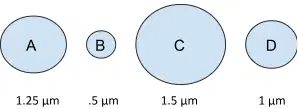
All else being equal, which of the following cells would be most efficient at diffusing CO2 waste from their cytoplasm to the outside environment?
a)
A
b)
B
c)
C
d)
D
2.

Microvilli are tiny projections that extend from the cell in areas of the body like the small intestine.  What purpose might they serve? 

a)

Increased surfaced area for absorption of nutrients

b)

Decrease the volume of the cell to decrease the loss of nutrients

c)

Increase the volume of the cell to increase the SA:V ratio

d)

Decrease the surface area of the cell to increase absorption of nutrients

3.
The movement of molecules directly across the phospholipid bilayer down their respective concentration gradients is best known as which of the following? Select all that apply.
a)
Passive transport
b)
Simple diffusion
c)
Primary active transport
d)
Receptor mediated endocytosis
e)
Active transport
4.
Which phrase best describes all types of passive transport?
a)
Movement of substances into or out of the cell that requires transport proteins.
b)
Movement of substances across the membrane that does not require energy expenditure by the cell.
c)
Movement of water across the membrane in an isotonic solution.
d)
Movement of substances against their concentration gradients by transporters using energy from the cell.
5.
Which of the following would increase the rate of water transport in a kidney cell? Check all that apply.
a)
Decreasing the density of potassium channels in the membrane.
b)

Adding many folds to the membrane to increase the SA:V ratio of the cell..

c)
Increasing the density of water channels (aquaporins) in the membrane.
d)
Increasing the density of the phospholipid bilayer by adding more saturated fatty acids.
e)
Increasing the fluidity of the bilayer by adding more cholesterol and unsaturated fatty acids.
6.

Which of these is true about how particle size and electric charge affects a molecule's transport across a cell membrane?

a)

Large, polar molecules can cross the cell membrane as long as they are uncharged.

b)

Small, uncharged molecules like CO2 and N2O require protein channels to move across the membrane.

c)

Charged molecules like ions move across the membrane without any additional help from membrane proteins.

d)

Small, uncharged molecules like O2 and N2 cross the bilayer along their concentration gradients without assistance.
7.
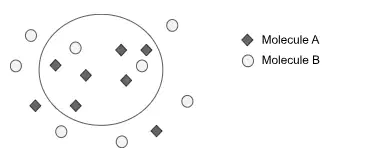
In the model below, how could the cell bring more of molecule A into the cytoplasm from the extracellular fluid?
a)
Gated protein channels specific to molecule A
b)
Molecule A will cross the membrane into the cell by simple diffusion.
c)
By a pump specific to molecule A, powered by ATP
d)
Molecule A will cross the membrane by osmosis.
8.

In which situation would passive transport NOT need to use a protein for entry into a cell?

a)

K+ ions moving into the cell through a channel

b)
glucose being absorbed from the blood
c)
an ion flowing into a nerve cell to create an electrical potential
d)
oxygen moving into a cell after oxygen deprivation
9.

Which of the following is an example of active transport.

a)

The movement of H+ ions through channels along their concentration gradient

b)
The transport of 3 Na+ ions out of the cell and 2 K+ ions into the cell by the sodium potassium pump against both of their gradients.
c)
The movement of glucose along its concentration gradient into the cell by glucose transporters.
d)

The movement of water out of the cell in a hypertonic environment

10.

Proton pump inhibitors (PPI) irreversibly block the functioning of proton pumps in the cell membrane that use ATP to move H+ into the extracellular fluid from the cytoplasm. Which of the following would you expect to observe in a cell that has been treated with PPI?

a)
A decrease in the consumption of ATP by the cell.
b)
An increase in the size of the H+ concentration gradient across the membrane.
c)

An increase in the activity of secondary active transporters that are powered by an H+ concentration gradient.

d)
A decrease in the number of H+ ions inside the cell.
11.

Which of the following is an example of primary active transport?

a)

ATP synthase uses an H+ concentration gradient to produce ATP

b)

The sodium-potassium pump moves uses the hydrolysis of ATP to move Na and K across the membrane against their gradients

c)

Aquaporins allow increased movement of water across the cell membrane down its concentration gradient.

d)

Glucose co-transporter moves glucose against its concentration gradient using the movement of Na+ ions along their gradient.

12.
A macrophage is a white blood cell that consumes invading pathogens like bacteria and viruses to protect your body. Which type of transport can a cell use to ingest very large particles like bacteria?
a)
Pinocytosis
b)
Receptor mediated endocytosis
c)
Phagocytosis
d)
Endocytosis
13.

The SARS-CoV2 virus binds to the ACE-2 receptor on the outside of a cell. Once it binds, it is brought into the cell inside a vesicle. What kind of transport does this describe?

a)

Receptor-mediated endocytosis

b)

Exocytosis

c)

Facilitated diffusion

d)

Pinocytosis
