
 Worksheets
DCA 2
Total questions: 36
Worksheet time: 18mins
Mason is using a scale to find out how much an object contains. What property is Mason measuring?
Mass
Density
Weight
Height
Harper is baking a cake and needs to measure the amount of sugar to add. Which unit of measurement should Harper use?
Liters
Grams
Pounds
Centimeters

Jackson is making lemonade. He measures the mass of sugar only in a container. What is the mass shown?
(a)

Grace is making lemonade. She measures the weight of just the water in a jug. What is the weight shown?
(a)

Grace is making lemonade. She first measures the weight of sugar only, then water only, and finally the mixture of water and lemon juice. Based on the images, how much does the lemon juice alone weigh?
(a)
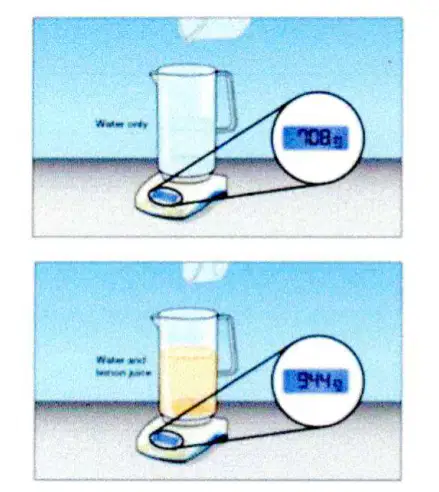
Once all of the ingredients are added together (water, lemon juice, sugar), determine the total mass of the ingredients in the pitcher. Choose the correct answer.
1060 g.
1150 g.
944 g.
708 g.
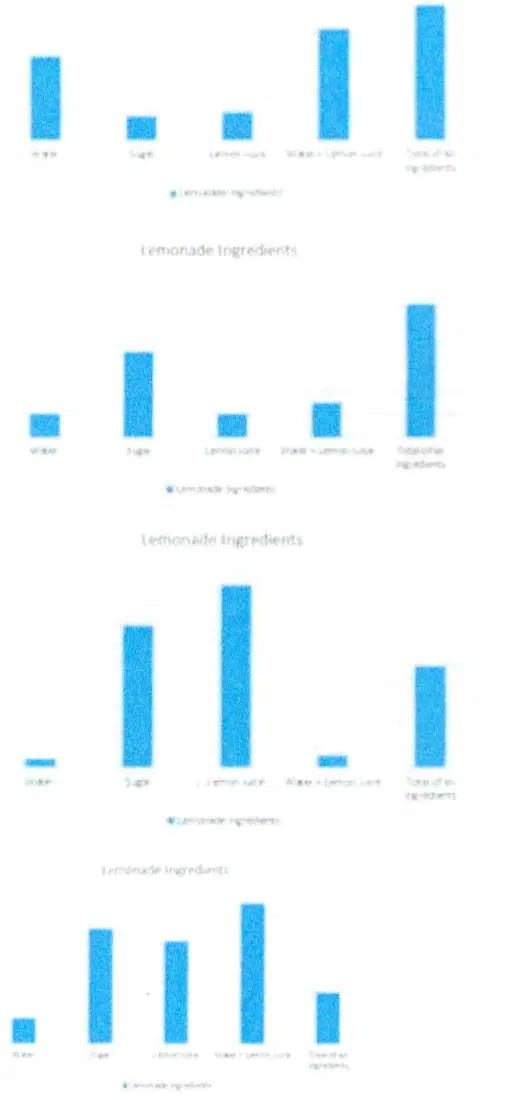
After collecting and recording the amount of each ingredient used to make lemonade, the students graphed the data. Which graph correctly shows the information?
A
B
C
D
Noah was making lemonade and added sugar to the water. After stirring, the sugar was not visible. Which statement best explains what happened to the sugar?
The sugar is turned into a solid due to the liquid particles.
The sugar turns into a gas and evaporates.
The sugar was broken down and is too small to be seen but is still present.
The sugar mixes with the other ingredients and destroyed.
Luna is conducting an experiment in her kitchen. She mixes water, juice, and sugar in a bowl and stirs the mixture. Based on both the investigation and your knowledge of science, which statement below provides the best evidence to support your answer in Part A?
The substances were mixed after the sugar was added.
The stirring of the mixture does not change the mass of the mixture.
The ingredients added were all liquids.
The sugar looks the same before and after the mixture.
At home, Lisa wanted to make jello as her afternoon snack. She started with 10 grams of jello mix and 50 mL/g of water. When she mixed the powder into water it ____.
After she placed the ____ into the refrigerator for 2 hours, it turned from a liquid to a solid.
She measured the mass of the jello after she took it out of the refrigerator and the mass had ____.
a. settled to the bottom
dissolved
floated to the top
b. substance
solution
solid
c. increased
decreased
stayed the same
d. dissolved
solution
stayed the same
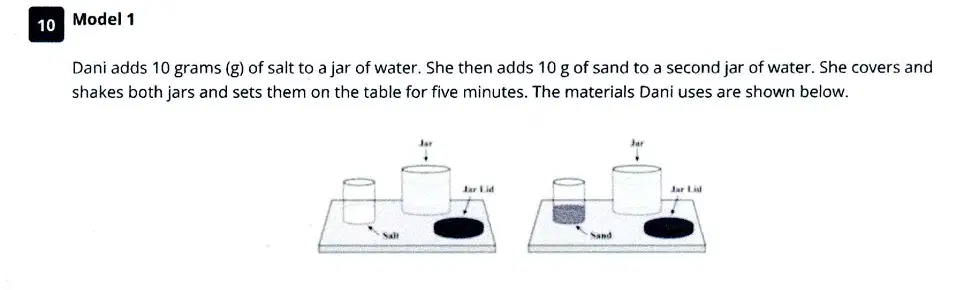
What should Dani expect to observe after those five minutes?
Both the sand and the salt dissolved in the water.
Both the sand and the salt settled to the bottom of the jar.
The salt settled to the bottom of the jar, and the sand dissolved in the water.
The salt dissolved in the water, and the sand settled to the bottom of the jar.

Sophia was conducting a science experiment in her kitchen. She stirred iron filings into a glass of water and carefully watched what happened. Describe the observations Sophia made while she was stirring the iron filings in water and after she stopped stirring.
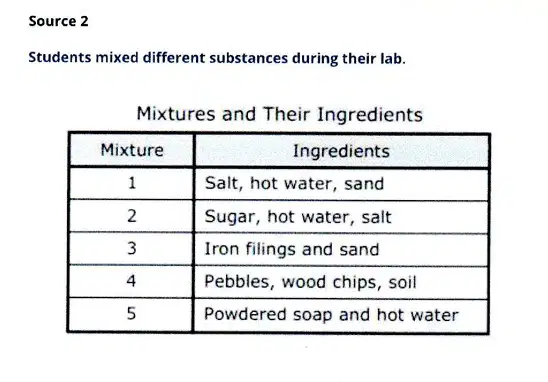
During a science lab, Michael created Mixture 3. Based on Source 2, list the ingredients in Mixture 3.
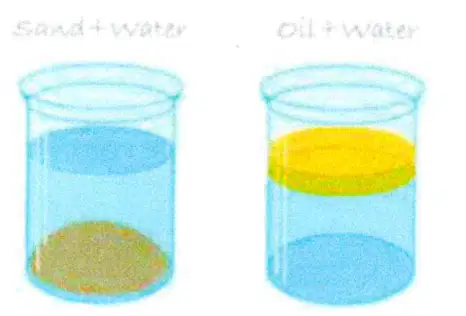
Michael is doing a science experiment at home. He mixes sand with water in one beaker and oil with water in another beaker, just like in Source 3. Explain the difference in appearance between the mixtures Michael made.
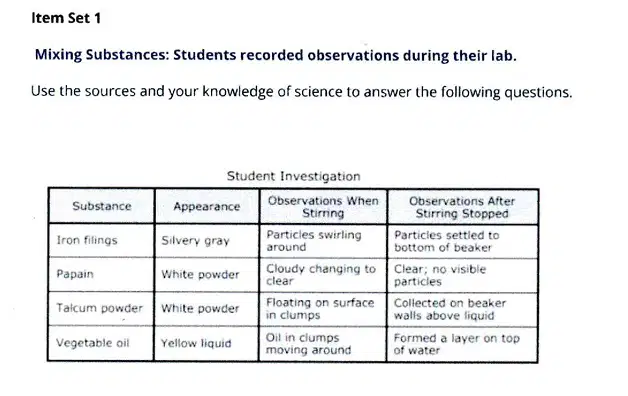
During a science experiment, Isla mixed four different substances with water and recorded her observations. Based on Isla's observations in Source 1, how many of the substances did NOT dissolve in the water?
1 substance
2 substances
3 substances
4 substances

Part A: Abigail is conducting an experiment using the models in Source 3. She mixes sand and water in one beaker, and oil and water in another beaker. Which of the following is a TRUE claim?
Both mixtures are solutions.
Only the oil and water mixture is a solution.
The mixtures are not solutions.
Only the sand and water mixture is a solution.
Part B: Benjamin is conducting an experiment in his kitchen. He mixes salt into a glass of water and notices that the water becomes clear and the salt disappears. Which of the following evidence supports Benjamin's claim?
Mixing two substances together creates solutions.
Solutions occur when something has dissolved and is transparent.
Mixing anything in water will always create a solution.
Solutions occur when mixing only liquids.
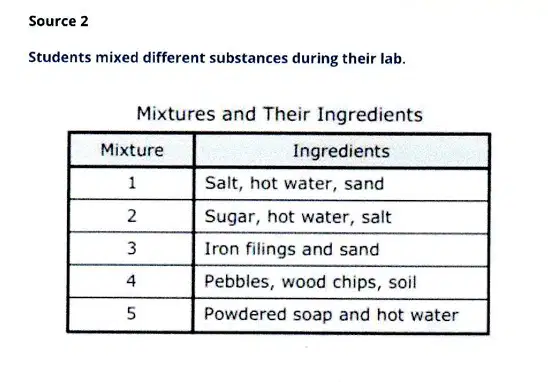
During a science lab, Lily, Elijah, and Michael mixed different substances to create various mixtures. Using source 2, which two mixtures would be the easiest to separate?
Mixtures 5 and 3
Mixtures 3 and 4
Mixtures 1 and 3
Mixtures 2 and 4
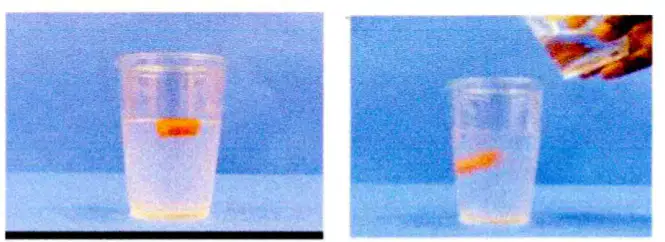
Priya is doing an experiment at home. She puts a piece of carrot in a cup of freshwater and notices that it sinks. Then, she puts the same piece of carrot in a cup of saltwater and sees that it floats. What evidence best supports why the carrot floats in saltwater but sinks in freshwater?
Saltwater is more dense than freshwater.
Freshwater is more dense than saltwater.
The carrot is more dense than saltwater.
The larger piece of carrot has less density.
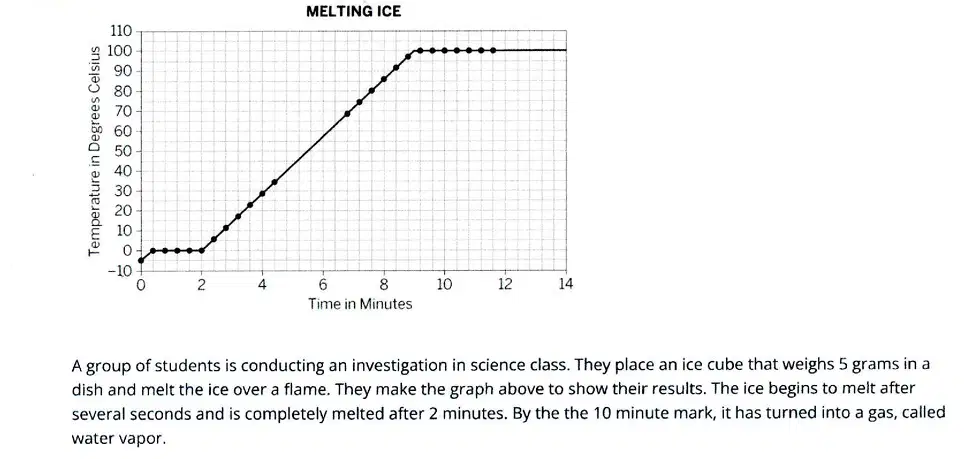
A group of students is conducting an investigation in science class. They place an ice cube that weighs 5 grams in a dish and melt the ice over a flame. By the 10 minute mark, it has turned into a gas, called water vapor. If the mass of the water vapor could be measured, which of the following would be the most likely result?
The mass of the water vapor would be 0 grams.
The mass of the water vapor would be 5 grams.
The mass of the water vapor would be 10 grams.
The mass of the water vapor would be 100 grams.

David is conducting an experiment in the laboratory. He wants to know: What is the initial mass of the materials before mixing?
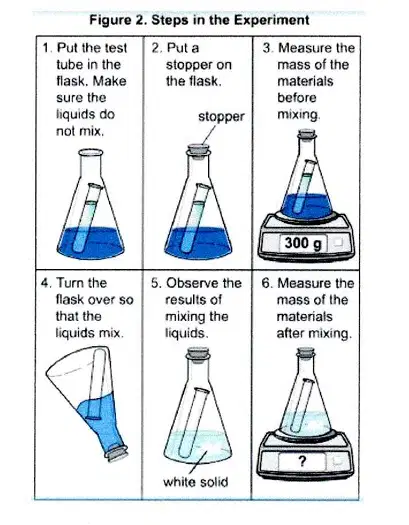
Anika is conducting an experiment in her science class. She measures the mass of the materials before mixing them, then mixes the liquids in a flask. What is the mass of the materials after mixing?

Mia is conducting an experiment in her science class. She mixes Solution A, which is clear, with Solution B, which is blue. Based on Table 1, describe the change in color of the solution after mixing.
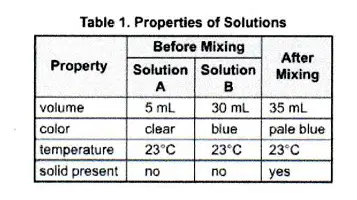
Ava mixes Solution A and Solution B together in a science experiment. According to Table 1, what observation is made regarding the presence of a solid after mixing?
Avery was conducting an experiment in the science lab. After mixing two different liquids, Avery recorded some observations. Select the two statements that provide evidence that mixing the two liquids produced new substances.
The flask was tilted over that the liquids were mixed.
A white solid formed in the flask.
The liquid changed to a lighter blue.
The flask was sealed with a stopper.
The total mass of the materials was measured.
James mixes two different liquids together during a science experiment. Which statement best describes the effect of mixing the two liquids in the experiment?
The mass of the liquids increases.
The phase of one of the liquids changes.
The properties of the liquids change.
The temperature of the liquids decreases.
Jackson mixes two clear liquids together in a beaker. After a few minutes, a white solid forms at the bottom of the beaker. Which statement best explains the cause of the answer to Part A?
New substances are formed.
Solution A becomes a solid.
The solid is heavier than the liquids.
Stirring makes the temperature of the liquids change.
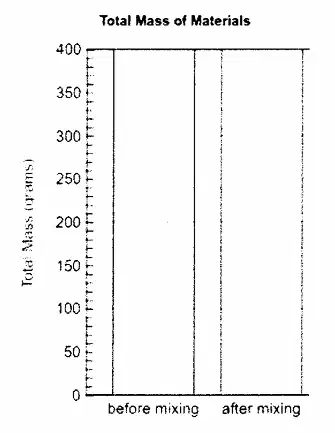
Predict the mass of the materials after the liquids are mixed. Drag the bars to the correct heights to show the mass of the materials before mixing and the predicted mass of the materials after mixing.
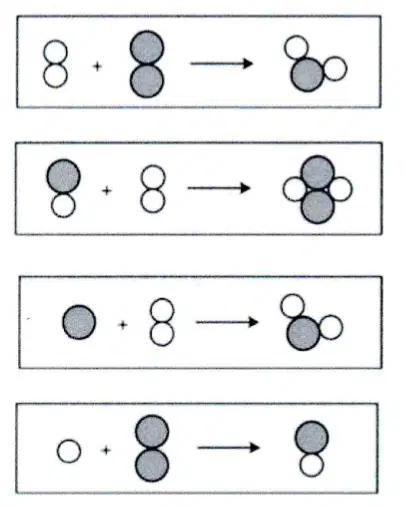
Abigail is conducting an experiment in her kitchen to demonstrate the law of conservation of mass using a chemical reaction. She mixes different substances and observes the results. Which of the following models of a chemical reaction best represents the law of conservation of mass?
A
B
C
D
Nora heated a 10 g sample of two substances in an open container. A chemical reaction occurred. The mass of the sample was measured again and found to be less than before. Which of the following best explains the change in mass of the sample?
The heat caused the sample to become less dense.
One of the reaction products was a gas.
The reaction gave off more heat than was added.
Some of the particles dissolved.
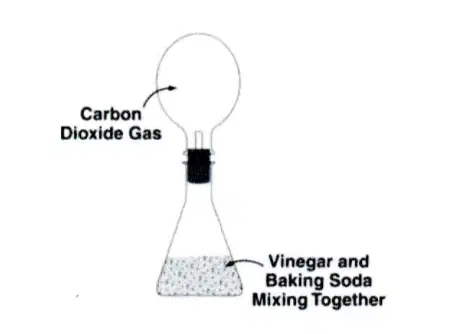
Ms. Jones added vinegar into a container of baking soda during her science class. Bubbles of carbon dioxide gas formed as the vinegar and baking soda mixed together. She put a balloon on top of the container to catch the carbon dioxide gas. Which of these caused a chemical change to happen?
The balloon on top of the container.
An increase in pressure because the gas could not escape.
Heat was applied to the container with vinegar and baking soda.
Vinegar and baking soda placed in the same container.
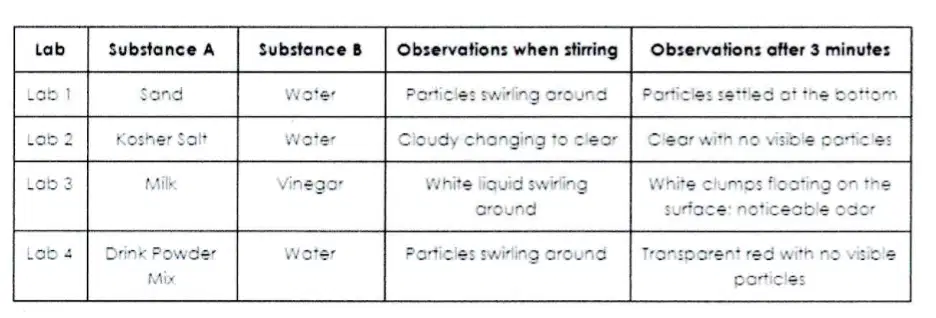
During science class, students combine different substances in a cup and record their observations. Here are their results: (Table showing combinations of substances and observations). Which of the combinations resulted in a chemical reaction?
Lab 1
Lab 2
Lab 3
Lab 4
Nora is conducting four different experiments in her science class. Which of the following observations would provide evidence that a chemical reaction has occurred?
Lab 1 particles settled on the bottom.
Lab 2 had no visible particles.
Lab 3 created a noticeable odor.
Lab 4 changed color when mixed.
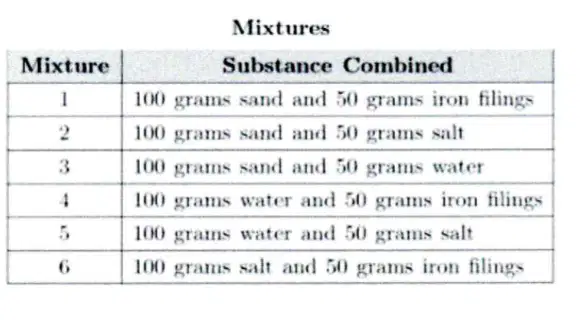
Use the information and data table below to answer the following questions. A scientist prepared six different mixtures in glass beakers, as indicated in the data table below. Three of the six mixtures included gray iron filings. Each beaker was tightly covered, labeled, and left undisturbed for several days. After several days, the scientist observed each mixture. He noticed the iron filings in Mixture 4 had turned red. The color change in Mixture 4 indicates that
iron dissolves in water.
salt has no effect on iron filings.
it must have received heat from a source.
a possible chemical reaction occurred.
Complete the bar graph to show the mass of the ice cubes and the mass of the liquid water.

Hailey measured the mass of 1 cup of water and found that it was 154 g. She then measured the mass of ¼ of a cup of salt and found that it was 43 g. She poured the salt into the water and stirred it until she could no longer see the salt. If Hailey measured the mass of the water again after, what should she find?
the mass will be 101 g
the mass will still be 154 g
the mass will be 197 g
the mass will be 53 g

