wayground logo

Free Printable Worksheets

Font size

S
M
L
XL
Worksheets

5.G.A.1 & 5.G.A.2

Total questions: 66

Worksheet time: 3hrs 31mins

Name
Class
Date
1.
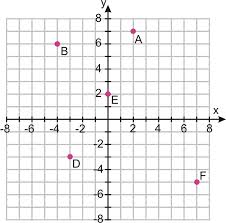
In the coordinate points (2,7) the 2 represents
a)
y
b)
origin
c)
x
d)
point
2.
How do you write an ordered pair?
a)
(X,X)
b)
(Y,X)
c)
(X,Y)
d)
(Y,Y)
3.
In the ordered pair (4,9), which number is the y-coordinate?
a)
4
b)
9
c)
neither
d)
both
4.
What is coordinate L?
a)
(6,6)
b)
(2,5)
c)
(2,3)
d)
(5,2)
5.
Ordered pair (0,0) is also known as the ___.
a)
y-axis
b)
x-axis
c)
origin
6.
In what order to you follow ordered pairs?
a)
vertex first then y
b)
y first then x
c)
none of these
d)
x first then y
7.
A set of two real numbers that locate a point on a plane is called __________________.
a)
Origin
b)
Coordinate Plane
c)
Ordered Pair
d)
Graph
8.
The __ - axis is vertical in the coordinate plane.
a)
X
b)
Y
c)
Z
d)
None of the above
9.
Which axis runs vertically?
a)
x
b)
Y
10.
If the x-coordinate and y-coordinate are both negative numbers.  What quadrant will the point lie in? 
a)
Quadrant 1
b)
Quadrant 2
c)
Quadrant 3
d)
Quadrant 4
11.
In the coordinate points (2,7) the 2 represents
a)
y
b)
origin
c)
x
d)
point
12.
How do you write an ordered pair?
a)
(X,X)
b)
(Y,X)
c)
(X,Y)
d)
(Y,Y)
13.
In the ordered pair (4,9), which number is the y-coordinate?
a)
4
b)
9
c)
neither
d)
both
14.
What is coordinate L?
a)
(6,6)
b)
(2,5)
c)
(2,3)
d)
(5,2)
15.
Ordered pair (0,0) is also known as the ___.
a)
y-axis
b)
x-axis
c)
origin
16.
In what order to you follow ordered pairs?
a)
vertex first then y
b)
y first then x
c)
none of these
d)
x first then y
17.
A set of two real numbers that locate a point on a plane is called __________________.
a)
Origin
b)
Coordinate Plane
c)
Ordered Pair
d)
Graph
18.
If the x-coordinate and y-coordinate are both negative numbers.  What quadrant will the point lie in? 
a)
Quadrant 1
b)
Quadrant 2
c)
Quadrant 3
d)
Quadrant 4
19.
Which quadrant contains the point named by (2, 5)?
a)
Quadrant I
b)
Quadrant II
c)
Quadrant III
d)
Quadrant IV
20.
In which quadrant is the following point?
(-3, 12)
a)
Quadrant I
b)
Quadrant II
c)
Quadrant III
d)
Quadrant IV
21.
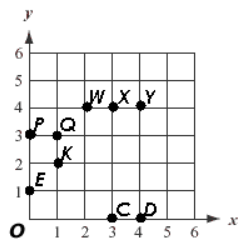
Where is point E located?
a)
( 2, 0 )
b)
( 2 , 2 )
c)
( 0 , 2 )
d)
( 0 , 0 )
22.
The axes divide the coordinate plane into four sections called what? 
a)
ordered pairs
b)
origins
c)
quadrants
d)
coordinate plane
23.
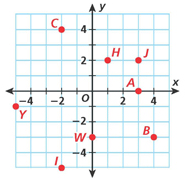
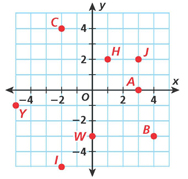
Name the quadrant where POINT A is located. 
a)
Quadrant I
b)
Quadrant IV
c)
No Quadrant
d)
Quadrant II
24.
Give the coordinates for POINT I.
a)
(-2, 5)
b)
(-2, -5)
c)
(2, 5)
d)
(2, -5)
25.
Which letter matches the coordinate (4, -6)?
a)
G
b)
Z
c)
K
d)
None of the above
26.
Which letter matches the coordinate (0, -6)?
a)
O
b)
L
c)
i
d)
Z
27.
The coordinate plane is divided by a horizontal number line called what? 
a)
y-axis
b)
origin
c)
x-axis
d)
quadrant
28.
The vertical number line in the coordinate plane is called what? 
a)
y-axis
b)
origin
c)
quadrant
d)
x-axis
29.
The Y axis is _______?
a)
Vertical
b)
Horizontal
c)
criss-cross
d)
diagonal
30.
The X axis is _______?
a)
vertical
b)
diagonal
c)
criss-cross
d)
horizontal
31.
The axes divide the coordinate plane into four sections called what? 
a)
ordered pairs
b)
origins
c)
quadrants
d)
coordinate plane
32.
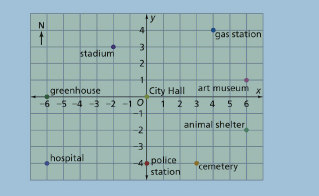
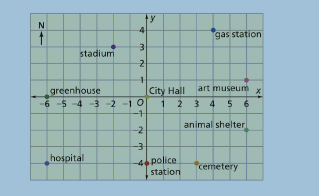
What is the distance from the hospital to the police station?
a)
5
b)
6
c)
4
d)
7
33.
What is the distance between point B and point A?
a)
2 units
b)
4 units
c)
6 units
d)
8 units
34.
What error did the student make when plotting the point (3, 4) according to the picture?                                                                                                                                                                                                                                                                                                                                                                         
a)
The student moved left along the x-axis when he should have moved right
b)
The student plotted the y-coordinate in place of the x-coordinate
c)
The student didn't make a mistake
d)
Both Options 1 and 2
35.
What is at (1,2)?
a)
the moon
b)
the sun
c)
a blue planet
d)
a robot
36.
I am at point D.  If I move up two units along the y- axis and 3 units to the left along the x-axis, where will I end up?
a)
point E
b)
point P
c)
point Q
d)
point K
37.
What is the distance from the greenhouse to City Hall?
a)
8
b)
5
c)
7
d)
6
38.
If you begin at that point and move south 3 blocks. Where will you end up?
a)
(0,8)
b)
(0,2)
c)
(0,4)
d)
(2,0)
39.
When connected, what shape will these vertices create? (3,5), (5,8), (7,5)
a)
rectangle
b)
circle
c)
square
d)
triangle
40.
Which ordered pair is located on the line shown in the graph?
a)
(9 , 8)
b)
(6 , 7)
c)
(5 , 7)
d)
(8 , 7)
41.
What is the distance from the hospital to the police station?
a)
5
b)
6
c)
4
d)
7
42.
What is the distance between point B and point A?
a)
2 units
b)
4 units
c)
6 units
d)
8 units
43.
What error did the student make when plotting the point (3, 4) according to the picture?                                                                                                                                                                                                                                                                                                                                                                         
a)
The student moved left along the x-axis when he should have moved right
b)
The student plotted the y-coordinate in place of the x-coordinate
c)
The student didn't make a mistake
d)
Both Options 1 and 2
44.
What is at (1,2)?
a)
the moon
b)
the sun
c)
a blue planet
d)
a robot
45.
I am at point D.  If I move up two units along the y- axis and 3 units to the left along the x-axis, where will I end up?
a)
point E
b)
point P
c)
point Q
d)
point K
46.
What is the distance from the greenhouse to City Hall?
a)
8
b)
5
c)
7
d)
6
47.
If you begin at that point and move south 3 blocks. Where will you end up?
a)
(0,8)
b)
(0,2)
c)
(0,4)
d)
(2,0)
48.
When connected, what shape will these vertices create? (3,5), (5,8), (7,5)
a)
rectangle
b)
circle
c)
square
d)
triangle
49.
Which ordered pair is located on the line shown in the graph?
a)
(9 , 8)
b)
(6 , 7)
c)
(5 , 7)
d)
(8 , 7)
50.
In the coordinate points (2,7) the 2 represents
a)
y
b)
origin
c)
x
d)
point
51.
What is coordinate L?
a)
(6,6)
b)
(2,5)
c)
(2,3)
d)
(5,2)
52.
The axes divide the coordinate plane into four sections called what? 
a)
ordered pairs
b)
origins
c)
quadrants
d)
coordinate plane
53.
What is the distance from the hospital to the police station?
a)
5
b)
6
c)
4
d)
7
54.
What is the distance between point B and point A?
a)
2 units
b)
4 units
c)
6 units
d)
8 units
55.
What error did the student make when plotting the point (3, 4) according to the picture?                                                                                                                                                                                                                                                                                                                                                                         
a)
The student moved left along the x-axis when he should have moved right
b)
The student plotted the y-coordinate in place of the x-coordinate
c)
The student didn't make a mistake
d)
Both Options 1 and 2
56.
What is at (1,2)?
a)
the moon
b)
the sun
c)
a blue planet
d)
a robot
57.
I am at point D.  If I move up two units along the y- axis and 3 units to the left along the x-axis, where will I end up?
a)
point E
b)
point P
c)
point Q
d)
point K
58.
What is the distance from the greenhouse to City Hall?
a)
8
b)
5
c)
7
d)
6
59.
If you begin at that point and move south 3 blocks. Where will you end up?
a)
(0,8)
b)
(0,2)
c)
(0,4)
d)
(2,0)
60.

Which ordered pair is located on the line shown in the graph?

a)

(9 , 8)

b)

(6 , 7)

c)

(5 , 7)

d)

(8 , 7)

61-70.

Answer the questions below after watching the video

61.

What is the correct order of coordinates on a coordinate plane?

a)

Alphabetical order

b)

X-coordinate, Y-coordinate

c)

Random order

d)

Y-coordinate, X-coordinate

62.

Where do we start plotting points on a coordinate plane?

a)

At (0,0)

b)

At (1,1)

c)

At (5,5)

d)

At (10,10)

63.

Which quadrant do we plot points if only positive numbers are used?

a)

Quadrant I

b)

Quadrant III

c)

Quadrant II

d)

Quadrant IV

64.

What is the origin on a coordinate plane?

a)

(1,1)

b)

(0,0)

c)

(0,1)

d)

(1,0)

65.

What does the point (5,8) represent on a coordinate plane?

a)

8 steps up, 5 steps right

b)

5 steps up, 8 steps right

c)

8 steps right, 5 steps up

d)

5 steps right, 8 steps up

66.

How does the point (8,5) differ from (5,8)?

a)

It's the same point

b)

It's plotted 8 steps right and 5 steps up

c)

It's plotted on a different quadrant

d)

It's plotted 5 steps right and 8 steps up

67.

What happens when the x-coordinate is 0?

a)

The point is at the origin

b)

The point is on the x-axis

c)

The point cannot be plotted

d)

The point is on the y-axis

68.

What does the coordinate (3,0) indicate?

a)

The point is on the x-axis

b)

3 steps right and then up

c)

3 steps up from the origin

d)

The point is on the y-axis

69.

How do you plot the point (2,1)?

a)

1 step up, 2 steps right

b)

2 steps up, 1 step right

c)

1 step right, 2 steps up

d)

2 steps right, 1 step up

70.

What does it mean when the y-coordinate is 0?

a)

The point cannot be plotted

b)

The point is at the origin

c)

The point is on the y-axis

d)

The point is on the x-axis

71.

Which describes how to locate point A from the origin?

a)

Count 3 units to the right and 5 units up.

b)

Count 5 units to the right and 3 units up.

c)

Count 3 units up and 5 units to the right.

d)

Count 5 units up and 3 units to the right.

72.

What error did the student make when plotting the point (3, 4) according to the picture?                                                                                                                                                                                                                                                                                                                                                                         

a)

The student moved left along the x-axis when he should have moved right

b)

The student plotted the y-coordinate in place of the x-coordinate

c)

The student didn't make a mistake

d)

Both Options 1 and 2

73-80.

Answer the questions below after watching the video

73.

What is a quadrilateral?

a)

A shape with 4 sides

b)

A shape with 6 sides

c)

A shape with 3 sides

d)

A shape with 5 sides

74.

What makes a square special among quadrilaterals?

a)

It has 3 equal sides

b)

It has 4 right angles

c)

It has 1 pair of parallel sides

d)

It has no parallel sides

75.

What is the difference between a rectangle and a square?

a)

A rectangle has sides of different lengths

b)

A rectangle has 3 right angles

c)

A rectangle has only 2 sides

d)

A rectangle has no parallel sides

76.

What defines a rhombus?

a)

4 equal angles

b)

4 equal sides

c)

No parallel sides

d)

Only 1 pair of parallel sides

77.

What is true for all parallelograms?

a)

They have no parallel sides

b)

They have two pairs of parallel sides

c)

They have sides of equal length

d)

They have 4 right angles

78.

What is a trapezoid?

a)

A quadrilateral with 1 pair of parallel sides

b)

A quadrilateral with no parallel sides

c)

A quadrilateral with 4 equal sides

d)

A quadrilateral with 4 right angles

79.

What is the sum of the angles in any quadrilateral?

a)

360 degrees

b)

450 degrees

c)

270 degrees

d)

180 degrees

80.

How can you find an unknown angle in a quadrilateral?

a)

Add all known angles and divide by 4

b)

Multiply the largest angle by 2

c)

Subtract the sum of known angles from 360

d)

Subtract the sum of known angles from 180

81.

Which of the following quadrilaterals has four right angles?

a)

Rectangle

b)

Rhombus

c)

Parallelogram

d)

Trapezoid

82.

If a figure is a square, then it is a rectangle. If a figure is a rectangle, then it has 4 right angles.


What can you conclude?

a)

If a figure has 4 right angles, then it is a square.

b)

If a figure is a square, then it has 4 right angles.

c)

Nothing

d)

If a figure is a rectangle, then it is a square with 4 right angles.