
 Worksheets
Early Republic - Nullification
Total questions: 37
Worksheet time: 21mins
What did the Federalists believe in?
Limiting the power of the federal government
Giving more power to individual states
A strong central government
Protecting the rights of ordinary people
Established a line 36 30 as a boundary between slave and free states
McCulloch vs. Maryland
Mudslinging
Missouri Compromise
Interstate Commerce
Ruled that the federal government had power over the states
McCulloch vs. Maryland
Mudslinging
Missouri Compromise
Interstate Commerce
Washington was the first president and warned against forming permanent foreign ___________________
commerce (trade)
adversaries (enemies)
alliances (friendships)
relations with Native Americans
Democrat-Republican Party was formed by Thomas Jefferson and favored stronger __________________ government.
federal
national
central
state
The main disagreement between the political parties was over the ____________________ of the Federal government and the ________________________.
power; national bank
weakness; FOC
strength; tariffs
power; Alien & Sedition Acts
What was the Supreme Court case that established Judicial Review?
McCullough v. Maryland
Dred Scott v. Sandford
Gibbons v. Ogden
Marbury v. Madison
What is Judicial Review?
President vetoes the judicial branch's ruling.
The Congress can override the Supreme Court.
The Supreme Court rules a law is unconstitutional.
Judges on the Supreme Court are reviewed by the Senate.
Which action contributed to the beginning of the War of 1812?
impressment of American sailors into the British navy
attacks on American ships by the Barbary Coast pirates
seizure of American ships by the Spanish navy
violations of American fishing rights on the Great Lakes
Making money for the mother country!
mercantilism
revolution
Marbury v. Madison
Monroe Doctrine
Which early political party wanted a larger and more powerful federal government?
Federalists
Democratic-Republicans
Which early political party wanted a smaller federal government with more power given to the states?
Federalists
Democratic-Republicans
First Secretary of Treasury and leader of the Federalist party.
John Adams
John Jay
Thomas Jefferson
Alexander Hamilton
Which early president led the Democratic Republican party?
John Adams
Thomas Jefferson
George Washington
James Madison
The Louisiana Purchase _________ the size of the United States.
Doubled
Tripled
Did not change
Jefferson first argued against the use of these constitutional powers then used them to make the Louisiana Purchase.
Executive Powers
Judicial Powers
Federal Powers
Implied Powers
Match the following
New trade routes to Asia, wealth, empire
rocky soil, cold climate, harbors, fish
distance from Britain, Mayflower Compact
Plantation system, cash crops
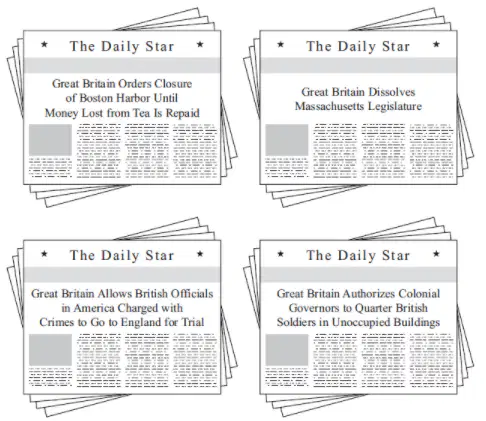
How did the American colonists IMMEDIATELY respond to the 1774 laws described in the headlines?
The First Continetnal Congress declared war on Great Britain
The colonists adopted the Articles of Confederation
The First Continental Congress sent a list of grievances to King George III
The colonists adopted the Bill of Rights
Precedence
The one who is in charge of the United States.
Future examples
Same as President
A fortune teller.
Marbury v. Madison
A prize fight during the early 1800's
A duel between James Madison and John Marbury.
U.S. Supreme Court case that established the principle of judicial review in the United States
An antifederalist v. federalist
Impressment
To print on a printing press
To make footprints in the sand
To brand an animal
The practice of Britain's Royal Navy of sending officers to board American ships, inspect the crew, and seize sailors.
Embargo
The name of a country.
A type of cargo.
An official ban on trade or other commercial activity with a particular country.
A river barge.
The Louisiana Purchase was in ...
1038
1803
1308
1830
Feeling” was a social effect of
Why did Northern States favor tariffs during the early years of the republic?
Southern smugglers would be forced to trade fairly and legally
Northern farmers would be able trade in foreign markets freely
Northern manufacturers would benefit from less foreign competition
Southern states would sell more raw materials to Northern businesses
A central issue contributing to the development of political parties in the United States was--
the expansion of US territory
the role of the Supreme Court
the diplomatic ties to foreign nations
the power of the federal government
Which of the following stated that the United States would not tolerate European intervention in Latin America?
XYZ Affair
Treaty of Ghent
Monroe Doctrine
Alien and Sedition Acts
Which principle did President James Monroe establish as a cornerstone of American foreign policy?
The United States would persuade Asian powers to increase commerce with American traders
The United States would use the military to topple dictators that threaten peaceful democracies
The United States would resist any nation attempting to interfere in the affairs of nations in the Western Hemisphere
How did the War of 1812 contribute to the expansion of industry in the United States?
The disruption of trade forced the development of US manufacturing
The burning of Washington, DC led to nationwide construction boom
The new US Navy increased the confidence of overseas trading expeditions
Foreign policy statement that challenged European involvement in the Western Hemisphere.
Monroe Doctrine
Farewell Adress
XYZ Affair
House of Burgesses
What was the Nullification Crisis?
A diplomatic dispute between the United States and Great Britain
A political crisis in the United States over the issue of tariffs
A social movement advocating for the abolition of slavery
A military conflict between the North and South during the Civil War
How did Andrew Jackson respond to the Nullification Crisis?
He called for a national referendum to decide the outcome of the crisis.
He threatened to use military force against South Carolina.
He ignored the crisis and focused on other issues.
He signed a compromise bill that resolved the crisis peacefully.
Which state played a central role in the Nullification Crisis?
South Carolina
Virginia
Georgia
North Carolina

