
 Worksheets
10th Grade - Global History Review
Total questions: 193
Worksheet time: 3hrs 16mins
Who advanced the scientific method as a way of obtaining knowledge?
Isaac Newton
Francis Bacon
Nicolaus Copernicus
René Descartes
René Descartes is known for which philosophical statement?
'The earth is flat'
'I think, therefore I am'
'The sun revolves around the earth'
'All matter is made of fire'
Isaac Newton formulated basic laws of ______ and gravity.
Motion
Thermodynamics
Chemistry
Biology
What did Isaac Newton reportedly dislike after formulating his laws?
Oranges
Apples
Bananas
Grapes
The heliocentric model of the solar system was developed by ______.
Nicolaus Copernicus
Johannes Kepler
Galileo
Isaac Newton
Which invention is associated with the Scientific Revolution?
Telescope
Steam engine
Electric light
Telephone
Fill in the blank: The final step in the scientific method is to _______.
form a hypothesis
state a conclusion
record results
repeat the steps
Voltaire was known for writing which satirical work?
The Wealth of Nations
On Crime and Punishments
Candide
The Age of Reason
Napoleon's invasion of which country led to his downfall?
Spain
Italy
Russia
Germany
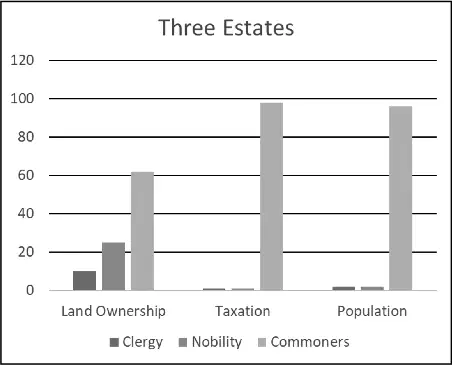
Fill in the blank: The French Revolution was partly caused by the inequality in ______ among the Three Estates.
Wealth
Power
Land ownership
Education
What was the main idea that developed among people after the French Revolution?
Communism
Nationalism
Capitalism
Socialism
Which languages are spoken in Latin America?
A) English, French, German
B) French, Spanish, Portuguese
C) Spanish, Italian, Russian
D) Portuguese, German, English
Who were the local people of Spanish ancestry in New Spain?
Criollos
Mestizos
Viceroys
Colonists
What claim can best be supported based on the passage?
1. Ask a question
2. Form a hypothesis
3. Experiment to test hypothesis
4. Analyze data
5. Draw a conclusion
Galileo Galilei was punished by the church for trying to teach that the earth revolved around the sun. How was he punished?
he was put to death
he was put on house arrest for the rest of his life
he was imprisoned for 10 years
he was beaten
A right, such as life and liberty, that a person is born wth
divine right
philosophes
natural rights
contract
A place where Enlightenment thinkers got together to discuss Enlightenment ideas
divine right
salon
laissez-faire
bourgeoisie
A person(s) who had unlimited authority and almost no legal limit.
A Monk
Absolute Monarch
A Philosophe
A Salon Manager
Enlightenment thinker who viewed humanity in a negative way and believed people were naturally wicked.
John Locke
Mary Wollstonecraft
Thomas Hobbes
Enlightenment thinker who believed in the natural rights of "Life, Liberty, and the right to Property".
Montesquieu
John Locke
Rousseau
Enlightenment thinker who was a pioneer for women's rights and education.
Mary Wollstonecraft
Voltaire
Thomas Hobbes
People are naturally cruel, greedy, and selfish. Powerful government needed to ensure orderly society
John Locke
Thomas Hobbes
Montesquieu
Rousseau
Voltaire
fought for freedom of speech and opposed religious intolerance and corruption in government
John Locke
Thomas Hobbes
Montesquieu
Rousseau
Voltaire
A right, such as life and liberty, that a person is born wth
divine right
philosophes
natural rights
contract
A place where Enlightenment thinkers got together to discuss Enlightenment ideas
divine right
salon
laissez-faire
bourgeoisie
A person(s) who had unlimited authority and almost no legal limit.
A Monk
Absolute Monarch
A Philosophe
A Salon Manager
Enlightenment thinker who viewed humanity in a negative way and believed people were naturally wicked.
John Locke
Mary Wollstonecraft
Thomas Hobbes
Enlightenment thinker who believed in the natural rights of "Life, Liberty, and the right to Property".
Montesquieu
John Locke
Rousseau
Enlightenment thinker who was a pioneer for women's rights and education.
Mary Wollstonecraft
Voltaire
Thomas Hobbes
People are naturally cruel, greedy, and selfish. Powerful government needed to ensure orderly society
John Locke
Thomas Hobbes
Montesquieu
Rousseau
Voltaire
fought for freedom of speech and opposed religious intolerance and corruption in government
John Locke
Thomas Hobbes
Montesquieu
Rousseau
Voltaire
Belief that authority comes from reason and not God
Enlightenment
Constitution
Absolutism
Philosophers
An agreement between free individuals and government
natural rights
social contract
popular sovereignty
separation of powers
Enlightenment ideas influenced American colonists to challenge British authority.
True
False
A new way of thinking based on the observation of the natural world and the questioning of old ideas.
scientific revolution
geocentric theory
catholic church
social contract
An intellectual movement focused on improving government and society using reason and thought.
natural rights
Scientific Revolution
Enlightenment
10 Commandments
The division of a state’s government into branches with separate powers and responsibilities to ensure that one branch of government is not greater than another is referred to as ____________________.
Locke Down Method
Separation of Powers
Enlightenment Powers
Divide and Conquer
_________________ was a French philosopher, writer, and composer who influenced the progress of the Age of Enlightenment throughout Europe and is best known for his contributions to the Social Contract Theory.
Baron de Montesquieu
Jean Felix
Marquis de Lafayette
Jean Jacques Rousseau
Absolute monarchs relied on ___________ to justify their rule.
Mercantilism
Divine Right
Social Contract
Separation of Powers
What impact did the Enlightenment have on Absolute Monarchs?
It caused an increase in them in various nations throughout Europe
It caused people to question them and favor more Democratic governments
It caused the acceptance of Divine Right as a legitimate political theory
All of the above
“God hath power to create or destroy, make or unmake, at his pleasure; to give life or send death; to judge…and to be judged (by) none… the same power is had by kings;…”
Which idea is described by this passage?
Constitutional Monarchy
Social Darwinism
Democracy
theory of divine right
What was one of the key factors contributing to the French Revolution?
Religious conflict
Economic inequality
Foreign invasions
Political instability
Which social class in pre-revolutionary France made up 98% of the population?
A) 1st Estate
B) 2nd Estate
C) 3rd Estate
D) Nobility
Which estate in pre-revolutionary France owned the majority of the land but paid very few or no taxes?
A) 1st Estate
B) 2nd Estate
C) 3rd Estate
D) Peasants
What was the name of the palace associated with King Louis XIV and his extravagant lifestyle?
A) Palace of Versailles
B) Palace of Louvre
C) Palace of Westminster
D) Palace of Madrid
Which estate in pre-revolutionary France was comprised of clergy members?
A) 1st Estate
B) 2nd Estate
C) 3rd Estate
D) Bourgeoisie
Which event marked the official start of the French Revolution?
A) Storming of the Bastille
B) Tennis Court Oath
C) Execution of Louis XVI
D) Reign of Terror
What document proclaimed equal rights for all men but did not grant political rights to women during the French Revolution?
A) Declaration of the Rights of Man and the Citizen
B) Declaration of Women's Rights
C) Declaration of Independence
D) Bill of Rights
Who was the leader of the Jacobins and head of the Committee of Public Safety during the Reign of Terror?
A) King Louis XVI
B) Maximilian Robespierre
C) Georges Danton
D) Camille Desmoulins
Which instrument of execution was used during the Reign of Terror in France?
A) Hanging
B) Firing squad
C) Guillotine
D) Electric chair
What event led to the overthrow and execution of King Louis XVI?
A) Tennis Court Oath
B) Storming of the Bastille
C) Flight to Varennes
D) Execution of Marie Antoinette
Which group of French citizens, known as "Sans Culottes," played a significant role in the early stages of the Revolution?
A) Nobility
B) Clergy
C) Common people
D) Peasants
What marked the end of the Reign of Terror in France?
A) Execution of Robespierre
B) Execution of Louis XVI
C) Establishment of the Directory
D) French victory in a major battle
What government body replaced the Legislative Assembly in France in September 1792?
A) National Assembly
B) National Convention
C) Committee of Public Safety
D) Directory
Which European monarch is often referred to as the "Sun King" and ruled France for 72 years?
A) Louis XVI
B) Louis XV
C) Louis XIV
D) Louis XIII
What was the primary reason behind the execution of Louis XVI?
A) His support for the Revolution
B) His involvement in foreign wars
C) His extravagant spending and debt
D) His alliance with foreign powers against France
What event led to the formation of the National Assembly during the early stages of the French Revolution?
A) Execution of Louis XVI
B) Tennis Court Oath
C) Storming of the Bastille
D) Reign of Terror
Which revolutionary figure is often associated with the phrase, "Let them eat cake," as a symbol of royal indifference to the suffering of the French people?
A) Maximilian Robespierre
B) Georges Danton
C) Marie Antoinette
D) Olympe de Gouges
What political ideology emerged during the French Revolution, emphasizing the rights of the common people and the overthrow of the monarchy?
A) Absolutism
B) Feudalism
C) Radicalism
D) Jacobinism
What was the fate of Maximilian Robespierre, one of the key figures of the Reign of Terror?
A) He fled to a foreign country.
B) He was executed by the guillotine.
C) He became the ruler of France.
D) He retired from politics.
Which governmental committee, tasked with controlling France and protecting the Revolution, was led by Maximilian Robespierre during the Reign of Terror?
A) National Assembly
B) Committee of Public Safety
C) Legislative Assembly
D) Paris Commune
What was the name of the code of laws introduced by Napoleon?
The French Code
The Revolutionary Code
The Country Code
The Civil Code
At the height of Napoleon's power, which was NOT part of his Grand Empire?
Dependent States
The French Empire
Allied States
Conquered States
What was the timeline of Napoleon's reign?
1799-1815
1776-1783
1830-1845
1899-1915
What principles were spread to areas under Napoleon's control?
Oppression of people.
Revolutionary ideas.
Free press.
Financial reforms.
What was the main goal of the Congress of Vienna?
To restore the balance of power in Europe
To establish a global empire
To promote democracy and equality
To expand the French empire
How was Great Britain able to hold off Napoleon's kingdom?
Better trained troops
Naval supremacy
Napoleon didn't want Great Britain.
They had help from Spain.
What contributed to the opposition of other countries to Napoleon's reign?
Desire for resources
Feelings of nationalism
Dislike of French ideas
Economic concerns
What was the final end of Napoleon's reign?
Exiled to another island after losing Battle of Waterloo.
Executed by guillotine for treason after losing Battle of Waterloo.
Killed in battle as part of the Battle of Waterloo.
He died a French hero and handed France to his son.
What was the purpose of the Continental System?
To promote free trade between European countries
To restrict trade with Great Britain
To establish a common currency in Europe
To encourage cultural exchange between European countries
What was the main reason for Napoleon's rise to power in France?
His military successes
His diplomatic skills
His popularity among the people
His family connections
When people have pride in their country because they feel a shared sense of history, culture, and language, it is called
imperialism
nationalism
militarism
globalization
In the late 1800's, nationalism helped this empire fall apart
The Roman Empire
The Devonian Empire
The Byzantine Empire
The Ottoman Empire

What country is highlighted on the map?
US
Mexico
Canada
Puerto Rico

Jamaica
Dominican Republic
Haiti
Belize

What is the country in red?
Peru
Brazil
Suriname
Venezuela

What is the country in red?
Bolivia
Chile
Argentina
Brazil

What is the country in red?
Brazil
Spain
Ecuador
Argentina

What is the country in red?
Ecuador
Chile
Argentina
Paraguay

What is the country in red?
Haiti
Suriname
Brazil
Peru
Latin America is
a term used for the countries in Asia with a strong Latin cultural influence
the region in Europe where Spanish & Portuguese are spoken
a term used to describe the region in Africa where Latin is spoken
the region in the Americas where people speak Spanish or Portuguese

Who was Toussaint Louverture?
Famous French king
Spanish military leader
Leader of the Haitian Revolution
Leader of the Mexican Revolution
What helped Haiti win against Napoléon?
yellow fever
What was the 1st independent nation in Latin America?
Yellow fever is caused by
How did the U.S. & French Revolutions impact South America & Mexico?

Who was Jose de San Martin?
South American priest
Mexican revolutionary leader

Who was Miguel Hidalgo?
a Spanish conquistador
a revolutionary leader for Argentina, Chile, & Peru
a Catholic priest & a leader of the Mexican War of Independence
a Spanish king
What country is highlighted on the map?
US
Mexico
Canada
Puerto Rico
Jamaica
Dominican Republic
Haiti
Belize
What is the country in red?
Peru
Brazil
Suriname
Venezuela
What is the country in red?
Bolivia
Chile
Argentina
Brazil
What is the country in red?
Brazil
Spain
Ecuador
Argentina
What is the country in red?
Ecuador
Chile
Argentina
Paraguay
What is the country in red?
Haiti
Suriname
Brazil
Peru
Latin America is
a term used for the countries in Asia with a strong Latin cultural influence
the region in Europe where Spanish & Portuguese are spoken
a term used to describe the region in Africa where Latin is spoken
the region in the Americas where people speak Spanish or Portuguese
Who was Toussaint Louverture?
Famous French king
Spanish military leader
Leader of the Haitian Revolution
Leader of the Mexican Revolution
What helped Haiti win against Napoléon?
yellow fever
What was the 1st independent nation in Latin America?
Yellow fever is caused by
How did the U.S. & French Revolutions impact South America & Mexico?
Who was Jose de San Martin?
South American priest
Mexican revolutionary leader
Who was Miguel Hidalgo?
a Spanish conquistador
a revolutionary leader for Argentina, Chile, & Peru
a Catholic priest & a leader of the Mexican War of Independence
a Spanish king
Who was the founder of "Young Italy?" He was also known as the soul of Italian Unification.
Giuseppe Mazzini
Camillo di Cavour
Who unified much of Southern Italy with only a volunteer army in 1860? He was also known as the sword of Italian Unification.
Vittorio Emmanuel II
What patriotic and nationalist group was formed in the beginning of the unification of Italy?
The first Kaiser of a unified Germany?
The Brains of Italian Unification: unites Italy under the kingdom of Piedmont-Sardinia.
Mazzini
What war started from an altered telegram sent by Bismarck? The German nations supported Prussia in this war and it ended with the creation of the country of Germany.
Crimean War
Austro-Hungarian War
Russo-Japanese War
Franco-Prussian War
This is the name of the man who led German unification:
Otto von Bismarck
Guiseppe Garibaldi
Count Cavour
Mikhail Gorbachev
Ethnic Groups share a common what?
Culture and Heritage
Government
Economy
Ancestor
The Frankfurt Assembly would be defined as?
The first war that Bismark was victorious in
A National Revolution in which Liberals successfully formed a unified Germany under a Constitutional Monarchy
A National Revolution in which Liberals failed to form a unified Germany under a Constitutional Monarchy
An agreement between the Emperor of Austria and King of Prussia to be allies
"Blood and Iron' was Prussia and Bismark's policy of?
Open Borders
Militarism
Amoral foreign policy
Realpolitik
Austria and Prussia joined together to beat which country in the 7 Days War?
France
Italy
England
Denmark
Prussia was able to win this war in 7 weeks after they broke an alliance and forced their emperor to declare war on them?
Austro-Prussian War
Franco-Prussian War
Danish War
War of 1868
Which two territories did France have to give to Germany after the Franco-Prussian War?
Lorraine and Versailles
Alsace and Paris
Bavaria and Venice
Alsace and Lorraine
Bismarck's practice of Realpolitik was guided by which of the following?
Doing what was moral
Doing what would best serve the people
Doing what was necessary to support the nation
None of the above
The term laissez-faire roughly translates to mean
leave alone
resist
freedom
control
During the Industrial Revolution, a new social and economic class that developed was the
serfs
rich, or the upper class
expanded lower class
middle class
Why was England the site of the beginnings of the Industrial Revolution?
England was the most powerful nation in the world
It wasn't; history has unfairly given England credit for the Industrial Revolution
England had an abundance of natural resources such as coal, iron ore, and waterways where water wheels and steam engines could be built
England was centrally located to many areas like France, Germany, Spain, and Ireland, giving them an advantage to bring in resources and talent from many places
In what industry did the Industrial Revolution start?
farming
textile/cloth industry
maritime industry
coal industry
Laissez-faire capitalism as attributed to Adam Smith called for
heavy taxation of manufacturers
strict government control of the economy
minimal government involvement in the economy
government investments in major industries
In his book The Communist Manifesto, Karl Marx expressed the idea that
religion should be the most important factor in society
power should be determined by a person’s wealth
profits from work should belong to the workers
supply and demand should control prices
A reason some businesses hired children was:
To provide the children a bright future and opportunities
So they could save money by paying the children less money
So the children could take care of the heavy labor required for their business
To improve their public image

Which of the following was NOT true of poor urban neighborhoods?
They were filled with overcrowded tenements.
The living conditions were dirty and squalid.
Most urbanites lived in factory-owned apartments.
The incidence of diseases was increasing.

What natural resources gave Great Britain an advantage in the Industrial Revolution?
water and forests
wildlife and precious gems
coal and iron
good harbors

Adam Smith, who took up for laissez-faire economics, believed that:
mercantilism was the only way to insure a truly free trade.
the government should regulate the economy.
the government should not interfere with the economy.
colonies were an important source of conpetition.

How did industrialization impact women?
Many women entered the paid workplace.
Many women practiced traditional economic activities.
It had no impact on the lives of women.
Women moved from cities to rural areas.
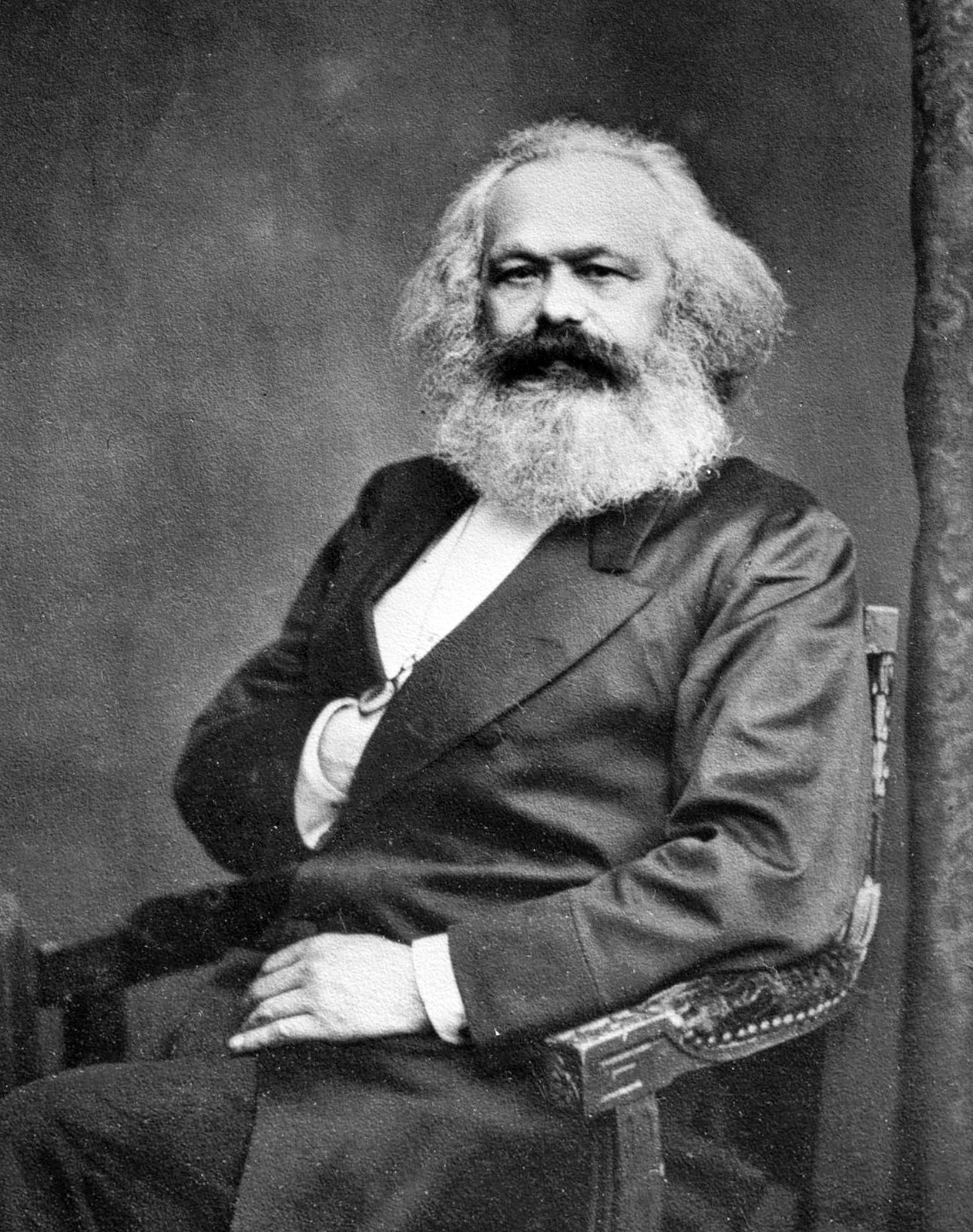
Karl Marx spelled out how he believed that workers should rise up against factory owners, outlining the basic principles of
capitalism
socialism
communism
command economies
What is domination by one country of the political, economic, or cultural life of another country or region
Imperialism
Industrialization
What was the name of the war where Britain sent navy to force China to allow Britain to sell opium in China
Opium War
War of 1812
War of the worlds
English war
What is the name of the reform in education, military, and industrial changes made after Japanese studied western nations
Sushi
Tokyo
Western
Meiji
The view that a nations most "fit" to survive had the right to dominate others
Dominator
Survivalist
Social Darwinism
Winner
What is a territory settled and ruled by people from another land
colony
territory
spoils
Island

Why was Africa so valuable to European nations?
advanced ships and weapons
valuable raw materials and resources
vast land for farming
tourism
Who benefited most from imperialism?
European nations
Native Americans
African Kingdoms
Indian Kingdoms
China and Britain fought a war over:
the Korean peninsula
conquests along the Nile River
opium production and distribution
the elimination of the samurai
Imperialism led to political tensions between European countries?
True
False
What country was the economic leader in the 1800's?
Great Britain
Germany
United States
Japan
Who were the Boers?
Fisherman from India
Carpenters from Transvaal
Farmers of Dutch descent
General worker from Orange Free State
Emperor Meiji promoted what in Japan?
isolation and nationalism
capitalism and democracy
revolution and absolutism
reform and modernization
Which action in Japanese history occurred during the Meiji Restoration?
Japan modernized its economy.
Mongols invaded the islands of Japan.
The Japanese government adopted an isolationist policy
Buddhism became the official religion of Japan

Source: The Little Journal, published in France, January 16, 1898 (Bibiotèque Nationale de France)
In this cartoon, the Chinese are reacting to the process of
imperialism
Industrialization
collectivism
unification

Source: The Little Journal, published in France, January 16, 1898 (Bibiotèque Nationale de France)
Which statement best represents a reason Japan is seated at the table in this cartoon?
The Meiji Restoration industrialized Japan.
The Tokugawa Shogunate centralized Japan’s government.
Japan was invited as an ally of China.
Japan had become industrialized & militarily stronger than many European powers.

Source: James L. Huffman, Modern Japan, A History in Documents, Oxford University Press
During which period of Japanese history did the changes shown in this wood block print occur?
Heian court
Tokugawa Shogunate
Meiji Restoration
United States occupation

Source: James L. Huffman, Modern Japan, A History in Documents, Oxford University Press
Identify one effect of the historical period depicted in this image.
Modernization of Japan
Isolation of Japan
Invasion of Japan
Chinese influence of Japan

Base your answer to question #30 on the 19th century song lyrics below and on your knowledge of social studies.
Which event is most closely associated with the conditions described in these lyrics?
civil war in England
famine in Ireland
famine in England
The English government providing humanitarian aid to Ireland

in the British East India Co. army.

What country did Louis XIV lead?
France
Prussia
Austria
Spain
What country did Peter the Great lead?
Prussia
Russia
Spain
France
What country did Philip II lead?
Spain
France
Prussia
Russia
What country did William and Mary eventually lead?
France
Prussia
Great Britain
Sicily
'Absolutism' refers to WHICH of the following governmental ideologies?
Constitutional Monarchy
Absolute Monarchy
Absolute Democracy
Absolute Dictatorship
Which of the following gave kings their 'right' to rule?
Hammurabi's Code
Divine Right
Magna Carta
English Bill of Rights
Oliver Cromwell was the leader of which of the following groups?
Royalists
Parliamentarians
Redcoats
French
The English Bill of Rights came BEFORE the US Bill of Rights
True
False
The English Civil War represented a struggle between which of the following?
Redcoats vs. Bluecoats
Cavaliers vs Royalists
Royalists vs Redcoats
Cavaliers vs Bluecoats
What did the Cavaliers stand for in the English Civil War?
A Parliamentarian Government
An Absolute Monarchy
Communism
Socialism
Peter the Great helped Russia with all of the following except:
Build a modern military
Build a warm water port
Become a world power
Dominate the European continent
Who was the clear winner of the Thirty Years War and gained territory in Spain and Germany?
Austria
Prussia
France
Germany
Absolute monarchs believe they only answer to -
their people
God
the Pope
nobility
James II was overthrown during the -
English Civil War
Restoration
Glorious Revolution
Dictatorship of Cromwell

This illustration shows King John of England signing the Magna Carta in 1215.
What was the purpose of the Magna Carta?
A. to weaken the power of nobles
B. to limit the power of the monarch
C. to increase tax collection in England
D. to increase the power of the monarch
Louis XIV was known by what name?
The Sun King
The Moon King
King of all Europe
King of the Franks
What is the best way to improve your grade in Mr. Centeno's class?
Sit there and do absolutely nothing.
Fail every test and continue to not do the study guide or take Quizizz seriously.
Prepare for your tests and then do test corrections afterwards.
Ask Mr. Centeno for extra credit and worship him like an Greek god.