
 Worksheets
10th Grade 3.2
Total questions: 17
Worksheet time: 17mins
Republic represent the idea of enlightenment (having knowledge or understanding) by placing emphasis on surroundings influencing what we understand. How does “The Country of the Blind” represent it differently?
“The Country of the Blind” emphasizes limitations as being a bigger influence on our understanding.
“The Country of the Blind” highlights the importance of an explanation in understanding what is not able to be seen.
“The Country of the Blind” highlights more effective ways of learning and understanding.
“The Country of the Blind” emphasizes barriers in learning when nobody guides you through the process.
Which statement best analyzes how the first person point of view of Socrates explaining the cave scenario from Republic has been adapted in “The Country of the Blind”?
“The Country of the Blind” is third person omniscient where the speaker is all knowing.
“The Country of the Blind” uses a first person narrator detailing what he sees in the new place.
“The Country of the Blind” to a first person narrator showing the experiences of Nunez in this new land.
“The Country of the Blind” is a third person narration where the speaker refers to the reader as “you” to detail the conditions in the new place Nunez has stumbled upon.
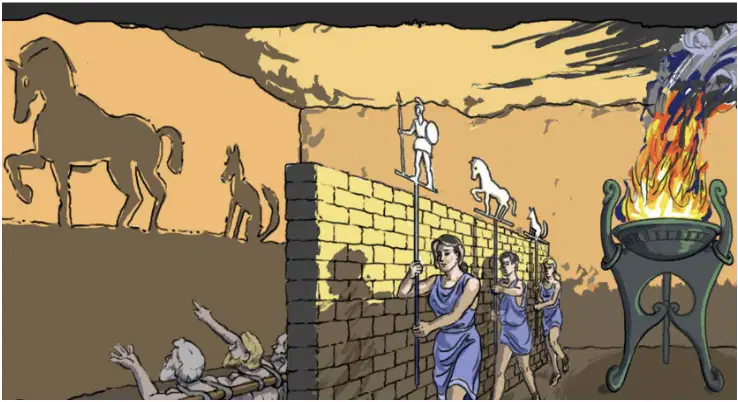
The image below represents the excerpt from Republic. How is the message different in “The Country of the Blind”?
The image shows the prisoners' knowledge expanding in Republic, whereas “The Country of the Blind” expresses knowledge as being changed through the reliance on touch.
The image represents the effective method of gaining knowledge in Republic, whereas “The Country of the Blind” focuses on the ineffective method of gaining knowledge through using different senses
The image represents the limitations explained in Republic, whereas “The Country of the Blind”expresses the peoples’ limited knowledge because of their blindness.
The image shows the wide range of the real world taught to the humans in Republic, whereas “The Country of the Blind” represents the smaller pieces of knowledge discovered by the blind through shared stories from those who could see.
Read the etymology of the word incoherent. Origin: French in - not, opposite of, without coherent - harmonious, connected, consistent What does the word incoherent mean, as it is used in paragraph 3 of “The Country of the Blind?” (V.1.2)
making sense
connected thoughts
emotionally removed
unable to comprehend
Read this section from Passage 2, paragraph 4: He went on to tell Nunez how this time had been divided into the warm and the cold, which are the blind equivalents of day and night, and how it was good to sleep in the warm and work during the cold, so that now, but for his arrival, the whole town of the blind would have been asleep. What is the best meaning of equivalents as used in the passage? (V.1.3)
tracking
opposites
correlations
definitions
Read the excerpt from “The Country of the Blind:”
For fourteen generations these people had been blind and cut off from all the seeing world; the names for all the things of sight had faded and changed; the story of the outer world was faded and changed to a child's story; (paragraph 3)
What does the repetition in these lines reveal? (R.3.4)
the importance of having ones sight
the change that has occurred over time
the changed relationship between the blind
the attention to detail in story telling to gain information
Eduardo Nunez, blind in one eye, accidentally falls off a ledge during his expedition and tumbles down the mountainside, arriving in The Country of the Blind. Read these sentences from the passage: Nunez found himself trying to explain the great world out of which he had fallen, and the sky and mountains and such-like marvels, to these elders who sat in darkness in the Country of the Blind. And they would believe and understand nothing whatever that he told them, a thing quite outside his expectation. (paragraph 3) How do these sentences add irony to the passage? (R.3.4)
He is unable to communicate with the elders.
His eyesight is not understood and dismissed.
He is not trusted because he is new to their land.
His description of the world around them is too descriptive to understand.
How does the natural setting add to the meaning of the poem? (R.1.1)
It shows that the speaker and her ancestors have a long and troubled history with this land.
It highlights the connection between the speaker and her ancestors through the shared land.
It suggests the relationship between the speaker and the setting is not connected to her ancestors.
It explains how the speaker’s family has passed down the skill of telling the stories of her ancestors through her weaving.
How does the imagery of weaving in these lines contribute to the reflective mood of the poem? (R.3.1)
The image of joy and care connects the poet’s past to the present.
The image of hopes and joy connects the poet’s heritage and her childhood.
The image of a created pattern connects the poet's heritage and her own life.
The image of the woven pattern connects the poet’s past struggles and her own life.
Which two universal themes are present in the poem? (R.1.2)
Heritage informs who you are
Change in traditions is inevitable
The stories of your culture must be shared
Understanding your past shapes your present
All cultures experience change over long periods of time
How are the universal themes in Part A related? (R.1.2)
They show changed history impacting one's hopes and dreams.
They link reflection of the past to being grateful for the present.
They demonstrate how struggle is similar among different cultures.
They connect cultural belief systems to blended belief systems.
How does the poet’s use of the phrase “the land of silence vast” create mood in the poem? (R.3.1)
It creates a saddened mood as the speaker connects the loss of wandering.
It creates a triumphant mood as the speaker explains her sense of belonging.
It creates a respectful mood as the speaker recognizes the struggle her people experienced to get to this land.
It creates a disheartened mood as the speaker questions the struggles her people had to endure which differed from other cultures.
How does the speaker’s tone add meaning to the poem? (R.1.1)
The speaker’s woeful tone connects the emotion she feels towards her heritage as she is actively weaving.
The speaker’s playful tone connects her heritage and current life through the act of weaving throughout the poem.
The speaker’s skeptical tone connects her uneasiness about her future as it relates to her heritage as she is weaving.
The speaker’s reflective tone connects both the literal and figurative action in the poem to what the weaving can accomplish.
Read the following lines from the poem: Crossing which the silent runner and The gaunt of co-yo-tees haste Shall I weave the zig-zag pathway Whence the sacred fire was born; And interweave the symbol of the God Who brought the corn— Select the statement that best represents how these lines create ambiguity. (R.1.4)
The reader is left to interpret what caused the desperation of the Navajo people moving through the land sporadically.
The reader is left to interpret the Navajo people being represented by the hungry coyotes.
The reader is left to interpret how the symbol of the God was a blessing to the Navajo people.
The reader is left to interpret the zig-zag pathway as representing the journey of her people or the actual pattern in what she is weaving.
Read the last 4 lines of the poem: All their wanderings of the past. Deftly now I trace the figures, This of joy and that of woe; And I leave an open gate-way For the Dau to come and go. How is the speaker’s focus in these lines ambiguous for the reader? (R.1.4)
It is left unclear if the focus is on returning to the land of her people.
It is left unclear if the focus in these lines is on her current journey or on the journey of her people.
It is left unclear if the focus is on the happiness or sadness her people have experienced throughout their past.
It is left unclear if the focus is to communicate the struggle of the Navajo people for others to relate to.
What does the word devious mean, as it is used in line 14? (V.1.2)
indirect
straightaway
underhanded
uninterrupted
Read the following lines from the poem: Who brought the corn— Of the Rain-god whose fierce anger Was appeased by sacred meal, And the trust that my brave people In him evermore shall feel? What is the best meaning of appeased as used in these lines? (V.1.3)
pleased
satisfied
triggered
provoked

