
NEW
Font size
 Worksheets
midterm review
Total questions: 15
Worksheet time: 8mins
Which subatomic particles were discovered as the result of experiments with cathode ray tubes?
electrons
neutrons
positrons
protons
Which numerical setup can be used to calculate the atomic mass of the element copper?
(62.93 u)(30.85) + (64.93 u)(69.15)
(62.93 u)(69.15) + (64.93 u)(30.85)
(62.93 u)(0.3085) + (64.93 u)(0.6915)
(62.93 u)(0.6915) + (64.93 u)(0.3085)
Which statement describes two different isotopes of carbon?
The isotopes contain the same number of neutrons and have the same atomic number.
The isotopes contain the same number of neutrons but have a different atomic number.
The isotopes contain a different number of neutrons but have the same atomic number.
The isotopes contain a different number of neutrons and have a different atomic number.
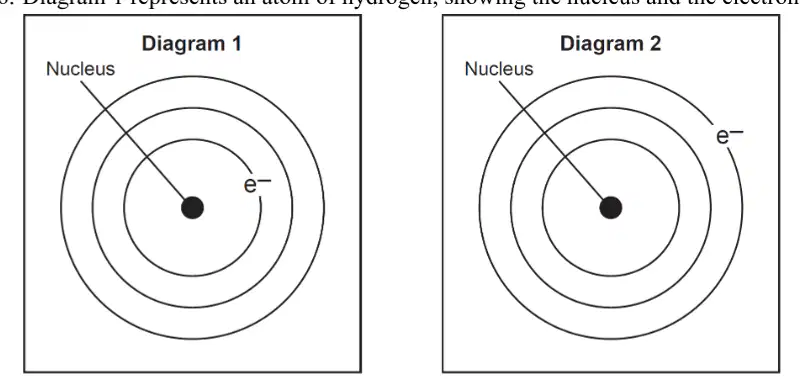
Diagram 1 represents an atom of hydrogen, showing the nucleus and the electron in the first shell. What is represented by diagram 2?
a positive ion of hydrogen
a negative ion of hydrogen
an atom of hydrogen in an excited state
an atom of hydrogen in the ground state
Which change in electron location in an atom of calcium is accompanied by the greatest amount of energy emitted?
from shell 1 to shell 2
from shell 2 to shell 1
from shell 1 to shell 4
from shell 4 to shell 1
The wave-mechanical model of the atom describes the location of electrons
as loosely packed in the nucleus of an atom
as densely packed in the nucleus of an atom
in circular paths around the nucleus
in orbitals outside the nucleus
Which atom forms an ion with a radius larger than the atomic radius?
calcium atom
oxygen atom
lead atom
tin atom
As the atomic number increases in Group 2 from Be to Ba, the first ionization energy
decreases, and the atomic radius decreases
decreases, and the atomic radius increases
increases, and the atomic radius decreases
increases, and the atomic radius increases
Which sample can be classified as a substance?
air
argon
soil
seawater
What is the number of moles in a 78.8-gram sample of MgCO₃ (gram-formula mass = 84.3 g/mol)?
0.949 mol
0.935 mol
0.843 mol
1.070 mol
Given the equation representing a reaction: F₂(g) + 2KCl(aq) → 2KF(aq) + Cl₂(g) Which type of chemical reaction is represented by the equation?
synthesis
decomposition
single replacement
double replacement
Given the equation representing a reaction: 3Mg(s) + N₂(g) → Mg₃N₂(s) What is the mass of Mg₃N₂ that is produced when 14.58 grams of magnesium completely reacts with 5.60 grams of nitrogen?
8.98 g
10.46 g
20.18 g
49.34 g
One mole of bromine gas, Br₂, has a mass of
35.0 g
70.0 g
79.9 g
159.8 g
Which equation represents a combustion reaction?
Cl₂ + 2NaBr → 2NaCl + Br₂
2CH₃OH + 3O₂ → 2CO₂ + 4H₂O
2K + 2H₂O → 2KOH + H₂
BaS + 2H₂O → Ba(OH)₂ + H₂S
What is the amount of heat that must be absorbed to increase the temperature of a 130.-gram sample of water from 20.0°C to 50.0°C?
3.90 × 10³ J
1.63 × 10⁴ J
4.34 × 10⁴ J
2.94 × 10⁵ J

