
 Worksheets
Earth and Space Sciences Fall Semester Final Exam
Total questions: 14
Worksheet time: 22mins

Mira
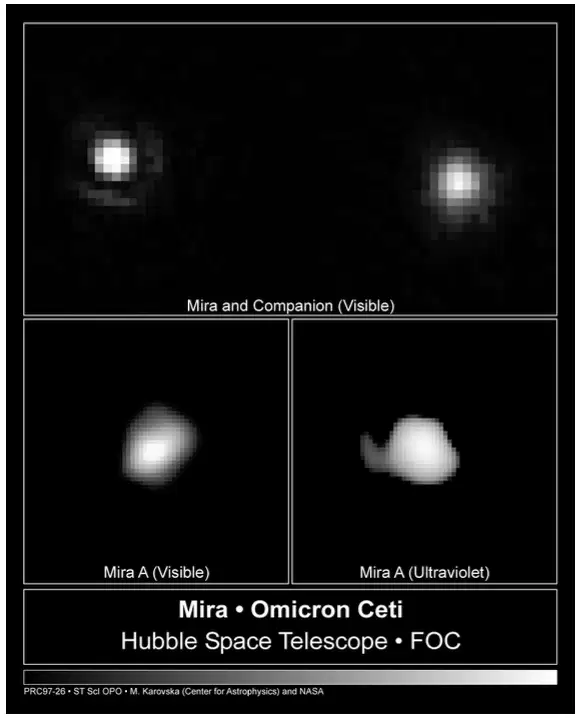
The Red Giant Mira is a pulsating variable star located in the constellation Cetus, approximately 300 light-years from Earth. It is one of the best-known examples of a Mira-type variable star, which undergoes periodic changes in brightness over a cycle of about 330 days. Mira's luminosity fluctuates as it expands and contracts, with its size increasing to nearly 400 times that of the Sun during its maximum brightness. As a red giant, Mira is nearing the end of its life cycle and is in the process of shedding its outer layers, which will eventually form a planetary nebula. Mira's variability and evolution provide valuable insights into the life cycles of stars similar to our Sun.
Which element is primarily produced in the core of a star during the main sequence phase?
Helium
Carbon
Oxygen
Iron

Mira
The Red Giant Mira is a pulsating variable star located in the constellation Cetus, approximately 300 light-years from Earth. It is one of the best-known examples of a Mira-type variable star, which undergoes periodic changes in brightness over a cycle of about 330 days. Mira's luminosity fluctuates as it expands and contracts, with its size increasing to nearly 400 times that of the Sun during its maximum brightness. As a red giant, Mira is nearing the end of its life cycle and is in the process of shedding its outer layers, which will eventually form a planetary nebula. Mira's variability and evolution provide valuable insights into the life cycles of stars similar to our Sun.
Explain how the life cycle of a star like Mira can provide insights into the future of our Sun.
Mira's variability shows how stars can change color over time.
Mira's expansion and contraction cycles demonstrate the processes that will occur in the Sun's later stages.
Mira's distance from Earth helps us understand the Sun's gravitational pull.
Mira's brightness fluctuations indicate the Sun's potential for increased luminosity.
Mira
The Red Giant Mira is a pulsating variable star located in the constellation Cetus, approximately 300 light-years from Earth. It is one of the best-known examples of a Mira-type variable star, which undergoes periodic changes in brightness over a cycle of about 330 days. Mira's luminosity fluctuates as it expands and contracts, with its size increasing to nearly 400 times that of the Sun during its maximum brightness. As a red giant, Mira is nearing the end of its life cycle and is in the process of shedding its outer layers, which will eventually form a planetary nebula. Mira's variability and evolution provide valuable insights into the life cycles of stars similar to our Sun.
How does the mass of a star determine its ultimate fate in the universe?
The mass of a star determines its color and temperature but not its fate.
The mass of a star determines whether it will become a white dwarf, neutron star, or black hole.
The mass of a star determines its ability to produce elements heavier than helium.
The mass of a star determines its ability to form planets.
Mira
The Red Giant Mira is a pulsating variable star located in the constellation Cetus, approximately 300 light-years from Earth. It is one of the best-known examples of a Mira-type variable star, which undergoes periodic changes in brightness over a cycle of about 330 days. Mira's luminosity fluctuates as it expands and contracts, with its size increasing to nearly 400 times that of the Sun during its maximum brightness. As a red giant, Mira is nearing the end of its life cycle and is in the process of shedding its outer layers, which will eventually form a planetary nebula. Mira's variability and evolution provide valuable insights into the life cycles of stars similar to our Sun.
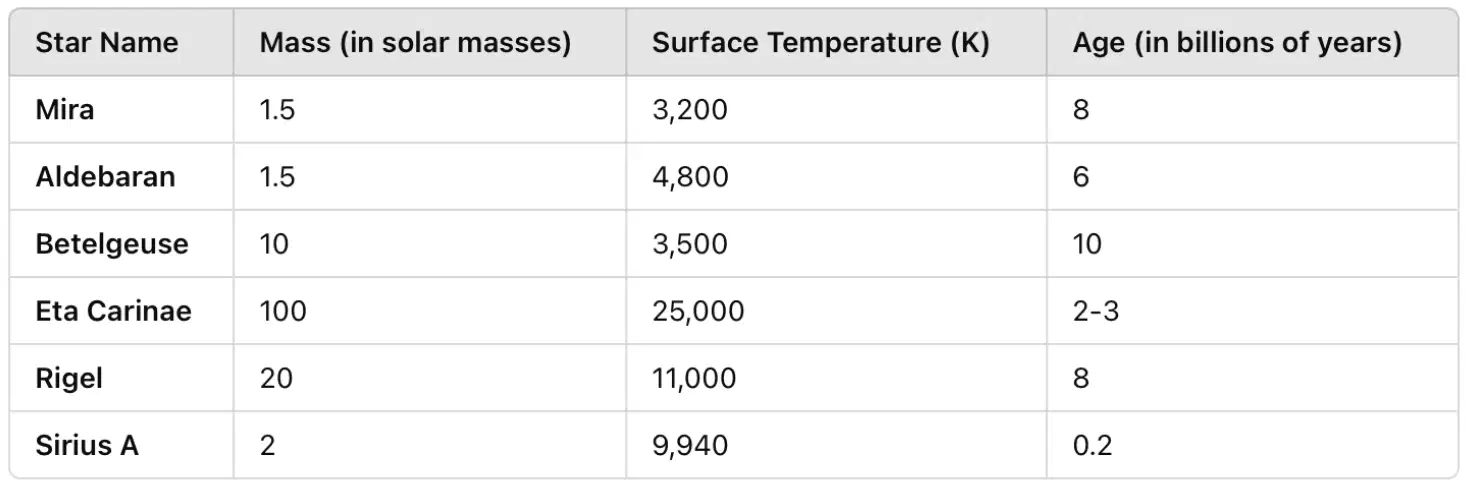
At the end of Mira's life cycle, it will shed its outer layers to form a planetary nebula. Create a claim identifying one of the stars that will not create a planetary nebula at the end of its life cycle, and identify what will happen to the star. Use relevant evidence from the data table to explain and support your claim.
Mira
The Red Giant Mira is a pulsating variable star located in the constellation Cetus, approximately 300 light-years from Earth. It is one of the best-known examples of a Mira-type variable star, which undergoes periodic changes in brightness over a cycle of about 330 days. Mira's luminosity fluctuates as it expands and contracts, with its size increasing to nearly 400 times that of the Sun during its maximum brightness. As a red giant, Mira is nearing the end of its life cycle and is in the process of shedding its outer layers, which will eventually form a planetary nebula. Mira's variability and evolution provide valuable insights into the life cycles of stars similar to our Sun.
Describe the relationship between a star's mass, temperature, and luminosity. Use specific data from real stars as evidence to support your answer.

Spectral Lines
Spectral lines are unique patterns of light that are emitted or absorbed by atoms and molecules when they transition between different energy levels. Each element or compound produces its own distinctive set of spectral lines, often observed in the form of bright lines in emission spectra or dark lines in absorption spectra. These lines occur at specific wavelengths corresponding to the energy differences between electron orbits within atoms. Spectral lines serve as powerful tools for identifying elements in distant stars and galaxies, as well as understanding the physical properties of matter, such as temperature and density.
What is the most likely composition of the unknown star?
Oxygen and Silicon
Helium and Carbon
Carbon and Oxygen
Just Hydrogen
Spectral Lines
Spectral lines are unique patterns of light that are emitted or absorbed by atoms and molecules when they transition between different energy levels. Each element or compound produces its own distinctive set of spectral lines, often observed in the form of bright lines in emission spectra or dark lines in absorption spectra. These lines occur at specific wavelengths corresponding to the energy differences between electron orbits within atoms. Spectral lines serve as powerful tools for identifying elements in distant stars and galaxies, as well as understanding the physical properties of matter, such as temperature and density.
Which of the following statements best describes the evolution of this unknown star over time?
The unknown star will begin to contract when the force of nuclear fusion and the force of gravity
decreases.
The unknown star will begin to contract when the force of gravity increases and overpowers the
force of nuclear fusion.
The unknown star will begin to expand when the force of nuclear fusion increases and
overpowers gravity.
The unknown star will begin to expand when the force of gravity decreases and the force of nuclear fusion takes over.

Plate Tectonics
Alfred Wegener was a German geophysicist and meteorologist who proposed the theory of continental drift in 1912. This theory attempted to explain how similar rock formations and plant and animal fossils could be found on separate continents. Widely dismissed by other scientists from Wegener's time, continental drift would eventually be accepted and become known as the theory of plate tectonics by the 1960s.
The model below shows some information about the position of the continents.
Use the model to explain how the Central Pangean Mountains were separated into the Appalachian Mountains and the Caledonian Mountains. In your explanation include a spatial or a temporal numerical value in which this process occurred.

Construct an explanation using evidence from the models to support the claim that although the Earth is continually creating new crust through tectonic interactions our planet is not growing any bigger.
All models of Earth's interior depend on indirect evidence. These models predict the sources of heat in Earth's interior. The substances found in the different layers of Earth's interior determine the possible source of heat in each layer. The core contains elements that "like to be with iron", but the mantle and crust contain "rock-loving" elements. These elements are the source of rock-forming minerals of the Earth's crust. Uranium, thorium, and potassium are unstable isotopes that are examples of these "rock-loving" elements.
Which statement correctly describes a source of heat within Earth's interior?
Radioactive elements in Earth's interior decay, cycling materials in convection currents only within Earth's crust.
Radioactive activity in the mantle and crust helps to cycle materials into Earth's inner core and asthenosphere.
Radioactive isotopes in Earth's interior decay in the mantle and crust, further driving convection currents that cycle materials.
Radioactive isotopes in Earth's interior decay, cycling materials in convection currents formed in the mantle and asthenosphere.
All models of Earth's interior depend on indirect evidence. These models predict the sources of heat in Earth's interior. The substances found in the different layers of Earth's interior determine the possible source of heat in each layer. The core contains elements that "like to be with iron", but the mantle and crust contain "rock-loving" elements. These elements are the source of rock-forming minerals of the Earth's crust. Uranium, thorium, and potassium are unstable isotopes that are examples of these "rock-loving" elements.
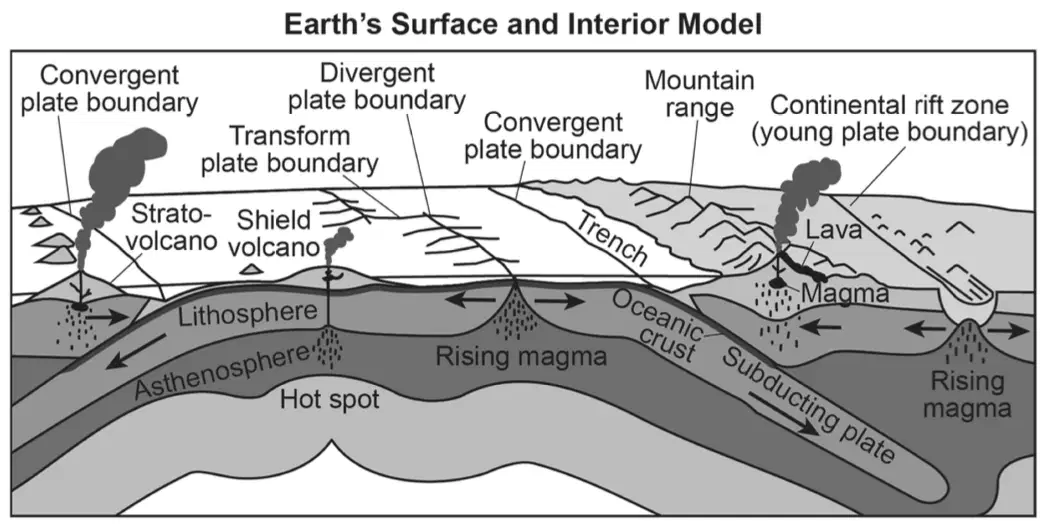
State the average density of the oceanic crust at the convergent plate boundary. Use evidence from the model to support the claim that the oceanic crust is more dense than the continental crust.
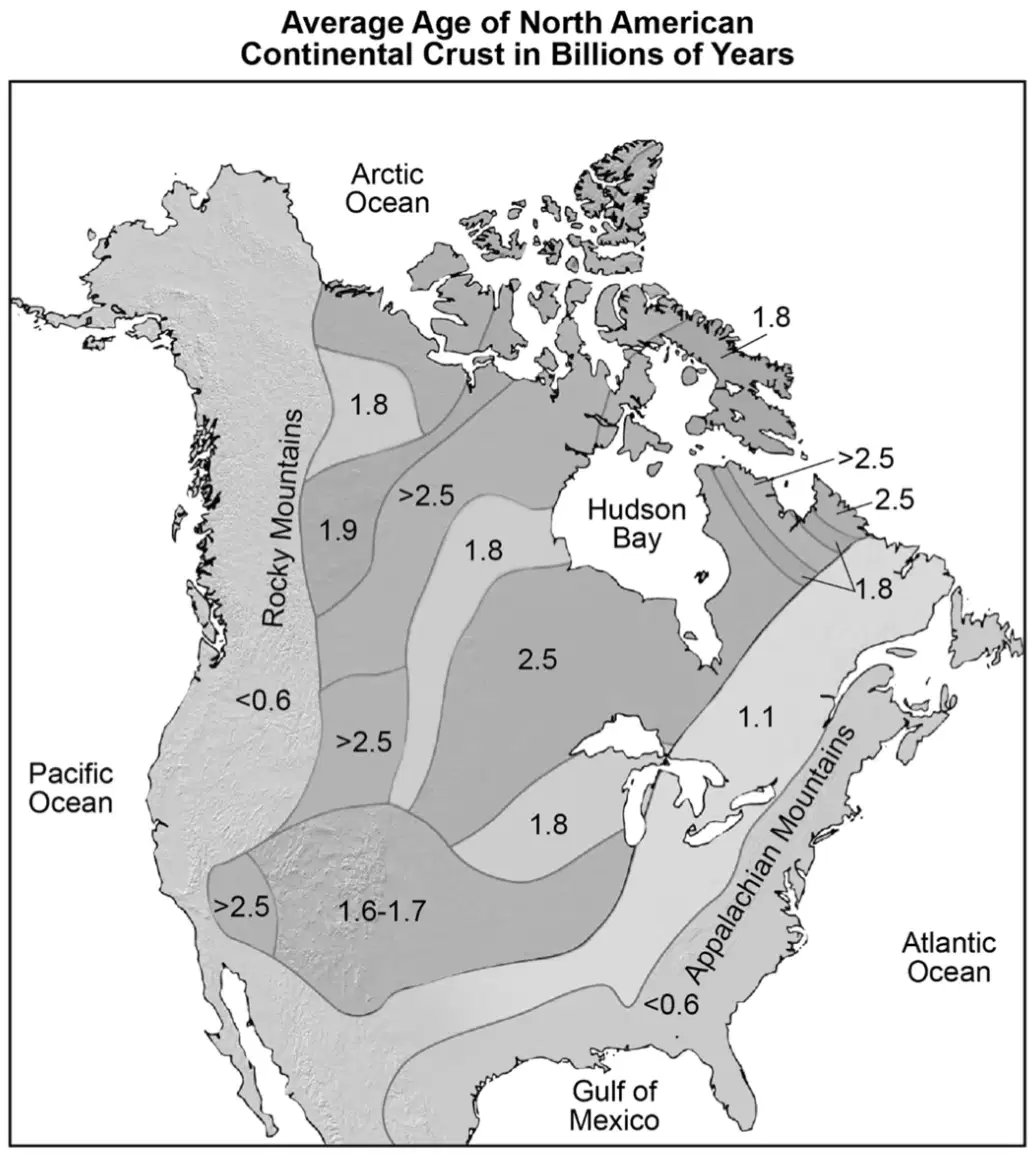
Based on the evidence from the map, which statement identifies the pattern of the ages of crustal rock in North America?
The oldest rocks are found in the Appalachian and Rocky Mountains.
The central region of the continent contains the oldest rocks, while the youngest rocks are found along the Atlantic and Pacific coasts.
The oldest rocks in North America are found along the Gulf of Mexico, and the youngest rocks
are found along the Hudson Bay.
Rocks of the same age are found along the entire coastline of North America.
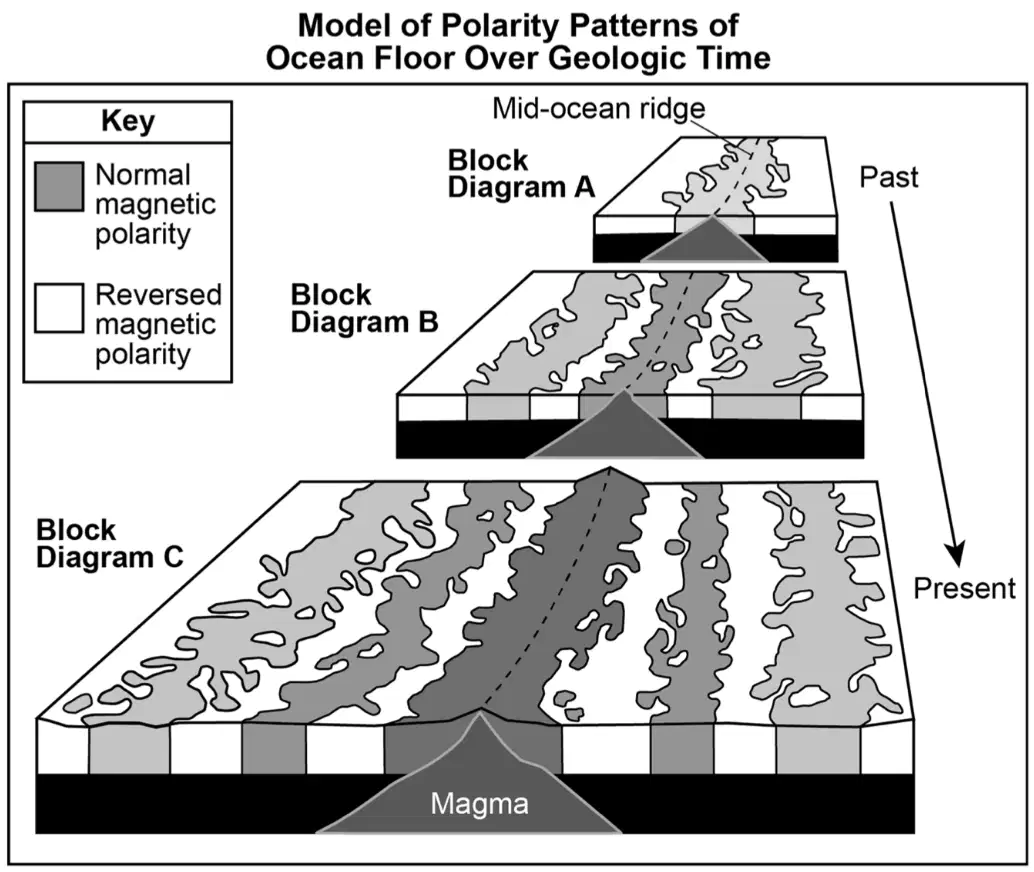
Which statement identifies the evidence for how the past and current movements of oceanic crust explain the ages of this oceanic floor rock?
The magnetic polarity rock closest to the mid-ocean ridge in block diagram A is younger than the reverse magnetic polarity rock closest to the mid-ocean ridge in block diagram B.
Oceanic crust at the mid-ocean ridge in block diagram A is now the youngest normal magnetic polarity rock found in block diagram C.
The reverse magnetic polarity rock in block diagram B is the same age as the normal magnetic polarity rock in block diagram B.
Oceanic crust at the mid-ocean ridge in block diagram A is now the oldest normal magnetic polarity rock found in block diagram C.

Iceland’s volcanic activity is due, in part, to the movement of the tectonic plates,
but is also intensified by a mantle plume directly under the island. A mantle
plume is a localized upwelling of hot rock material from deep within Earth’s
mantle. This plume provides an additional source of heat and magma, fueling
frequent eruptions and creating diverse volcanic landforms.
Which of these rock types would be found in abundance at the tectonic boundary on
Iceland? Support your answer with an explanation.

