
 Worksheets
FOSS EH Inv. 1-2 Review
Total questions: 20
Worksheet time: 21mins
Scientists who study Earth and use tools and models to study the rocks that make up the Earth.
Archeologist
Meteorologist
Seismologist
Geologist
Which is NOT a type of rock that makes up the sedimentary rock of the Grand Canyon?
Limestone
Cement
Shale
Sandstone
This reacts with acid to create fizzing and bubbling.
Salt
Calcite
CO2
Oxygen
The process by which rocks are broken down into smaller pieces WITHOUT CHANGING WHAT THE ROCK IS MADE OF.
Chemical weathering
Physical weathering
Freezing
Melting
A low-lying area where water may accumulate and there is no outlet
Lake
Pond
Basin
River
The movement of weathered earth materials by water, wind, or ice.
Deposition
Erosion
Weathering
Rivers
Limestone
Sandstone
Shale
Cement
In a canyon you can see different ________ of rock.
layers
puddles
people made
correlations
Strong wind and fast moving water carry
Some sediments
All sediments (big and small)
Only large pieces of rock
Only small pieces of rock
As water begins to slow down which sediments does it let go of first?
All sediments
Larger sediments
Medium sediments
Smaller sediments

Some students are testing rock samples they collected.
If you wanted to test these rocks for calcite, what would you put in the bottle and what would you expect to happen if calcite is there?
Put water in the bottle; if there is calcite, the rock will dissolve.
Put acid in the bottle; if there is calcite, the rock will fizz.
Put salt water in the bottle; if there is calcite, the rock will turn a darker color.
Put liquid soap in the bottle; if there is calcite, the liquid will form a dome on the rock.

Which size sediments would you most likely find at each location, X, Y, and Z? Explain why.
Which explanation best describes how a boulder can turn into silt as it moves down a river?
Water washes over the boulder until it is silt-sized.
The boulder moves down the river until it lands in a basin and becomes silt.
The boulder hits other rocks or objects and breaks apart.
A chemical reaction turns the boulder into silt.
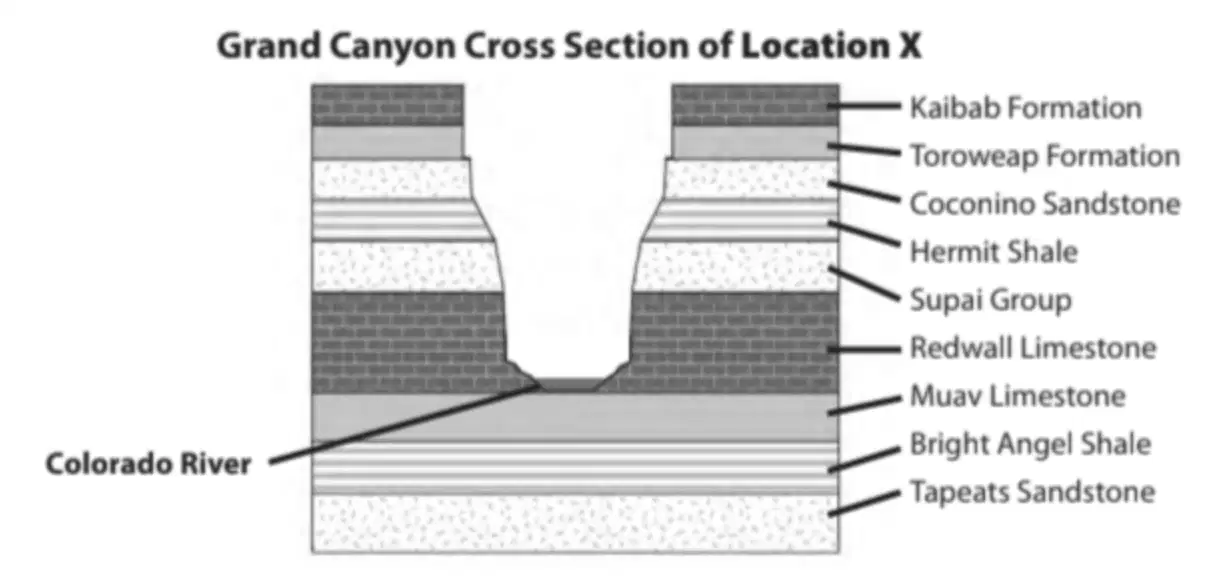
The Colorado River started eroding the Grand Canyon 6 million years ago.
Of the layers shown at location X, which two layers did the Colorado River erode away first?
Kaibab Formation and Toroweap Formation
Bright Angel Shale and Tapeats Sandstone
Redwall Limestone and Supai Group
All layers are eroded at the same time by the Colorado River.

