
 Worksheets
EXAM REVIEW - Electricity
Total questions: 122
Worksheet time: 1hrs 1mins
Name
Class
Date
1.
Electrical charge build up in one area of a substance
a)
A storm cloud
b)
Electric Force
c)
Static electricity
d)
Unlike charges
2.
Objects that LOSE electrons will have...
a)
Positive charge
b)
insulators
c)
No charge
d)
Negative charge
3.
Objects that GAIN electrons will have...
a)
Negative charges
b)
Neutral charges
c)
Like charges
d)
Positive charges
4.
Electrons have:
a)
Negative charges
b)
Neutral charges
c)
Positive charges
d)
No charge
5.
Protons have:
a)
Negative charges
b)
No charge
c)
Positive charges
d)
Neutral charges
6.
Symbol for electrons
a)
-
b)
+
c)
0
d)
None of these choices
7.
Symbol for protons
a)
+
b)
-
c)
None of these choices
d)
0
8.
Non metal substance that does not allow electrons to flow
a)
Metal
b)
Electrons
c)
Insulating material
d)
Conductive material
9.
A material that conducts heat or electricity well
a)
Insulator
b)
Conductor
c)
Insulating material
d)
Rubber
10.
They are the same force so they will REPEL one another
a)
Like charges
b)
+ and - charges
c)
Unlike charges
d)
- and 0 charges
11.
- - or + +
a)
Unlike charges
b)
Like charges
c)
Will attract
d)
Will not react
12.
They are the opposite force to one another so they ATTRACT each other
a)
Like charges
b)
+ and +
c)
Unlike charges
d)
0 and 0
13.
Electricity that DOES NOT move freely
a)
Current electricity
b)
Electrical current
c)
Static electricity
d)
Protons
14.
Attract
a)
UNLIKE charges
b)
+ and +
c)
Insulators and conductors
d)
LIKE charges
15.
Lets electricity flow through it
a)
Friction
b)
Conductor
c)
Insulator
d)
Electrons
16.
DOES NOT let electricity flow through it
a)
Insulator
b)
Friction
c)
Conductor
d)
Electrons
17.
We experience this if we discharge built up charge onto a door handle
a)
Sparking
b)
Discomfort
c)
Electrostatic shock
d)
Electricity
18.
Positive charges (+)...
a)
Are metals
b)
Move freely
c)
Are attracted to other +
d)
DO NOT move freely
19.
Rubbing two different materials together causes electrons to TRANSFER from one object to the other
a)
Grounding
b)
Charging by Induction
c)
Charging by Friction
d)
Slapping
20.
An object with a HIGHER electron affinity will
a)
Gain electrons more easily
b)
Lose electrons more easily
c)
Always become positive
d)
Always become neutral
21.
Like charges _________
a)
Attract
b)
Do not react
c)
Repel
d)
Pull towards each other
22.
Unlike charges
a)
Attract
b)
Repel
c)
Do not react
d)
Push away from each other
23.
Objects that __________ electrons become negatively charged
a)
Lose
b)
Gain
c)
Give up
d)
Have
24.

In charging by FRICTION, two objects start __________ and end up with __________ charges.
a)
NEUTRAL, OPPOSITE
b)
NEUTRAL, POSITIVE
c)
CHARGED, NEUTRAL
d)
NEUTRAL, NEGATIVE
25.
The greater the charge difference between a negative and positive object, the ____________ the _______________.
a)
STRONGER, ATTRACTION
b)
WEAKER, REPULSION
c)
WEAKER, ATTRACTION
d)
STRONGER, REPULSION
26.
contains an equal number of protons and electrons
a)
Positive charge
b)
Negative charge
c)
Neutral charge
d)
Electrons
27.
the law that states that like charges repel and opposite charges attract
a)
Electrostatic means that is electrical charge on the surface of a conductor or non conductor?
b)
charging by induction
c)
Protons are + or - ?
d)
Law of electric charges
28.
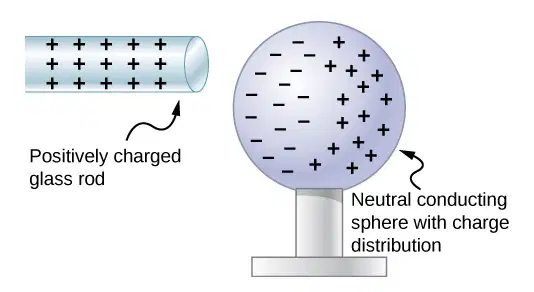
A SHIFT in the position of electrons in a neutral object that occurs when a CHARGED object is brought NEAR IT but not touching it
a)
Insulating material + friction =
b)
Objects that gain electrons become positively or negatively charged?
c)
What is an insulating material?
d)
Induced charge separation
29.
An instrument used to detect electric charge
a)
Law of electric charges
b)
Like charges
c)
Charge by conduction
d)
Electroscope
30.
In charging by CONTACT, what happens when a NEGATIVE rod touches a NEUTRAL ball?
a)
Rod = POSITIVE
Ball = NEGATIVE
b)
Rod = POSITIVE
Ball = POSITIVE
c)
Rod = NEGATIVE
Ball = NEGATIVE
d)
Rod = NEUTRAL
Ball = NEUTRAL
31.
Insulators
a)
Has more electrons than protons
b)
A buildup of charges on an object.
c)
materials that prevent electric charges from flowing through them easily
d)
materials that allow electric charges to flow through them easily
32.
Conductors
a)
materials that allow electric charges to flow through them easily
b)
materials that prevent electric charges from flowing through them easily
c)
two neutral objects rub together and one becomes positively charged and the other becomes negatively charged
d)
Has more protons than electrons
33.
Neutral objects
a)
Has more electrons than protons
b)
Has more protons than electrons
c)
Has equal numbers of protons and neutrons
d)
materials that prevent electric charges from flowing through them easily
34.
Positively charged objects
a)
Has more electrons than protons
b)
Has more protons than electrons
c)
materials that prevent electric charges from flowing through them easily
d)
Charging an object by allowing it to come into contact with an object that already has an electrical charge
35.
Negatively charged objects
a)
two neutral objects rub together and one becomes positively charged and the other becomes negatively charged
b)
materials that allow electric charges to flow through them easily
c)
A buildup of charges on an object.
d)
Has more electrons than protons
36.
Static electricity
a)
Has equal numbers of protons and neutrons
b)
A buildup of charges on an object.
c)
materials that allow electric charges to flow through them easily
d)
Charging an object by allowing it to come into contact with an object that already has an electrical charge
37.

A negatively charged rod is brought NEAR a neutral ball that is not grounded.
a)
Electrons (-) in the ball will move TOWARDS the rod
b)
Protons (+) in the ball will move TOWARDS the rod
c)
Electrons (-) in the ball will move as far AWAY FROM the rod as possible
d)
Protons (+) in the ball will move as far AWAY FROM the rod as possible
38.
A NEGATIVELY charged rod is brought near a grounded NEUTRAL ball
a)
The electrons (-) from the ball go into the ground. (Path to escape) Ball becomes +
b)
The electrons (-) from the ball go into the ground. (Path to escape) Ball becomes neutral 0
39.
A POSITIVELY charged rod is brought near a grounded NEUTRAL ball.
a)
Negative Electrons (-) are attracted to positive charges in rod. Ball becomes NEUTRAL
b)
Negative Electrons (-) are attracted to positive charges in rod. Ball becomes NEGATIVELY charged.
40.
Induced charge separation
a)
When a charge object can charge a neutral object WITHOUT (no) TOUCHING when neutral object is grounded.
b)
Occurs when a charged object placed near a neutral object causes the charges (electrons) to shift within the neutral object.
41.
Charging by Friction
a)
A grounded neutral ball is placed on the ground and a positively charged rod is brought near it.
b)
When two objects of different materials are rubbed together and charges move from low electron affinity to high electron affinity.
c)
A positively charged rod is brought near a neutral ball not grounded.
d)
When an object is connected to the Earth (ground). NEEDED for charging by induction
42.

A POSITIVELY charged rod is brought near a NEUTRAL ball that is not grounded.
a)
Electrons (-) will attract TOWARDS the rod
b)
Protons (+) will move TOWARDS the rod
c)
Electrons (-) will repel AWAY FROM the rod as far possible
d)
Protons (+) will move as far AWAY FROM the rod as possible
43.
Induced charge separation is ____________.
a)
Permanent
b)
Temporary
c)
Friction
d)
Conduction
44.

Rubber and glass are rubbed together. Which will become NEGATIVE?
a)
Rubber
b)
Glass
c)
Both
d)
None
45.

Nylon and hair are rubbed together. Which will become POSITIVE?
a)
Nylon
b)
Hair
c)
Both
d)
None
46.
Which method of charging RUBS two NEUTRAL objects together to charge them?
a)
Induction
b)
Conduction
c)
Friction
d)
All of the above
47.
The flow of electricity through a circuit.
a)
Current electricity
b)
Static electricity
c)
Heat energy
d)
Thermal energy
48.
Current is measured in...
a)
Amperes (Amps)
b)
Volts
c)
Ohms
d)
All of the above
49.
Potential Difference (Voltage) is measured in...
a)
Amperes
b)
Volts
c)
Ohms
d)
All of the above
50.
Resistance is measured in...
a)
Amperes
b)
Volts
c)
Ohms
d)
All of the above
51.
A series circuit has...
a)
Only one path for electrons to flow
b)
Multiple pathways for each load
c)
Only 3 pathways
d)
Only 2 pathways
52.
A parallel circuit has...
a)
Only one path for electrons to flow
b)
Multiple pathways for each load
c)
Only 3 pathways
d)
Only 2 pathways
53.
The opposition of flow of electrons
a)
Current
b)
Potential difference
c)
Resistance
d)
Electricity
54.
The rate of how much electric charge flows per second
a)
Current
b)
Potential difference
c)
Resistance
d)
Electricity
55.
How much electric potential energy is carried per unit of charge
a)
Current
b)
Potential difference (Voltage)
c)
Resistance
d)
Electricity
56.
Potential difference
a)
Resistance
b)
Current
c)
Voltage
d)
Energy
57.
High resistance means there is...
a)
HIGH amount of current flowing through the circuit
b)
LOW amount of current flowing through the circuit
58.
Low resistance means there is....
a)
HIGH amount of current flowing through the circuit
b)
LOW amount of current flowing through the circuit
59.
Ω Measured in Ohms
a)
Voltage
b)
Current
c)
Energy
d)
Resistance
60.

Materials which don't allow electric current to flow freely
a)
Insulators
b)
Electricity
c)
Resistors
d)
Conductors
61.

Substances or objects which allow electrical currents to pass through, because they have lots of free charges. Metals are an example, because they contain free electrons, which can move with the current.
a)
Electricity
b)
Conductors
c)
Series circuit
d)
Resistors
62.
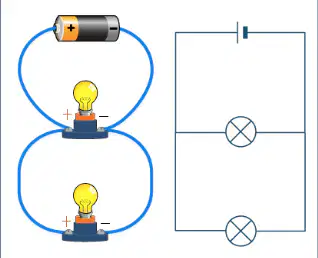
An electric circuit that has two or more pathways for electric current to take. Some of the moving charges travel through one pathway of the circuit, and other moving charges travel through other pathways of the circuit.
a)
Conductors
b)
Series Circuit
c)
Electricity
d)
Parallel Circuit
63.

An electric circuit that has only one pathway for electric current to take. You can think of this type of circuit as a set of parts that are connected end to end.
a)
Parallel circuit
b)
Electricity
c)
Series circuit
d)
Resistor
64.

A device used to introduce some amount of resistance into a circuit.
a)
Potentiometer
b)
Load
c)
Resistor
d)
Switch
65.
battery
a)
A device that converts chemical energy to electrical energy
b)
A circuit made of 3 parts: One Energy Source, One Energy Path, One Energy User
c)
a metallic conductor, especially one made of copper, usually insulated, and used to carry electric current in a circuit.
d)
a resistor that makes sound
66.
open circuit
a)
a complete circuit through which electricity flows
b)
a resistor that makes sound
c)
A device used to measure voltage, or electrical potential energy difference
d)
an incomplete electrical circuit in which no current flows
67.
lamp or bulb
a)
converts electrical energy into light and heat energy
b)
a metallic conductor, especially one made of copper, usually insulated, and used to carry electric current in a circuit.
c)
Converts electrical energy into kinetic energy.
d)
a complete circuit through which electricity flows
68.
Wire
a)
a resistor that makes sound
b)
Converts electrical energy into mechanical energy.
c)
light bulb
d)
A metallic conductor, especially one made of copper, usually insulated, and used to carry electric current in a circuit.
69.
motor
a)
a complete circuit through which electricity flows
b)
an incomplete electrical circuit in which no current flows
c)
Converts electrical energy into mechanical energy.
d)
light bulb
70.
closed circuit
a)
A device used to measure voltage, or electrical potential energy difference
b)
A device used to measure current in a circuit
c)
A circuit made of 3 parts: One Energy Source, One Energy Path, One Energy User
d)
a complete circuit through which electricity flows
71.
switch
a)
a complete circuit through which electricity flows
b)
a device that opens or closes a circuit
c)
A metallic conductor, especially one made of copper, usually insulated, and used to carry electric current in a circuit.
d)
Slows current down in a circuit
72.
ammeter
a)
A circuit made of 3 parts: One Energy Source, One Energy Path, One Energy User
b)
A device used to measure voltage, or electrical potential energy difference
c)
A metallic conductor, especially one made of copper, usually insulated, and used to carry electric current in a circuit.
d)
A device used to measure current in a circuit
73.
voltmeter
a)
Converts electrical energy into mechanical energy.
b)
A circuit made of 3 parts: One Energy Source, One Energy Path, One Energy User
c)
A device used to measure current in a circuit
d)
A device used to measure voltage, or electrical potential energy difference
74.
Formula to find CURRENT:
a)
I = R/V
b)
I = VR
c)
I = V/R
d)
V = R + V
75.
Formula to find VOLTAGE:
a)
V =RI
b)
V = IR
c)
V= RI
d)
I = VR
76.
Formula to find RESISTANCE:
a)
R =VI
b)
R = IV
c)
R= VI
d)
R = V
77.

What will happen if you unscrew ONE of the light bulbs in this series circuit?
a)
The other will stay on
b)
The other bulb gets brighter
c)
The other bulb will go out
d)
Nothing will happen
78.
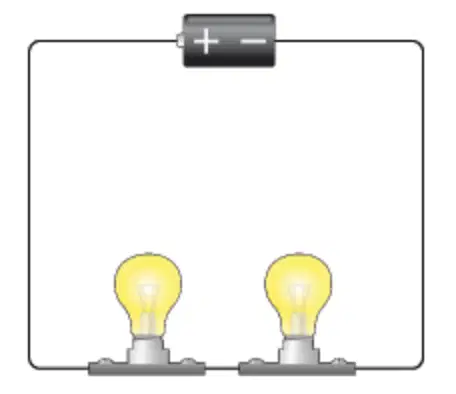
What will happen if you add ANOTHER light bulb in series with these bulbs?
a)
The other bulbs will get brighter
b)
The bulbs will all have the same brightness
c)
All the bulbs will get less bright
d)
Nothing will happen
79.
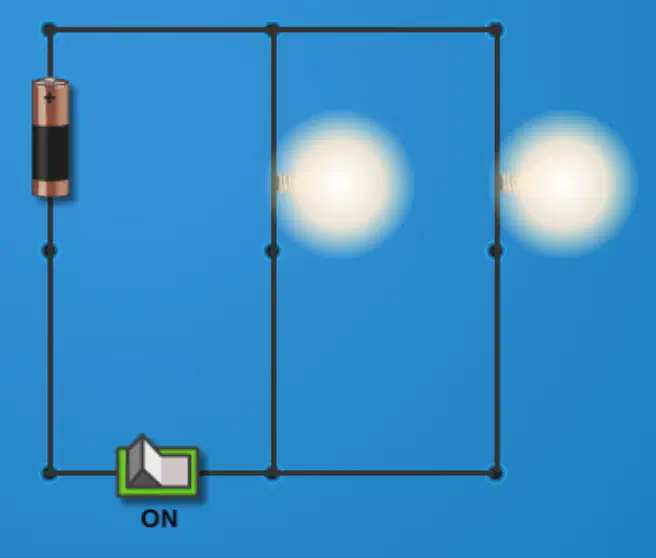
What will happen if you unscrew ONE of the light bulbs in this parallel circuit?
a)
The other will stay on
b)
The other bulb gets brighter
c)
The other bulb will go out
d)
Nothing will happen
80.
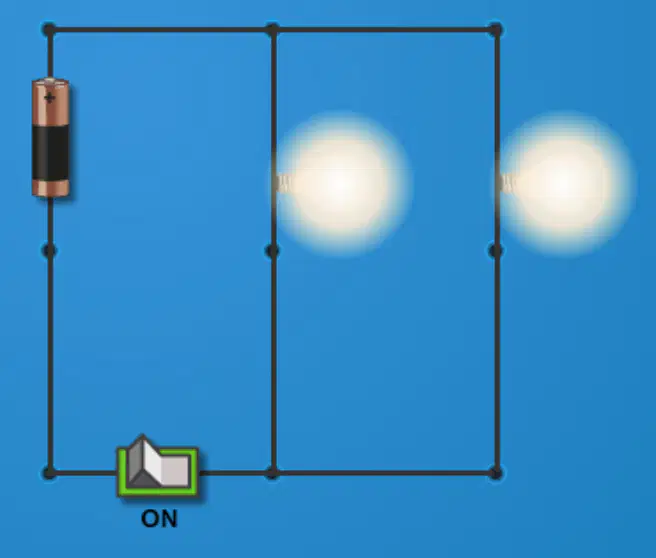
What will happen if you add ANOTHER light bulb in parallel with these bulbs?
a)
The other bulbs will get brighter
b)
The bulbs will all have the same brightness
c)
All the bulbs will get less bright
d)
Nothing will happen
81.

Which switches need to be closed to make only BULB 2 go on?
a)
Switch A, B and C
b)
Switch A & B
c)
Switch A & C
d)
Switch B & C
82.

Which switches need to be closed to make only BULB 2 go on?
a)
Switch A, B and C
b)
Switch A & B
c)
Switch A & C
d)
Switch B & C
83.

The following shows... (keep in mind the arrows are showing conventional circuit flow, not electron flow which would be - to +)
a)
A short circuit
b)
A 2-cell battery
c)
A series circuit
d)
All of the above
84.
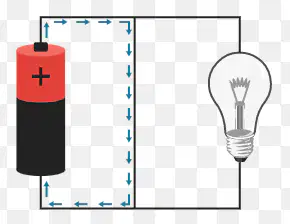
A short circuit...
a)
Has very LOW resistance
b)
Can overheat and cause a fire
c)
Has extremely high current flowing since there are no resistors or loads
d)
All of the choices are correct
85.

How is resistance useful in a hair dryer?
a)
Converts electrical energy to heat and kinetic energy
b)
Converts electrical energy to light and kinetic energy
c)
Converts electrical energy to potential and chemical energy
d)
Converts electrical energy to potential and kinetic energy
86.
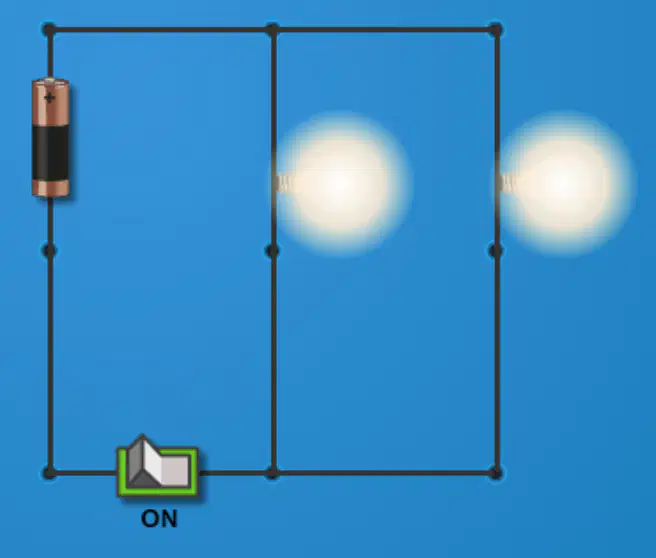
What will happen if you add ANOTHER CELL (to make a 2-cell battery) to this parallel circuit?
a)
The bulbs will have the same brightness
b)
The bulbs will get brighter and have the same brightness
c)
The bulbs will decrease in brightness
d)
The bulbs will go out
87.

If the total voltage of the circuit shown is 10V, Voltage at bulb 1 and 2 would be...
a)
5 V
b)
10 V
88.

If the total CURRENT of the circuit shown is 8 A , current at bulb 1 and 2 would be...(assume they have the same resistance)
a)
8 A
b)
4 A
89.

If the total CURRENT of the circuit shown is 8 A , current at bulb 1 and 2 would be...(assume they have the same resistance)
a)
8 A
b)
4 A
90.
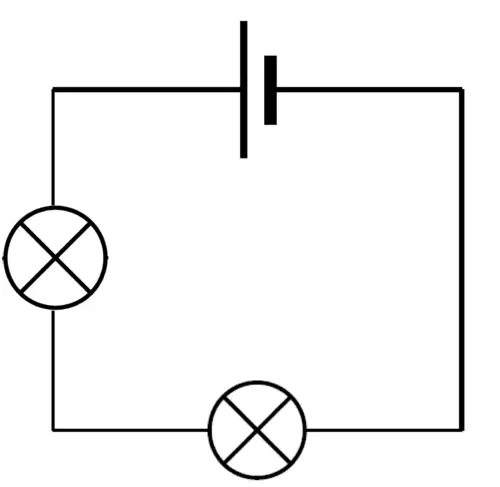
If the total VOLTAGE of the circuit shown is 10V, Voltage at bulb 1 and 2 would be...
a)
5 V
b)
10 V
91.
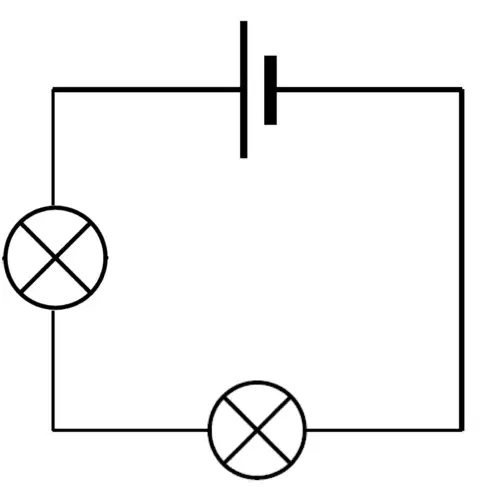
Which formula is used to find VOLTAGE in SERIES circuits?
a)
VT=V1 + V2 + V3 ... +Vn
b)
VT=V1 = V2 = V3 ...= Vn
92.
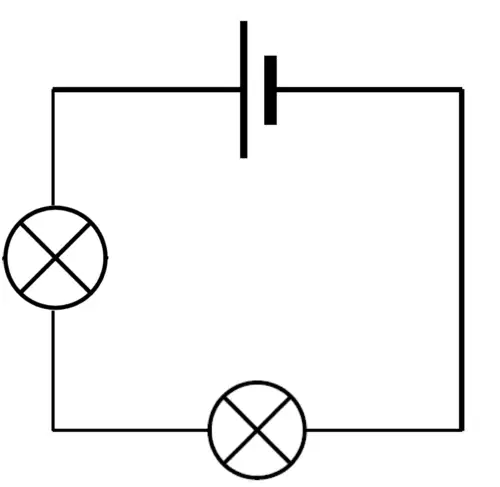
Which formula is used to find CURRENT in SERIES circuits?
a)
IT=I1 + I2 + I3 ... +In
b)
IT=I1 = I2 = I3 ...= In
93.
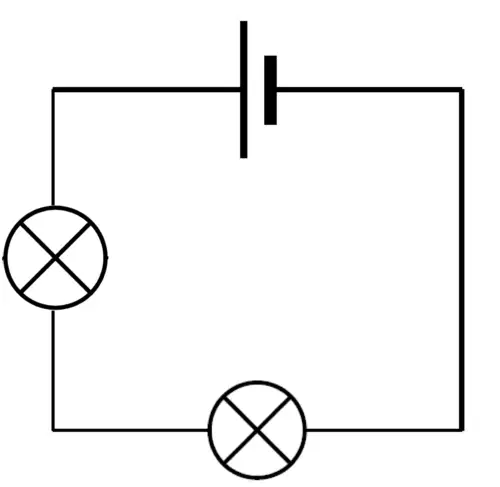
If the TOTAL CURRENT in a SERIES circuit is 12A, the current flowing through each bulb is ____.
a)
12A; The same at all points throughout the circuit
b)
6A; The sum of the current running through each pathway
94.

If the TOTAL VOLTAGE in a SERIES circuit is 10V, the voltage (potential difference) across each bulb is ____.
a)
10V; The same at all points throughout the circuit
b)
5V; The sum of the voltage across each load
95.

If the TOTAL CURRENT in a PARALLEL circuit is 12 A, the current passing through each bulb is _____.
a)
12A; The same at all points throughout the circuit
b)
6A; The sum of the branches of current running through each pathway
96.
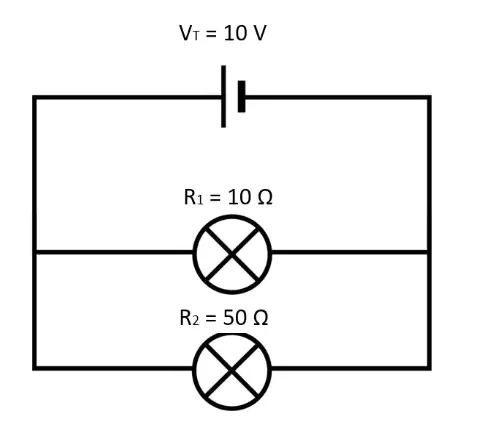
If total voltage in a PARALLEL circuit is 10V, the voltage at each load will be _____.
a)
The same at all points; 10V
b)
The sum of the voltage across each load; 5V
97.
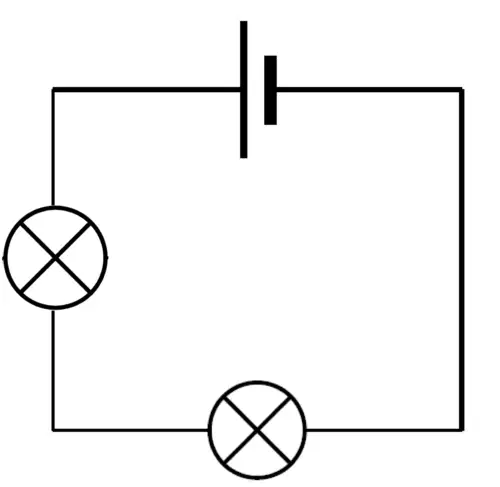
If the TOTAL RESISTANCE in a SERIES circuit is 10 ohms, the resistance at each bulb is ____.
a)
The same at all points throughout the circuit (10 ohms at each bulb)
b)
The sum of the resistance of each load/each resistor in the circuit (5 ohms at each bulb)
98.

Which formula is used to find VOLTAGE in PARALLEL circuits?
a)
VT=V1 + V2 + V3 ... +Vn
b)
VT=V1 = V2 = V3 ...= Vn
99.
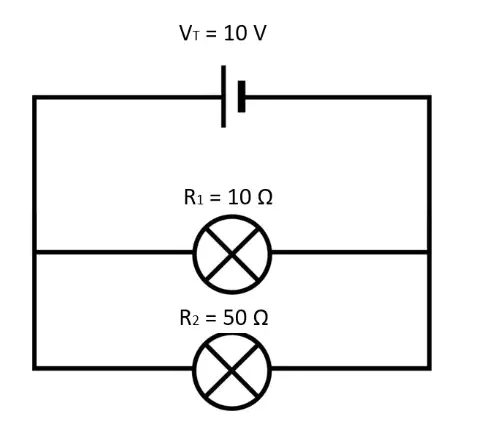
Which formula is used to find CURRENT in PARALLEL circuits?
a)
IT=I1 + I2 + I3 ... +In
b)
IT=I1 = I2 = I3 ...= In
100.
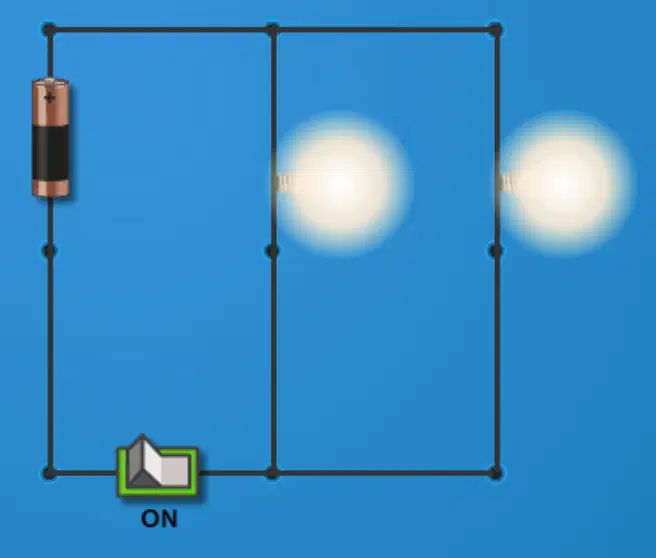
What will happen if you add another bulb in parallel to the existing bulbs?
a)
The voltage across each bulb will INCREASE
b)
The voltage across each bulb will DECREASE
c)
The voltage across each bulb will stay the same
101.
Holiday lights are often connected in series. What happens when a single light goes out and why?
a)
All lights go out because a surge burns the others out
b)
All lights go out because the circuit is disconnected and current can't travel to other bulbs
c)
The lights will stay on because there are alternative paths for current to travel
d)
The lights will The lights stay on because only one burned out
102.
Your bedroom has lights in series. What will happen to the voltage drop if you add two more lights in series?
a)
The voltage of each bulb will INCREASE because you're adding more bulbs
b)
The voltage of each bulb will INCREASE because you're lowering resistance
c)
The voltage of each bulb will DECREASE because the total voltage is divided between more bulbs
d)
The voltage of each bulb will DECREASE because the total voltage decreases
103.
An AMMETER is hooked up...
a)
In parallel to other components
b)
In series with other components
104.
A VOLTMETER is hooked up...
a)
In parallel to components being measured
b)
In series with components being measured
105.
Which direction does electricity flow?
a)
From (+) end of battery to (-) end
b)
From (-) end of battery to (+) end
c)
Clockwise
d)
Counter- clockwise
106.
Transforms electrical energy into other forms of energy
a)
a load
b)
energy source
c)
conductor
d)
switch
107.
Provides a pathway for electric current to flow
a)
a load
b)
energy source
c)
conductor
d)
switch
108.
Supplies electrons with energy to flow
a)
a load
b)
energy source
c)
conductor
d)
switch
109.
Controls the flow of electric current in a circuit by opening or closing it
a)
a load
b)
energy source
c)
conductor
d)
switch
110.
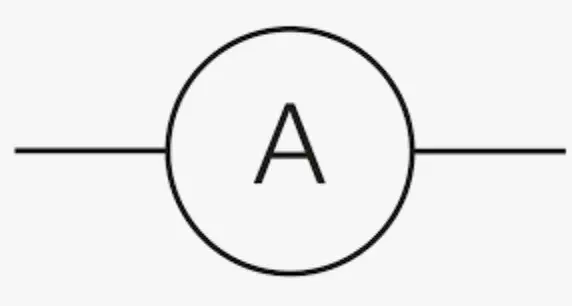
Which symbol is this?
a)
Ammeter
b)
Voltmeter
c)
Fuse
d)
Amps
111.

Which symbol is this?
a)
Volts
b)
Voltmeter
c)
Very high current
d)
Load
112.
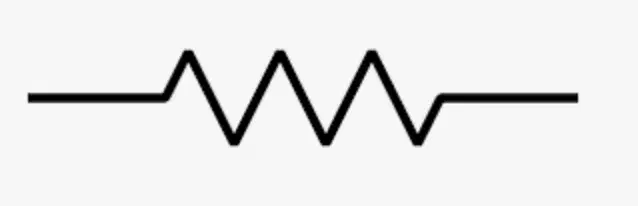
Which symbol is this?
a)
Load
b)
Switch
c)
Current
d)
Resistor
113.

Which symbol is this?
a)
Closed switch
b)
Resistor
c)
Open switch
d)
Circuit break
114.
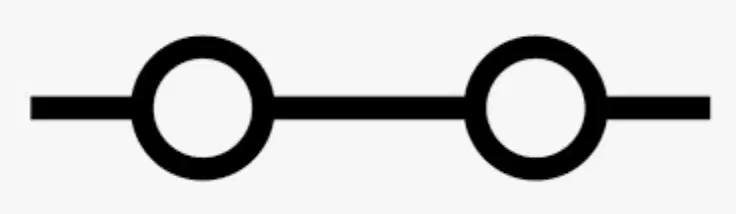
Which symbol is this?
a)
Closed switch
b)
Resistor
c)
Open switch
d)
Circuit break
115.

Which symbol is this?
a)
Resistor
b)
Voltmeter
c)
Ohmmeter
d)
Load (and often used for bulb)
116.
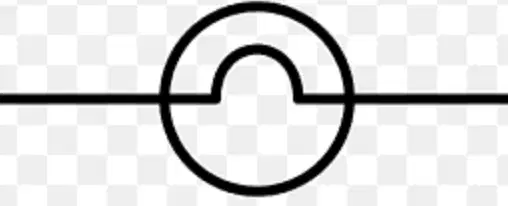
Which symbol is this?
a)
Load
b)
Bulb/lamp
c)
Resistor
d)
Ohmmeter
117.

This is a...
a)
1-cell battery
b)
Cell
c)
2-cell battery
d)
Resistor
118.

This is a...
a)
Cell
b)
2-cell battery
c)
Battery
d)
Source
119.

Which formula is used to find total RESISTANCE in SERIES circuits?
a)
RT= R1 + R2+R3 + ... Rn
b)
RT= R1 = R2=R3 = ... Rn
c)
1RT = 1R1+1R2+1R3+...1Rn
120.

Which formula is used to find total RESISTANCE in PARALLEL circuits?
a)
RT= R1 + R2+R3 + ... Rn
b)
RT= R1 = R2=R3 = ... Rn
c)
1RT = 1R1+1R2+1R3+...1Rn
121.
Which method of charging TOUCHES a CHARGED object to a NEUTRAL object?
a)
Induction
b)
Conduction
c)
Friction
d)
All of the above
122.
Object G is positive. G attracts F, while F repels E.
What charge does object E have?
a)
positive
b)
negative
c)
neutral
d)
impossible to know
100 %

