
 Worksheets
Periodic Table Review Quiz
Total questions: 66
Worksheet time: 1hrs 9mins
What is the periodic table?
A chart of all known elements organized by their properties
A list of chemical reactions
A table of mathematical formulas
A chart of historical events
Who first discovered a trend in the elements?
Johann Dobereiner
Dmitri Mendeleev
John Newlands
Henry Mosely
Who is given credit for inventing the first periodic table?
Johann Dobereiner
Dmitri Mendeleev
John Dalton
Henry Moseley
What changes did the periodic table undergo?
It was turned into a digital format
Elements were added and organized by atomic number
It was translated into multiple languages
It was divided into two separate tables
How is the periodic table now organized?
By the date of discovery
By atomic number and chemical properties
Alphabetically by element name
By color and shape
Who proposed the Law of Octaves in chemistry?
Dmitri Mendeleev
John Dalton
John Newlands
Johann Dobereiner
Made first orderly arrangement of all the elements known
Dmitri Mendeleev
John Dalton
John Newlands
Johann Dobereiner
Who proposed the Law of Triads in chemistry?
Dmitri Mendeleev
John Dalton
John Newlands
Johann Dobereiner
According to John Newlands, how were the elements arranged?
By decreasing atomic mass
By increasing atomic mass
By increasing atomic number
By decreasing atominc number
Who is credited with the first orderly arrangement of all 63 elements based on increasing atomic mass and periodic properties?
John Newlands
Johann Dobereiner
Dmitri Mendeleev
Henry Mosely
What did Dmitri Mendeleev have to do in order to make sense of the periodic table?
Add more elements
Remove some elements
Leave some gaps in the table
Change the order of elements
What was one of the interesting observations made by Mendeleev about the periodic table?
Elements were arranged by atomic number
Gaps in the table predicted the existence of undiscovered elements
All elements fit perfectly in order of atomic mass
Elements were grouped by color
What credit is Mendeleev given in the field of chemistry?
Discovering the electron
Creating the first periodic table
Developing the theory of relativity
Inventing the microscope
According to the modern periodic law, how are elements arranged?
By increasing atomic mass
By increasing atomic number
By alphabetical order
By decreasing atomic number
Which group of elements was not placed on Moseley's periodic table?
Alkali metals
Halogens
Noble gases
Transition metals
What is a characteristic property of noble gases?
Highly reactive
Unreactive
Metallic
Radioactive
Which element is located in Group 1 and Period 2 of the periodic table?
Helium (He)
Lithium (Li)
Beryllium (Be)
Hydrogen (H)
Which of the following elements is a noble gas?
Nitrogen (N)
Oxygen (O)
Argon (Ar)
Chlorine (Cl)
Which element is in Group 17 and Period 3?
Fluorine (F)
Chlorine (Cl)
Bromine (Br)
Iodine (I)
Where are metals located on the periodic table?
On the right of the staircase
On the left of the staircase
Touching the staircase
Above the staircase
Which element is an exception to the location of metals on the periodic table?
Helium
Hydrogen
Aluminum
Carbon
Where are non-metals located on the periodic table?
On the left of the staircase
Touching the staircase
On the right of the staircase
Below the staircase
Which element is a non-metal but located on the left of the staircase?
Helium
Hydrogen
Aluminum
Carbon
What are metalloids on the periodic table?
Elements on the left of the staircase
Elements on the right of the staircase
Elements touching the staircase
Elements above the staircase
How are elements arranged in groups on the periodic table?
Horizontally
Vertically
Diagonally
Randomly
How are elements arranged in periods on the periodic table?
Vertically
In circles
Horizontally
In zigzags
What is the period number for the element with the symbol 'P'?
3
4
5
6
Which of the following is a characteristic of alkali metals?
Hard and brittle
Soft, silvery colored metals
Non-reactive
Dense and heavy
What is a common property of alkali metals?
Very reactive
Poor conductors of electricity
High melting points
Non-metallic
Which of the following alkali metals is known to react vigorously with water?
Lithium
Beryllium
Magnesium
Calcium
What would you expect from Francium when it reacts with water?
No reaction
Mild reaction
Vigorous reaction
Dissolves slowly
Select all that arranged elements by atomic mass
Johann Doberreiner
John Newlands
Dmitri Mendeleev
Henry Mosely
Select all that arranged elements by atomic number
Johann Doberreiner
John Newlands
Dmitri Mendeleev
Henry Mosely
Why were noble gasses not disovered until later in history?
they are unreactive
they didn't have the instruments
they didn't want to
who knows
What is the most reactive metal
Lithium
Potassium
Francium
Rubidium
What is the most reactive nonmetal?
Hydrogen
Phosphorus
Fluorine
Chlorine
What type of gasses are mostly in neon lights
Halogens
Noble Gasses
Chalcogens
Nitrogen and Oxygen
Elements in this group react with water
Alkaline Earth Metals
Alkali Metals
Transition Metals
Halogens
Used in WW1 and WW2
Oxygen
Iodine
Bromine
Chlorine
How many elements occur naturally?
92
72
118
52
Malleable?
Conducts Electricity
Bent or hammered into sheets
Drawn into wires
Conducts heat
Ductile?
Conducts Electricity
Bent or hammered into sheets
Drawn into wires
Conducts heat
Can cut this group with a butter knife
alkali
lanthanide
transition
alkline earth
most reactive group of metals
metalloids
transition
alkali
alkaline earth
most reactive group of nonmetals
chalcogens
halogens
noble gasses
other nonmetals
least reactive group of all on periodic table
chalcogens
metalloids
noble gasses
inner transition
Which of the following elements is a transition metal?
Sodium (Na)
Iron (Fe)
Neon (Ne)
Phosphorus (P)
What property is common to all noble gases?
Ability to form salts
Colorless and odorless
Metallic luster
High reactivity
Who introduced the concept of atomic number for arranging elements?
John Dalton
Henry Moseley
Marie Curie
Dmitri Mendeleev

Which group is represented here?
Alkaline Earth Metals
Halogens
Noble Gasses
Alkali Metals

Which group is shown in this image
Transition Metals
Alkali Earth Metals
Noble Gasses
Halogens

Which group is shown?
Halogens
Noble Gasses
Metalloids
Alkali Metals

Which group is shown in this image?
Noble Gasses
Lanthanides
Actinides
Halogens

Which groups are shown in this image?
Lanthanides and Actinides
Transition Metals
Alkali Metals
Halogens

Which group is shown in this image?
Non Metals
Metalloids
Halogens
Noble Gasses
Which is true about the Noble Gasses?
They are highly reactive
They RARELY react
They react when they feel like it
They don't Exist.

What is the name of the group that contains highly reactive nonmetals, each with 7 valence electrons?
Noble Gases
Halogens
Alkaline Earth Metals
Metalloids

What is the name of the group that contains highly reactive metals, each with 1 valence electron?
Noble Gases
Halogens
Alkali Metals
Rare Earth Metals
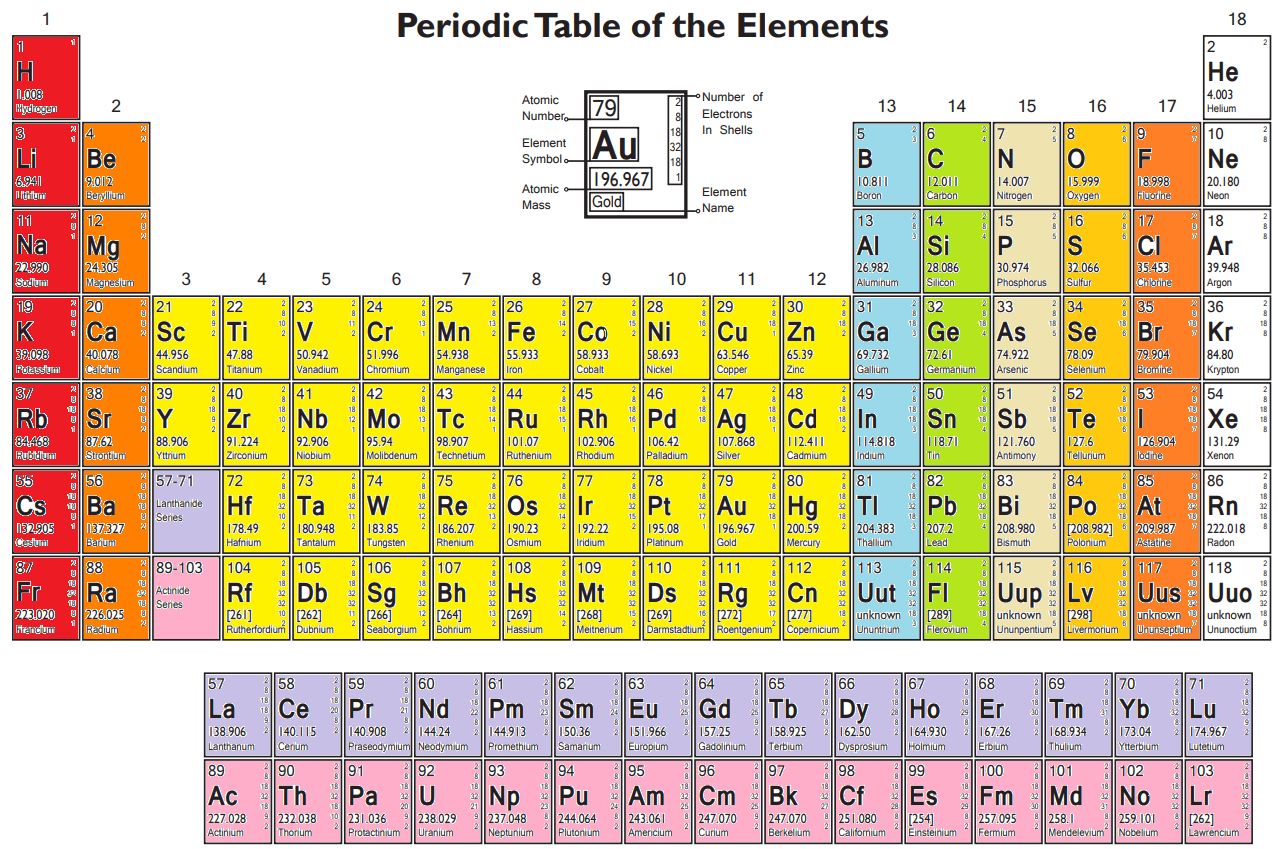
How many groups and periods are on the Periodic Table?
¿Cuántos grupos y períodos hay en la tabla periódica?
18 Periods
7 Groups
18 Groups
7 Periods
Unknown
Desconocido
Who developed the first periodic table?
Mendelev
Einstein
Newton
Galileo
Where are the alkali metals located?
Where are the rare Earth metals (lanthanide series) located?
Where are the Noble gases located?
Where are the alkaline Earth metals located?
Where are the transition metals located?
Where are the halogens located?

