
NEW
Font size
 Worksheets
Judicial Branch Concepts and Principles
Total questions: 20
Worksheet time: 10mins

Which option completes this process?
Cross-Examine
Witness Testimony
Investigation
Verdict
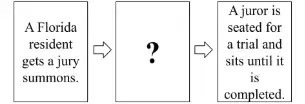
Which statement completes this diagram?
The jury pool listens to arguments and delivers a verdict.
Attorneys narrow the jury pool through the voir dire process.
Attorneys identify a foreperson to speak on behalf of the jury pool.
The jury pool meets with court clerks to determine any biases that would affect the trial.

Which option best completes the diagram?
Edits laws
Writes laws
Approves laws
Interprets laws
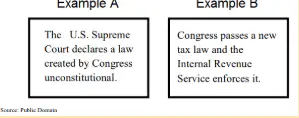
These boxes describe two events relating to the U.S. government.
Example A: separation of powers; Example B: individual rights
Example A: checks and balances; Example B: judicial review
Example A: separation of powers; Example B: checks and balances
Example A: checks and balances; Example B: separation of powers
Which option below best describes the power of judicial review?
The power of the legislative branch to interpret a law
The power of the lower courts to interpret the constitution
The power of the president to decide if a law is unconstitutional
The power of the supreme court to decide if a law is unconstitutional
Which Article of the U.S. Constitution outlines the purposes and functions of the Judicial Branch of government?
Article 1
Article 2
Article 3
Article 4
Which principle does the US Supreme Court apply when it declares an act of Congress unconstitutional?
Separation of powers
Checks and balances
Advice and consent
Executive privilege

What is the proper court based
on the sequence?
Bankruptcy Court
Circuit Court
Municipal Court
U.S. Court of Appeals
Sam Morgan is convicted of committing mail fraud by the U.S. District Court for the Southern District of Florida. Sam believes the judge was unfairly biased against him. To which court should he send his appeal?
U.S. Supreme Court
Florida Circuit Court
U.S. Court of Appeals
Florida Supreme Court
If a case went from the US District Court to the US Circuit Court of Appeals, what would the next stop be?
U.S. Supreme Court
Florida Supreme Court
County Court
Trial Court

What type of hearing is best described in the picture?
Appellate review
Bench trial
Indictment
Trial by Jury
What was the Supreme Court’s ruling in Marbury v. Madison?
The judicial branch has the power to review the other branches’ actions.
Students do not shed their First Amendment rights at the schoolhouse gate.
The President of the United States is not above the law.
Separate is inherently not equal in schools.
What was the significance of the Supreme Court’s ruling in In re Gault?
Minors are required to attend school until the age of 16.
Minors could be tried as adults if they were charged with a violent crime.
Minors are not be required to have parents present during interrogations.
Minors are entitled to due process and other constitutional protections.
Which was an outcome of the U.S. Supreme Court decision in Brown v. Board of Edu. (1954)?
Administrators may limit the content of student publications.
Public school districts that segregate deny equal protection.
Students have a reduced expectation of privacy in school.
Criminal defendants have the right to an attorney.
How did the decision in Plessy v. Ferguson differ from that of Brown v. Board of Education?
Brown overturned Plessy decision regarding racial segregation.
Plessy overturned Brown decision regarding racial segregation.
Brown protected the rights of the accused more than Plessy.
Plessy protected the right to an attorney more than Brown.
What was the significance of the Supreme Court decision in Brown v. Board of Education?
Individuals accused of serious crimes unable to pay for an attorney were entitled to a state-sponsored one.
The 2nd Amendment protects an individual’s right to keep handguns at home for self-defense.
States could no longer maintain racially segregated public schools.
The Court has the power to mediate disputes
between different states.
What was the significance of the
Supreme Court decision in Gideon v. Wainwright?
Individuals accused of serious crimes unable to pay for an attorney were entitled to a state-sponsored one.
The 2nd Amendment protects an individual’s right to keep handguns at home for self-defense.
Southern states could no longer maintain racially segregated public schools.
The Court has the power to mediate disputes between different states.
The Supreme Court case Miranda v. Arizona established rights for citizens who are accused of a crime. What is the purpose of giving rights to citizens accused of a crime?
The accused is more likely to receive justice.
The number of people in prison will decrease.
The government’s role is to cares for its citizens.
People will lose all sense of hope without their rights.
What was the result of the Supreme Court decision in Plessy v. Ferguson?
"Black Codes" were ruled to be unconstitutional.
It permitted the placing of Indians onto reservations.
The doctrine of "separate but equal" became legalized.
It said that children of all races could attend the same schools.
How did the Supreme Court decisions in Gideon v. Wainwright and Miranda v. Arizona affect individual liberties?
Prevented the use of organized prayer in public schools
Eliminated the poll tax as a voting requirement
Required equal pay for men and women performing the same job
Expanded the constitutional rights of people accused of crimes.

