
NEW
Font size
 Worksheets
Legislative Branch
Total questions: 24
Worksheet time: 12mins
The legislative branch is located in which article of the Constitution?
Article II (2)
Article I (1)
Article III (3)
Article V (5)
How many members of the House of Representatives are there?
100
435
320
265
How is the number of members in the House of Representatives determined?
Equality
How big the state is
The state's population
The President picks
What is the term length of a member of the House of Representatives?
Life
2 years
4 years
6 years
How many members are in the Senate?
50
435
100
310
What is the term length of a Senator?
6 years
5 years
2 years
4 years
Congress is considered a bicameral body because...
The Great Compromise established equal representation in the House.
It has a House of Representatives and a Senate.
It has 535 members.
The Legislative branch is more powerful than the Executive branch.
What is the purpose of the Legislative Branch?
To enforce laws.
To interpret laws.
To create laws.


What are enumerated powers of Congress?
new powers of the Constitution
specific powers listed in the Constitution
optional powers of the Constitution
powers that are not granted to the federal government that belong to (are reserved to) the states and the people, see Tenth Amendment
reserved powers
delegated powers
enumerated powers
state government
The implied powers of Congress come from
the elastic or necessary and proper clause
the establishment clause
the supremacy clause
the congressional powers clause
The President or Executive Branch has the power to declare war.
True
False
Which of these is a way the Senate can check another branch of the government?
approving presidential treaties or appointments
impeaching officials accused of wrongdoing
declaring laws unconstitutional
vetoing a bill
How does Congress exercise its power in the impeachment process?
The House of Representatives impeaches and the Senate conducts the trial
The Senate impeaches and the House of Representatives conducts the trial
Both the House of Representatives and the Senate impeach
Both the House of Representatives and the Senate conduct the trial
Which term means "having two houses"?
Bicameral
Two-party
Bipartisan
Two-House
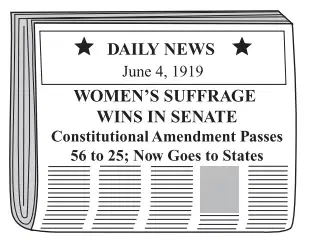
Bonus: How did the passage of this amendment to the U.S. Constitution impact the political process in the United States?
Women were allowed to contribute to political campaigns.
Women were allowed to hold citizenship rights.
Women were allowed to hold public offices.
Women were allowed to vote in national elections.
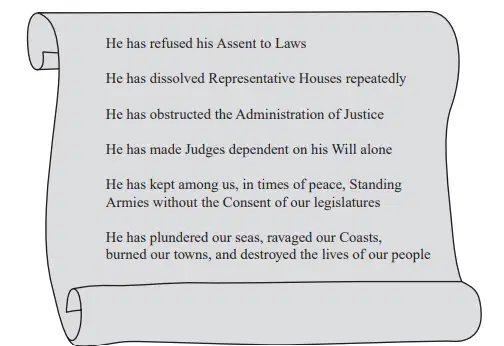
Bonus: Using the picture-what document are these statements found in?
Magna Carta
Mayflower Compact
Articles of Confederation
Declaration of Independence
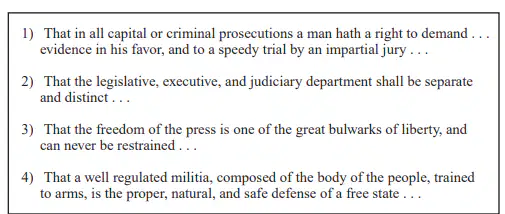
Bonus: Which statement reflects the Enlightenment ideas of government as expressed by Montesquieu?
1
2
3
4

