
Font size
 Worksheets
WH Chapter 10 Test
Total questions: 100
Worksheet time: 50mins
When did the British expeditionary force arrive at Hong Kong to begin negotiations with the Chinese?
Spring 1839
Early 1840
May 1841
Late August 1842
What event escalated the antagonism between the British and Chinese in July 1839 that brought the two nations closer to war?
The British exporting opium to China
The British destroying a Chinese blockade
The death of a Chinese villager at the hands of a Drunken British sailors
The capture of Nanjing by British forces
What was the outcome of the Opium War by late August 1842?
The British government decided to stop the opium trade
The Chinese government confiscated more opium chests
The British held against the Chinese offensive and captured Nanjing
The Chinese courts agreed to try British subjects
What is the main argument presented by Lin Zexu in his letter to Queen Victoria?
The British should respect China's legal system
The opium trade is harmful and should not be imposed on other countries
The British are entitled to trade opium for profit
The Chinese people are willingly consuming opium
What was the purpose of the Treaty of Nanjing in 1842?
To mark the beginning of the First Opium War
To establish trade relations between China and India
To end the First Opium War and provide terms for British subjects in China
To create an alliance between the United Kingdom and China
How much did China agree to pay as ransom for the lives of British subjects according to the Treaty of Nanjing?
6,000,000 pounds
6,000,000 dollars
600,000 dollars
60,000,000 dollars
Which of the following cities was NOT mentioned as a place where British subjects could reside and carry out their mercantile pursuits in the Treaty of Nanjing?
Canton
Shanghai
Beijing
Amoy
What was the primary motivation for European intrusion into Africa during the capitalist industrialization period?
Cultural exchange
Assured sources of raw materials
Religious missions
Political alliances
How was the Congo Free State under King Leopold II described at the time?
A model colony with fair trade practices
Legalized robbery enforced by violence
A successful example of European governance
A peaceful territory with high economic growth
What was King Leopold II's Congo Free State notorious for?
Providing education to the local population
Harvesting its wild rubber and brutal punishments
Promoting religious freedom
Establishing democratic institutions
Who are the two figures representing Great Britain and the U.S. in the caricature "The White Man's Burden"?
John Bull and Uncle Sam
Winston Churchill and Abraham Lincoln
The British Lion and The American Eagle
King George and President Wilson
According to the note in the document, how are the images and caricatures like the one shown considered today?
Humorous and light-hearted
Inaccurate but harmless
Incredibly offensive
Historically accurate
What was the name of the war where Britain sent navy to force China to allow Britain to sell opium in China
Opium War
War of 1812
War of the worlds
English war
China and Britain fought a war over:
the Korean peninsula
conquests along the Nile River
opium production and distribution
the elimination of the samurai
What product did the government of China try to prevent the British from trading in their country?
opium
silver
tea
silk
Before the Opium War, the British were trading their silver for what Chinese goods?
Silk, tea, and porcelain
Porcelain, cotton, gold
Diamonds, silk, opium
Silk, tea, and gunpowder
What was a direct result of the Opium War in 19th-century China?
Japan got control of Hong Kong
Chinese ports were opened for trade with European powers.
To say that foreign countries seized “spheres of influence” in China means that they...
had secret agreements with the Chinese government.
created a new territorial government to prevent the U.S. from entering the trade market.
gained control of trade and resources in specific areas of China.
established a circular discussion forum.
Who is Lin referring to when he says the "barbarians"?
An ancient tribe
Chinese peasants
Americans
Europeans
What were the Chinese demands on British traders?
Promise not sell opium and only trade at Canton.
Follow Chinese laws and only trade at Canton.
Follow Chinese laws and promise not sell opium.
Where did the British troops in the First Opium War deployed from?
Britain
India
Africa
Hong Kong
Why was the British Empire unhappy with the first peace treaty?
They wanted more money.
They didn't get to keep the territory they conquered.
They didn't get as many open ports as they wanted.
Opium was still illegal in China.
All the above.
What did the British field test in the First Opium War?
Steam ships
Rockets
Trains
Grenades
By 1650s, China was ruled by the ... dynasty.
Qing
Ching
Chin
King
The Europeans had a good reputation in China.
True
False
The Chinese authorities attempted a ... policy to restrict trade with the West.
'closed country'
'closed window'
'closed trade'
'closed door'
Britain was interested in Chinese...
ports
silver
ships
opium

Imperialism would benefit the economies of imperial countries.
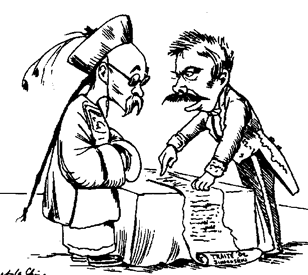
Why did the Chinese emperor ban the sale of Opium?
Opium was not making the Chinese enough money
The emperor wanted to make money from other goods
Opium is highly addictive and was ruining China
Opium growers were gaining power in Chinese court
What treaty ended the Opium Wars?
Treaty of Hong Kong
Treaty of Versailles
Treaty of Manchuria
Treaty of Nanjing
Which of the following is true about the Boxer Rebellion?
The rebellion took place in Japan.
The Boxers were trying to keep Christianity in China.
The Boxers were unhappy with foreign influence in China.
The Boxers were able to drive out the foreigners from China.

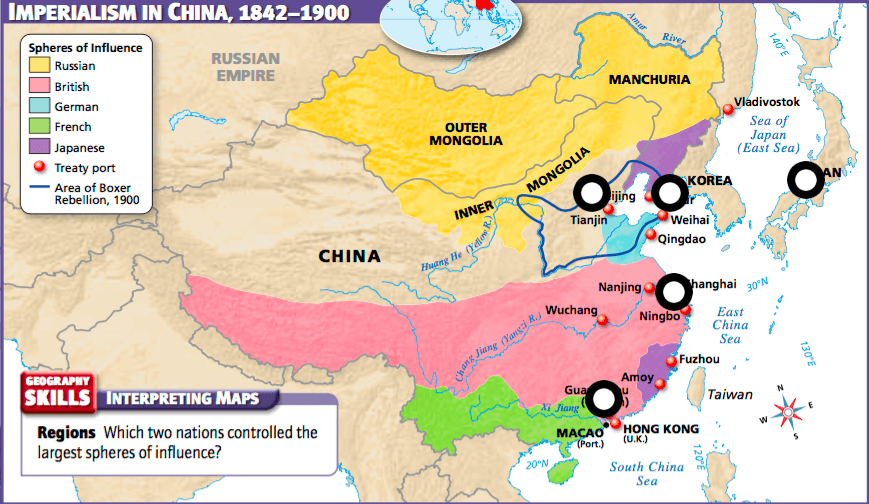
1839 open clash between the British and the Chinese. The battles took place mostly at sea.
Opium War
extraterritorial rights
Taiping Rebellion
sphere of influence
Under these rights, foreigners were not subject to Chinese law at Guangzhou and four other Chinese ports.
Opium War
extraterritorial rights
Taiping Rebellion
sphere of influence
occurred in the late 1830s, a movement with the goal of having all Chinese people share in the vast wealth of the country and no one would live in poverty.
Opium War
extraterritorial rights
Taiping Rebellion
sphere of influence
an area in which a foreign nation controlled trade and investment in China.
Opium War
extraterritorial rights
Taiping Rebellion
sphere of influence
A US policy that proposed that China’s “doors” be opened to merchants of all nations
Open Door Policy
Boxer Rebellion
Treaty of Kanagawa
Meiji era
A movement that broke out in China in 1900, led by the Society of Righteous and Harmonious Fists in order to demonstrate their discontent with Western influence in their country.
Open Door Policy
Boxer Rebellion
Treaty of Kanagawa
Meiji era
An 1854 treaty where Japan agreed to open 2 ports for trade with the US.
Open Door Policy
Boxer Rebellion
Treaty of Kanagawa
Meiji era
The period of time that Mutsuhito reigned which means, “enlightened rule”. This period was marked with concentrated efforts to modernize Japan.
Open Door Policy
Boxer Rebellion
Treaty of Kanagawa
Meiji era
A 1904 war between Japan and Russia that changed the world’s balance of power.
Russo-Japanese War
Annexation
caudillo
Monroe Doctrine
When one country brings another country under their control.
Russo-Japanese War
Annexation
caudillo
Monroe Doctrine
A word that means a military dictator
Russo-Japanese War
Annexation
caudillo
Monroe Doctrine
Played a leading role in Mexico’s fight for independence
Antonio Lopez de Santa Anna
Benito Juarez
La Reforma
Porfirio Diaz
a liberal reformer who strongly influenced the politics of Mexico.
Antonio Lopez de Santa Anna
Benito Juarez
La Reforma
Porfirio Diaz
Juarez’s liberal reform movement
Antonio Lopez de Santa Anna
Benito Juarez
La Reforma
Porfirio Diaz
a caudillo who came to power in Mexico in 1876
Antonio Lopez de Santa Anna
Benito Juarez
La Reforma
Porfirio Diaz
A reformer who attempted to run for election against Diaz. He was jailed and exiled. He called for a revolution against Diaz.
Francisco Madero
“Pancho” Villa
Emiliano Zapata
Porfirio Diaz
A revolutionary leader in Northern Mexico who used “Robin Hood” like policies that made him very popular.
Francisco Madero
“Pancho” Villa
Emiliano Zapata
Porfirio Diaz
Another powerful revolutionary leader from southern Mexico. His battle cry was “Tierra y Libertad” (Land and freedom)
Francisco Madero
“Pancho” Villa
Emiliano Zapata
Porfirio Diaz


One reason for Japan’s rapid industrialization during the Meiji Restoration was that Japan had
rejected Western ideas
used its access to the sea for fishing
relied on traditional isolationist policies
reformed its political and economic systems
. One effect of industrialization on Meiji Japan was that it
strengthened the power of the Shogunate
decreased the level of pollution
modernized transportation
increased the number of small farms
Which statement best explains Japan's relationships with other nations since the 1860s?
An abundance of natural resources has made Japan self-sufficient.
Japan's island location has discouraged Japanese imperialism.
Rejection of foreign technology has forced Japan into isolation.
Japan has needed to acquire sufficient raw materials for its industries.
"...I am willing to admit my pride in this accomplishment for Japan. The facts are these: It was not until the sixth year of Kaei (1853) that a steamship was seen for the first time; it was only in the second year of Ansei (1855) that we began to study navigation from the Dutch in Nagasaki; by 1860, the science was sufficiently understood to enable us to sail a ship across the Pacific. This means that about seven years after the first sight of a steamship, after only about five years of practice, the Japanese people made a trans-Pacific crossing without help from foreign experts. I think we can without undue pride boast before the world of this courage and skill. As I have shown, the Japanese officers were to receive no aid from Captain Brooke throughout the voyage. Even in taking observations, our officers and the Americans made them independently of each other. Sometimes they compared their results, but we were never in the least dependent on the Americans. . . ."
— Eiichi Kiyooka, trans., The Autobiography of Fukuzawa Yukichi, The Hokuseido Press, 1934
The changes in Japanese science and technology described in this passage most directly resulted from which of the following?
the Russo-Japanese War
an abundance of natural resources in Japan
the arrival of Commodore Matthew Perry in Japan
Japanese isolationism
Base your answer to the following question on on the poem below and on your knowledge of social studies.
May our country
Taking what is good
And rejecting what is bad Be not inferior to any other.
–Mutsuhito
According to this Japanese poem, Mutsuhito believed Japan should modernize by
completely changing Japanese society
borrowing selectively from other societies
controlling other cultures that were superior
rejecting foreign influences
In the years following the Meiji Restoration in Japan and the unification of Germany in the 19th century, both nations experienced
an increase in military production and strengthened military forces
a reduction in tensions with neighboring nations
a restructuring of government that included popularly elected monarchs
a decrease in the reliance on industrialization and trade
"...I am willing to admit my pride in this accomplishment for Japan. The facts are these: It was not until the sixth year of Kaei (1853) that a steamship was seen for the first time; it was only in the second year of Ansei (1855) that we began to study navigation from the Dutch in Nagasaki; by 1860, the science was sufficiently understood to enable us to sail a ship across the Pacific. This means that about seven years after the first sight of a steamship, after only about five years of practice, the Japanese people made a trans-Pacific crossing without help from foreign experts. I think we can without undue pride boast before the world of this courage and skill. As I have shown, the Japanese officers were to receive no aid from Captain Brooke throughout the voyage. Even in taking observations, our officers and the Americans made them independently of each other. Sometimes they compared their results, but we were never in the least dependent on the Americans. . . ."
— Eiichi Kiyooka, trans., The Autobiography of Fukuzawa Yukichi, The Hokuseido Press, 1934
The changes described in this passage most directly contributed to which of the following?
the development of Japanese feudalism
the Meiji Restoration
decreased trade between Japan and Europe
an alliance between Japan and Russia
What was one effect of the Russo-Japanese War (1904–1905)?
Japan emerged as a major world power.
Korea gained its independence.
Czar Nicholas II gained power in Russia.
Russia formed a military alliance with Japan.

The policy proposed by the United States giving all nations equal opportunities to trade in China
Opium War
Extraterritorial Rights
Open Door Policy
Boxer Rebellion

War between Britain and China over the opium trade
Opium War
Extraterritorial Rights
Sphere of Influence
Boxer Rebellion

The rights of foreign residents to follow the laws of their own government rather than those of the host country
Taiping Rebellion
Extraterritorial Rights
Sphere of Influence
Boxer Rebellion

An area in which a foreign nation controls trade and investment
Taiping Rebellion
Extraterritorial Rights
Sphere of Influence
Boxer Rebellion

Rebellion aimed at ending foreign influence in China
Taiping Rebellion
Extraterritorial Rights
Sphere of Influence
Boxer Rebellion
What island was won by Britain in the Opium War?
Hawaii
Guam
Hong Kong
Discovery Island

What was the name of the treaty that ended the Opium war and gave Britain Hong Kong and extraterritorial rights?
Treaty of Nanjang
Treaty of Versailles
Treaty of Beijing
Treaty of London
China resists foreign influence for hundreds of years because they are self sufficient.
True
False
Who benefited most from the granting of extraterritorial rights in 19th century China
Foreigners in China
Chinese peasants
Chinese Christians
Chinese government officials

Addition of territory
Treaty of Kanagawa
Meiji Era
Russo–Japanese War
Annexation

A war between Russia and Japan fought in 1904 Addition of territory
Treaty of Kanagawa
Meiji Era
Russo–Japanese War
Annexation

The period of rule by Emperor Mutsuhito from 1867 to 1912
Treaty of Kanagawa
Meiji Era
Russo–Japanese War
Annexation

The treaty between the United States and Japan opening trade between the two nations
Treaty of Kanagawa
Meiji Era
Russo–Japanese War
Annexation
What did Mathew Perry do?
I'm not sure what the original Mathew Perry did, but Matthew Perry was in Friends!
commanded a fleet of well-armed American ships to take a letter to Japan to demand them to open their ports
defeated the Japanese in an important battle
helped write the Open Door Policy

Who was the harsh leader of Mexico who ruled with violence and intimidation?

He was known for his "Robin Hood" tactics of stealing from the rich and giving to the poor.
Diego Rivera
Emiliano Zapata
Francisco “Pancho” Villa
Porfirio Díaz
Which country originally conquered Mexico?
Spain
England
France
Germany
Who became the president after Diaz resigned?
Francisco I. Madero
Victoriano Huerta
"Pancho" Villa
Emiliano Zapata
Are you having a good day?
Yes
No (don't pick this, it will make me sad!!)

