
 Worksheets
REVISION TOPIC 1,2,3
Total questions: 20
Worksheet time: 10mins
Name
Class
Date
1.
1. According to the Coulomb’s law, the electrostatic force between two point charges is directly proportional to the
a)
sum of charges
b)
product of the magnitude of charges
c)
their separation distance
d)
square of their separation distance
2.
2. An attractive force exists between
a)
two neutral charges
b)
a negative charge and a neutral charge
c)
a negative charge and a positive charge
d)
two positive charges
3.
3. The electric field strength at a point is the
a)
work done to bring a proton from infinity to the point
b)
electric potential energy to bring a unit of positive test charge from infinity to the point
c)
electric potential of charge per unit square of distance at the point
d)
electrostatic force that acts on a unit of positive test charge at the point
4.
4. The electric field lines point towards
a)
a positive charge
b)
a negative charge
c)
a positive plate
d)
zero potential point
5.
5. The unit of electric potential is
a)
coulomb
b)
volt
c)
newton
d)
ohm
6.
6. The electric potential at all points on an equipotential surface of a positively charged sphere is
a)
not the same
b)
the same
c)
infinity
d)
zero
7.
7. Which of the following statements is CORRECT to define a capacitor?
a)
A device that is capable of storing electric charges or electric potential energy
b)
The ratio of the charge on either plate to the electric field strength between them
c)
The ratio of the charge on either plate to the potential difference between them
d)
The ratio between the potential difference between the plates and the charge on either plate
8.
8. Farad is the unit of
a)
resistance
b)
time constant
c)
charge
d)
capacitance
9.
9. Which of the following equations is CORRECT to represent energy stored in a
capacitor?
a)
Option 1
b)
Option 2
c)
Option 3
d)
Option 4
10.
10. The quantity RC that appears in the exponent for all equations in the charging and discharging process refers to the
a)
rest time
b)
time constant
c)
time required for the charge on the capacitor decreases to zero
d)
time for the capacitor to fully charged
11.
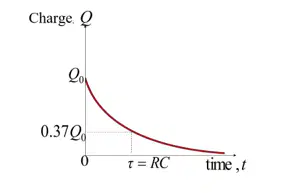
11. Based on the FIGURE which of the following equations represents the graph?
a)
Option 1
b)
Option 2
c)
Option 3
d)
Option 4
12.
12. What happens to the capacitance of a parallel plate capacitor when a dielectric material is inserted between its plates?
a)
Capacitance reduce to zero
b)
Capacitance decreases
c)
Capacitance increases
d)
Capacitance remains the same
13.
13. A battery is disconnected from a fully charged parallel plate capacitor. When a dielectric material is inserted between the plates, the ___________________.
a)
charge increases
b)
capacitance decreases
c)
electric field decreases
d)
electric potential increases
14.
14. When a metal conductor is connected to a battery, free electrons in the metal experience electric force causing the free electrons to drift with a drift velocity, vd in the metal. The direction of the drift velocity is
a)
towards negative terminal
b)
towards positive terminal
c)
randomly moves in all directions
d)
same direction as the electric field
15.
15. Which of the following represents the equation of current?
a)
Option 1
b)
Option 2
c)
Option 3
d)
Option 4
16.
16. Which of the following statements about Ohm's Law is CORRECT?
a)
The type of a metal conductor is proportional to the current flowing through it
b)
The potential difference across a metal conductor is proportional to the current flowing through it
c)
The potential difference across a metal conductor is inversely proportional to the current flowing through it if its temperature is constant
d)
The potential difference across a metal conductor is directly proportional to the current flowing through it if its temperature is constant
17.
17. Choose the correct units for resistivity.
a)
Option 1
b)
Option 2
c)
Option 3
d)
Option 4
18.
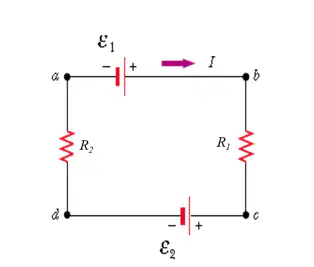
18. Based on the Figure, which of the following expressions can be used to determine current, I in the loop?
a)
Option 1
b)
Option 2
c)
Option 3
d)
Option 4
19.
19. If the current, I flow through a resistor, R and the potential difference, V across it, then the power loss through the resistor is
a)
Option 1
b)
Option 2
c)
Option 3
d)
Option 4
20.
20. Which of the following applications of the potentiometer is NOT CORRECT?
a)
Measure the current flows through a cell
b)
Compare the emfs between two cells
c)
Measure the internal resistance of a cell
d)
Measure an unknown emf of a cell.
100 %

