
 Worksheets
Unit 6 and BMK II Review
Total questions: 20
Worksheet time: 10mins
Which of the following two were results of the McCulloch vs. Maryland decision?
It reinforced the supremacy of the federal government.
It held that Congress had the power to regulate interstate commerce.
The Federal government had the right to seize Native American lands.
State governments could break contracts.
Congress had the right to establish a national bank.
What did the Supreme Court decisions in McCulloch v. Maryland and Gibbons v Ogden have in common?
State legislatures have the power to void federal laws deemed unconstitutional
The Congress does not have implied powers in the Constitution
States could not interfere with federal institutions or violate federal law
The Supreme Court could declare a law unconstitutional
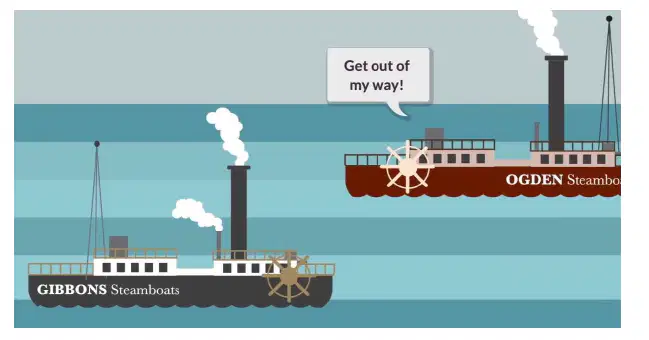
What was the primary issue in the Gibbons v Ogden Supreme Court case that is represented in the image above?
Implied powers of Congress
Interstate commerce
The National Bank
Indian Removal

The Supreme Court’s interpretation of these clauses in the Constitution increased congressional power by
allowing the federal government to issue money to the states.
authorizing the federal regulation of interstate commerce.
creating a state agency to collect taxes from other states.
enabling the federal government to increase military spending.
What was the primary question surrounding the 1832 Nullification Crisis?
Can a state overturn a federal law?
Can a state regulate a federal agency?
Can the federal government levy taxes on states?
Can the federal government regulate interstate commerce?
Which of the following groups initially came to the Americas for the primary goal of finding wealth and converting the indigenous peoples to Christianity?
French colonists
Spanish colonists
Dutch colonists
British colonists
What colony is considered by many historians to have the first written constitution of a Western civilization?
Plymouth Colony
Georgia Colony
Connecticut Colony
Virginia Colony
What British acts led directly to the assembly of the First Continental Congress in Philadelphia on September 5, 1774?
Intolerable Acts
Townshend Acts
Sugar and Stamp Act
Quartering Acts
Which significant figure of the American Revolution was nominated as the commander in chief of the Continental Army as well as elected as the first President of the United States?
John Adams
Benjamin Franklin
Thomas Jefferson
George Washington
Who is often described as the Father of the American Revolution, and is known for writing the pro-independence pamphlet "Common Sense"?
Samuel Adams
Wentworth Cheswell
James Armistead
Thomas Paine
What major battle is considered the first engagement of the Revolutionary War?
Battle of Bunker Hill
Battle of Lexington and Concord
Battle of Yorktown
Battle of Saratoga
When creating the Constitution, large and small states disagreed over how many congressional representatives each state should receive, so to solve this issue they finally settled on
The Virginia Plan
The New Jersey Plan
The Great Compromise
The Three-Fifths Compromise
What major political parties formed in the late 1700s and disagreed on the balance of power between national and state government?
Federalists and Democratic Republicans
Democrats and Whigs
Federalists and Anti-Federalists
National Republicans and Anti-Federalists
After Great Britain and France entered into conflict in 1793, what US president damaged the US economy by banning all trade with Europe in an effort to force the warring nations to acknowledge the United States' neutral stance?
Adams
Jefferson
Madison
Monroe
Of the major land acquisitions in the late 1700s/early 1800s, what major territory was acquired by the United States from Britain through the Treaty of Paris?
Northwest Territory
Southwest Territory
Michigan Territory
Louisiana Territory
The Monroe Doctrine was primarily concerned with
Social reform
Westward expansion
Foreign policy
sectionalism
Who was an abolitionist and women's rights activist, that led the Seneca Falls convention alongside Lucretia Mott?
Elizabeth Cady Stanton
Harriet Beecher Stowe
Corretta Scott King
Dorothy Height
Which of the following influenced the United States Bill of Rights, specifically the right to trial by jury and the prohibition of excessive bail and cruel and unusual punishment?
The English Bill of Rights
The Magna Carta
The Mayflower Compact
The Federalist Papers
Republicanism is a governing philosophy that emphasizes all of the following ideas EXCEPT
popular sovereignty
inalienable rights
majority rule
individual liberty
What Supreme Court case established the principle of judicial review, which means the judiciary can determine that a law is unconstitutional?
Georgia v. Worchester
McCullough v. Maryland
Marbury v Madison
Gibbons v. Ogden

