wayground logo

Free Printable Worksheets

Font size

S
M
L
XL
Worksheets

Factors Affecting the Biosphere

Total questions: 90

Worksheet time: 1hrs 15mins

Name
Class
Date
1.

What is bioaccumulation?

a)

Movement of water through plants

b)

Increase of pollutants in organisms

c)

Circulation of ocean currents

d)

Formation of clouds

2.

What human activity increases greenhouse gases?

a)

Planting trees

b)

Burning fossil fuels

c)

Recycling

d)

Using solar panels

3.

What direction do Westerlies move?

a)

East to west

b)

West to east

c)

North to south

d)

South to north

4.

What is the Great Ocean Conveyor Belt responsible for?

a)

Trapping heat in the atmosphere

b)

Distributing thermal energy

c)

Creating surface currents

d)

Forming clouds

5.

Which process stores energy, and which releases it for use in life functions?

a)

Photosynthesis stores, cellular respiration releases

b)

Cellular respiration stores, photosynthesis releases

c)

Fermentation stores, glycolysis releases

d)

Glycolysis stores, fermentation releases

6.

Approximately what percentage of energy is transferred to the next trophic level in a food chain?

a)

100%

b)

50%

c)

10%

d)

90%

7.

What is the importance of photosynthesis for living organisms on Earth?

a)

Provides oxygen

b)

Provides chemical energy

c)

Provides carbon dioxide

d)

Provides nitrogen

8.

What is the main function of cellular respiration?

a)

Store energy

b)

Release energy

c)

Absorb sunlight

d)

Produce glucose

9.

What happens in a food chain at each trophic level?

a)

Energy is transferred up, but only 10% of the energy is passed to the next level.

b)

Energy is transferred up, with 100% efficiency.

c)

Energy is transferred down, losing 50% at each level.

d)

Energy is transferred sideways, with no loss.

10.

Where is phosphorus stored?

a)

In rocks and soil, released through weathering.

b)

In the atmosphere.

c)

In the ocean.

d)

In plants only.

11.

What is the human impact on the phosphorus cycle?

a)

Excess phosphorus from fertilizers can lead to algal blooms in water bodies, disrupting aquatic ecosystems.

b)

Humans have no impact on the phosphorus cycle.

c)

Humans decrease phosphorus levels in water bodies.

d)

Humans convert phosphorus into nitrogen.

12.

What is the effect of burning fossil fuels on the environment?

a)

Releases excess CO₂, contributing to global warming.

b)

Has no effect on the environment.

c)

Decreases CO₂ levels.

d)

Stabilizes the climate.

13.

What is eutrophication?

a)

A process where excess nutrients lead to oxygen depletion in water bodies.

b)

A process that increases oxygen levels in water bodies.

c)

A process that has no effect on aquatic life.

d)

A process that stabilizes aquatic ecosystems.

14.

What is the primary source of nitrogen for plants?

a)

Nitrogen-fixing bacteria.

b)

The atmosphere.

c)

The ocean.

d)

Sunlight.

15.

What is the effect of deforestation on the environment?

a)

Releases excess CO₂, contributing to global warming.

b)

Increases oxygen levels.

c)

Has no effect on the environment.

d)

Stabilizes the climate.

16.

Identify what the biosphere contains.

a)

The ozone layer

b)

All of the Earth's living organisms

c)

All of the Earth's water

d)

The Earth's crust and soils

17.

Recall the components of the atmosphere.

a)

All of the water on the Earth's surface

b)

Clouds, rain and gases

c)

All of the gases above the Earth's surface

d)

All of the living things on Earth

18.

Identify the components of the hydrosphere

a)

The Earth's rainfall

b)

The Earth's ocean and rivers

c)

The Earth's icebergs

d)

All of the above

19.

Determine which of the following is NOT part of the lithosphere.

a)

Grass

b)

Mountains

c)

Soil

d)

Rocks

20.

This picture best represents a connection between which two spheres?

a)
Atmosphere-Biosphere
b)
Hydrosphere-Atmosphere
c)
Hydrosphere-Geosphere
d)
Geosphere-Biosphere
21.
Wind is part of what sphere of Earth?
a)
Windosphere
b)
Atmosphere
c)
Hydrosphere
d)
Airosphere
22.
 When a volcanic eruption spews gases and ash into the air, which two spheres are interacting? 
a)
a.  Hydrosphere and geosphere
b)
a.  Biosphere and geosphere
c)
a.  Geosphere and atmosphere
d)
a.  Biosphere and atmosphere
23.

The greenhouse effect is a natural process

a)

true

b)

false

24.

The greenhouse effect is caused by

a)

more heat arriving at the Earth from the sun

b)

the Earth releasing more heat at night

c)

gases in the air trapping heat released by the Earth

25.

Which of the gases is NOT a greenhouse gas?

a)

water vapour

b)

carbon monoxide

c)

carbon dioxide

d)

methane

26.
Which is a natural source of greenhouse gases?
a)
aerosols
b)
deforestation
c)
volcanic eruptions
d)
burning fossil fuels
27.

Which are greenhouse gases? (Select all that apply)

a)

Oxygen

b)

Carbon Dioxide

c)

Nitrogen

d)

Methane

28.

What do greenhouse gases do?

a)

absorb UV light

b)

absorb visible light

c)

absorb infrared radiation

d)

reflect infrared radiation

29.

What happens to the light energy from the sun when it hits the Earth's surface? (Select all that apply)

a)

It is absorbed

b)

It is reflected back to space

c)

It is trapped by greenhouse gases in the Earth's atmosphere

30.

If we didn't have the 'greenhouse effect' at all, Earth would

a)

have volcanoes erupting everywhere

b)

Cool to a point where we could not live here

c)

Catch on fire

d)

blow up from being hit by meteors

31.

What is the primary function of the clear glass of the greenhouse?

a)

The glass allows long wavelengths of radiation to enter, but reduces the amount of short wavelength radiation that escapes.

b)

The glass allows short wavelengths of radiation to enter, but reduces the amount of long wavelength radiation that escapes.

c)

The glass allows all wavelengths of radiation to enter and all wavelengths of radiation to escape.

d)

The glass reduces the amount of solar radiation entering the greenhouse.

32.

Why is the Ozone important to life on Earth?

a)
A.   The Ozone reflects all the Ultra Violet radiation
b)
A.  The Ozone absorbs all the heat that come up from the Earth.
c)
The Ozone provides all the oxygen to Earth.
d)
The Ozone protects the Earth’ s atmosphere and the life on Earth from harmful radiant energy emitted by the sun   
33.
The gas that is most abundant in the atmosphere is
a)
oxygen
b)
nitrogen
c)
carbon dioxide
d)
argon
34.
The gas that is the second most abundant in the atmosphere is
a)
oxygen
b)
nitrogen
c)
carbon dioxide
d)
argon
35.

The majority of Earth's energy comes from...

a)

the Earth's core

b)

the Sun

c)

hydroelectric power

d)

burning fossil fuels

36.

What are the three primary wind systems in global circulation?

a)

Trade Winds, Westerlies, Polar Easterlies

b)

Trade Winds, Monsoons, Westerlies

c)

Westerlies, Monsoons, Jet Streams

d)

Monsoons, Polar Easterlies, Trade Winds

37.
Warm-water currents begin near the _______ and carry ______ water to other parts of the ocean.
a)
pole, warm
b)
equator, warm
c)
equator, cold
d)
pole, cold
38.
The Gulf stream carries _____________ water from the east coast of The United States to the West coast of Europe.
a)
Cold
b)
Warm 
c)
Freezing
d)
Fresh
39.

What are the major air circulation patterns responsible for the creation and development of wind belts around the Earth?

a)

Tropical Easterlies, Westerlies, and Subpolar Winds

b)

Northern Winds, Southern Winds, and Equatorial Winds

c)

Equatorial Winds, Subtropical Winds, and Polar Winds

d)

Polar Easterlies, Westerlies, and Trade Winds

40.

What is the primary reason for the creation of wind patterns on Earth?

a)

Unequal heating of the Earth's surface

b)

Rotation of the Earth on its axis

c)

Interaction between the moon and the Earth

d)

Distribution of land and water on the planet

41.

Which wind belt is located around the Equator and is characterized by warm air rising and moving towards the Poles?

a)

Polar Easterlies

b)

Equatorial Winds

c)

Trade Winds

d)

Prevailing Westerlies

42.

What is the wind pattern that moves north in the northern summer and south in the northern winter?

a)

Equatorial Winds

b)

Trade Winds

c)

Prevailing Westerlies

d)

Polar Easterlies

43.

Which wind belt is formed between the Equator line and 30 degrees in both hemispheres and is known for its counterclockwise loop?

a)

Equatorial Winds

b)

Polar Easterlies

c)

Prevailing Westerlies

d)

Trade Winds

44.

What is the term used for the air current that moves from the Poles and heats up quickly at 60 degrees in both hemispheres?

a)

Equatorial Winds

b)

Polar Easterlies

c)

Trade Winds

d)

Prevailing Westerlies

45.
Movements of ocean water in a continuous flow are called?
a)
ocean currents
b)
global winds
c)
air mass
d)
front
46.
The Coriolis Effect is caused by
a)
Earth rotating around the sun
b)
Earth rotating on its axis
c)
The tides
d)
Gravity
47.
Due to the Coriolis Effect, water in the northern hemisphere moves
a)
clockwise
b)
counter clockwise
c)
both
d)
neither
48.
Due to the Coriolis Effect, water in the southern hemisphere moves
a)
clockwise
b)
counter-clockwise
c)
both
d)
neither
49.
Deep Ocean currents are a result of
a)
Global Wind Patterns
b)
Earth's Rotation
c)
Density
d)
All of the above
50.

______ causes surface currents.

a)

The Coriolis Effect

b)

gravity

c)

density differences

d)

wind

51.

Two types of ocean currents are

a)

local and global

b)

sea and land

c)

surface and deep

d)

warm and cold

52.

Constantly moving system of deep-ocean circulation driven by temperature and salinity. It moves water around the globe.

a)

California Current

b)

Global Conveyor Belt

c)

Surface Currents

d)

Gulf Stream

53.

Which is an example of an ecosystem?

a)

An area of cold climate and communities of different species

b)

one elk

c)

a group of elks living together in the same area

d)

elks, snow rabbits, and owls living in the same area

54.
What is the source of energy for photosynthesis?
a)
carbohydrates-chemical
b)
sunlight-radiant
c)
heat-thermal
d)
television-electrical
55.
What are the reactants (what's needed) for photosynthesis?
a)
glucose and oxygen
b)
light, water, and carbon dioxide
56.
What gas is released by plants during photosynthesis?
a)
sulfur
b)
carbon dioxide
c)
oxygen
d)
hydrogen
57.
What is the purpose of photosynthesis?
a)
make glucose
b)
make ATP
c)
make light
d)
release carbon dioxide
58.
What are the products (what's made) during photosynthesis?
a)
glucose and oxygen
b)
water, light, and carbon dioxide
59.
What type of organism uses photosynthesis?
a)
plants
b)
bacteria
c)
animals
d)
both plants and bacteria
60.
What is the energy conversion during photosynthesis?
a)
chemical --> chemical
b)
thermal --> electrical
c)
chemical --> electrical 
d)
radiant --> chemical
61.
In which organelle (part of the cell) does photosynthesis take place?
a)
mitochondria
b)
chloroplast
c)
nucleus
d)
cell membrane
62.
What is the gas we breath out that plants use for photosynthesis?
a)
sulfur
b)
carbon dioxide
c)
oxygen
d)
hydrogen
63.
How can photosynthesis be related to cellular respiration?
a)
What's produced (made) by one is needed (the reactants) for the other
b)
They both produce the same products
c)
They both have the same reactants (need the same things)
d)
These 2 processes have nothing in common
64.
What is another name for glucose?
a)
Chlorophyll
b)
Chloroplasts
c)
Stomata
d)
Sugar
65.
What molecule absorbs sunlight for photosynthesis?
a)
chloroplast
b)
thylakoid
c)
grana
d)
chlorophyll
66.
Cellular respiration takes place in the
a)
nucleus
b)
cytoplasm
c)
ribosomes
d)
mitochondria
67.
Which is not a waste product of cellular respiration?
a)
Water
b)
Heat
c)
Carbon Dioxide
d)
Oxygen
68.
What are organisms that use other organisms for food in order to gain energy?
a)
decomposers
b)
producers
c)
herbivores
d)
consumers
69.
What type of organism makes its own food?
a)
consumer
b)
carnivore
c)
producer
d)
animal
70.
Where do producers get their energy?
a)
the ground
b)
other animals
c)
decomposers
d)
The Sun
71.
What is the relationship between producers and consumers?
a)
Producers eat the wastes of consumers.
b)
Consumers eat producers.
c)
Consumers eat the wastes of producers
d)
Producers eat consumers
72.
Where does all of the energy in a food web originally come from?
a)
Soil
b)
Producers
c)
Air
d)
Sun
73.
a)
Consumer
b)
Producer
c)
Decomposer
d)
Food Web
74.

Arrows in a food web represent...

a)

eating

b)

sunlight

c)

energy

d)

matter

75.
An organism that needs to eat other organisms to obtain energy is known as a:
a)
Autotroph
b)
Producer
c)
Consumer
d)
Mutualist
76.
An organism that uses sunlight to create its own food is known as a:
a)
Producer
b)
Heterotroph
c)
Consumer
d)
Decomposer
77.

Bacteria, fungi, and worms typically serve what role in an ecosystem?

a)
herbivore
b)
carnivore
c)
omnivore
d)
decomposer
78.
_______are animals that eat only plants.
a)
herbivore
b)
carnivore
c)
omnivore
79.
Humans are considered...
a)
consumers
b)
decomposers
c)
producers
80.
A third-level consumer has to be which type?
a)
Carnivore.
b)
Decomposer.
c)
Producer.
d)
Herbivore.
81.
Which organism recieves the least amount of energy from the producer?
a)
Owl
b)
Grasshopper
c)
Lilypad
d)
Mouse
82.
Which organism in this food chain is a secondary consumer?
a)
Fish
b)
Grass
c)
Grasshopper
d)
Hawk
83.
In this food pyramid, which level has the greatest amount of energy?
a)
Producers
b)
Primary Consumers
c)
Secondary Consumers
d)
Tertiary Consumers
84.
How much energy is passed from one trophic level to the next?
a)
1%
b)
10%
c)
50%
d)
100%
85.

What is the ultimate source of energy in most food webs?

(a)  
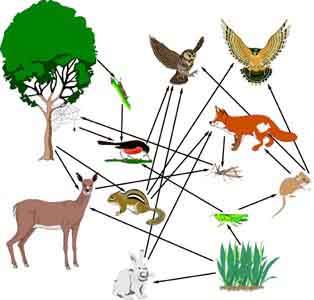
86.
What does a food web represent?
a)
All connections of energy flow throughout all organisms in a habitat.
b)
The specific ways that mutualism is carried out.
c)
A single pathway or energy flow between organisms. 
d)
How carnivores get their food. 
87.
Which of the following would be the most likely effect, if there were a sudden increase in the cricket population?
a)
There would be a decrease in the small bird population.
b)
There would be a decrease in the grass/flowers population.
c)
There would be a decrease in the mice population.
d)
There would be an increase in the grass/flowers population.
88.

What might happen if all the rabbits died?

a)

There would be more hawks because there are fewer rabbits in competition with them.

b)

There would be fewer lizards because the hawks would eat more of them.

c)

There would be less grass because the grasshoppers would eat it.

d)

There would be more snakes because they would not compete with the rabbits.

89.
A living organism that puts materials from dead  plants and animals back to the soil is called a ____________?
a)
carnivore
b)
decomposer
c)
herbivore
d)
omnivore
90.
What do the arrows represent in this diagram?
a)
who is being eaten
b)
the flow of energy
c)
the decomposition of organisms
d)
what things can change into