
 Worksheets
Age of Jackson Unit Test
Total questions: 25
Worksheet time: 6hrs 34mins
Which event caused the Democratic-Republican Party to split into two separate parties?
The start of the War of 1812
The passage of protective tariffs
The Election of 1824
The creation of the American System

The above painting would be connected to -
Hudson River School
Abolitionists
Secessionists
War Hawks

Which Congressional action is best described in the statement above?
Trail of Tears
Corrupt Bargain
Missouri Compromise
Indian Removal Act
Southerners felt they had the right to ignore laws passed by the federal government if it violated their states’ rights. Which of the following events best illustrates that action?
Indian Removal Act
Nullification Crisis
Spoils system
Panic of 1837
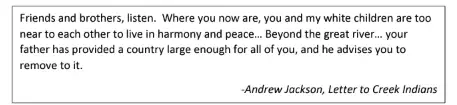
Which physical feature is Andrew Jackson referencing when he is addressing the Creek Indians?
Missouri River
Mississippi River
Arkansas River
Red River
Why were southern representatives against high protective tariffs?
Protective tariffs created potential trade issues with European countries.
Southerners preferred to buy American-made products over foreign goods.
Tax money collected from tariffs would be stored in federal banks.
Most southern states had already settled their debt from the American Revolution.
Why was the National Bank originally created AND why did Andrew Jackson not support the bank? Think about the question carefully. Then enter your answer to BOTH parts of the question in the box provided.

The shaded area on the map above was significant during which event?
Nullification Crisis
Creation of the National Bank
Trail of Tears
Election of Jackson
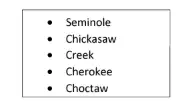
Why were the groups identified above forced to move during Jackson’s presidency?
Large groups of European immigrants caused tensions and overcrowding.
Heavy flooding made living in the area a major health hazard.
European countries had attempted to reclaim lands in the area.
Americans’ desire to gain land for farming and ability to search for gold.
During the presidency of Andrew Jackson, the spoils system resulted in -
federal laws being nullified by the states
elected officials rewarding their supporters with government jobs
all free males being given the right to vote
the end of political corruption in the federal government
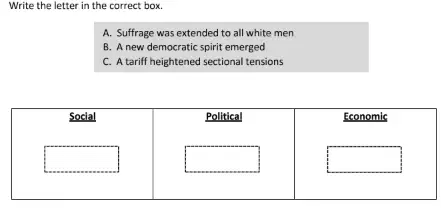
Determine which detail explains the impact of Jackson’s presidency on the United States. Write which letter goes to which box. Example: Social= A
Political= B ...
Which of the following BEST describes Native American policy during the Age of Jackson?
“I render it impossible that you can flourish among a civilized community. You have but one remedy within your reach, and that is to remove to the west.”
“A common ancestry promotes understanding between Cherokee and Whites. We are all brothers under the skin.”
“It is essential to maintain peaceful relations with our Native American neighbors.”
“No one can indulge a more friendly feeling than myself…to reclaim them from their wandering habits and make them happy, prosperous people.”

What factor explains the change in voters between the elections of 1824 and 1828?
Former slaves were emancipated and allowed to vote.
An amendment was enacted ending voting fees.
Women were given the right to vote.
Many states had put an end to property qualifications.
When Andrew Jackson was elected president, democracy was expanded by -
extending voting rights to the common man
stopping recolonization in the Americas
increasing the debt of the United States
appointing Henry Clay to serve in his cabinet
Supporters of Andrew Jackson accused Henry Clay and John Quincy Adams of making a “corrupt bargain” in 1824. Which of the following BEST explains what they were referring to?
Clay enforced protective tariffs on southern plantations.
Clay used his influence to gain House votes for Adams.
Adams appointed Clay to the position of Vice President.
Adams changed the results of the popular vote.

Complete the sentences by selecting the correct answer for 16
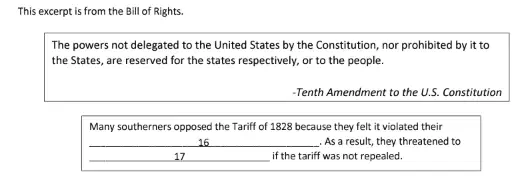
Complete the sentences by selecting the correct answer for 17
Which detail explains the issues surrounding Worcester v. Georgia? Select THREE correct answers.
President Jackson ignored a Supreme Court ruling and forced the Cherokee off their land
Chief Justice John Marshall argued the Cherokee nation was a distinct community
Native Americans were granted the right to vote
Missionaries were convicted of illegally living on Cherokee land
Reservation policies were repealed and replaced with land grants
The duty on imports...gives them the means of selling to us at a higher price; while we cannot dispose of our products. Our section of the country, from which springs the richest products...[will] sink into decay... The excerpt above represents a confirmation of a -
Southerner’s view about tariffs
Democrat’s view about the banking system
Northerner’s view about tariffs
Republican’s view about the banking system
If the Union is severed, the line of separation will grow wider, and the controversies which are now debated will now be tried in fields of battle and determined by the sword.
Which controversy is the speaker referencing in the quote above?
National bank
Kitchen cabinet
Nullification Crisis
Spoils system
On the morning of November the 17th we encountered a terrific sleet and snow storm with freezing temperatures...the sufferings of the Cherokees were awful. They had to sleep in the wagons and on the ground without fire. And I have known as many as twenty-two of them to die in one night of pneumonia due to ill treatment, cold, and exposure. The Cherokee attempted to prevent the event described above by -
appealing to the U.S. Congress to stay on their lands.
paying the U.S. government $15 million to keep their lands.
waging war against the U.S military to remain a sovereign nation.
settling the issue in court through the case, Worcester v. Georgia.
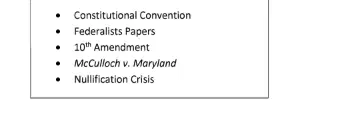
What conclusion can be drawn from the bulleted list above?
Americans disagreed over the effectiveness of the U.S. judicial branch.
Americans debated over the authority of federal versus state governments.
Americans recognized the need to further amend the U.S. Constitution.
Americans exercised their right to call upon Congress to settle disputes.
White settlers in Georgia complained that the Cherokee were on lands they wished to inhabit, and therefore, they revoked the constitution of the Cherokee Nation. Which of the following was a lasting impact of this decision?
Cherokee Indians were forced off their lands and relocated westward.
Congress voided the Georgia state charter allowing the Cherokee to stay.
President Jackson allowed the Cherokee to stay in Georgia temporarily.
Supreme Court ruled that white settlers had claim to Cherokee land.

Which location on the map threatened to secede from the Union over the Tariff of Abominations? Select the correct answer.
A
B
C
D
Which of the following BEST reflects Henry Clay’s actions during the Nullification Crisis?
He encouraged southern states to secede from the United States immediately and form their own nation.
He asked Congress to allow President Jackson to use the military in order to enforce the lowered tariff.
He requested that Congress repeal all tariffs since they were negatively impacting the South’s economy.
He developed a compromise that both supporters and opponents of the tariff agreed upon.

