
 Worksheets
Earth's History
Total questions: 20
Worksheet time: 10mins
Name
Class
Date
1.
Name:
4 lines
2.
Period
a)
1
b)
2
c)
4
d)
5
e)
6
3.
1 Which process will most accurately determine the ages of two similar fossils?
a)
by using seismic waves
b)
by using radioactive (absolute) dating
c)
by comparing the two fossils to index fossils
d)
by comparing the geographic locations where the fossils were found
4.
2 How can the law of superposition show that fossilized organisms have evolved or changed over time.
a)
Each rock layer contains specific types of fossils.
b)
Only igneous rock layers contain fossils of simple life forms.
c)
Rock layers closer to the surface have fossils of simpler life forms.
d)
More complex fossils are found in rock layers closer to the surface.
5.
3 Geologists believe that a vast saltwater sea once covered the entire state of New Mexico, in the Southwestern United States. Geological investigations of the Jemez Mountains of New Mexico support this theory. Which evidence from the Jemez Mountains provides the most support for the inland sea theory?
a)
The mountains contain volcanic rock.
b)
The mountains contain layers of sandstone.
c)
The mountains show evidence of earthquake activity.
d)
The mountains contain fossils from shallow water organisms.
6.
4 Of the following methods, which led scientists to infer that Earth is about 4.6 billion years old?
a)
studying fault lines
b)
studying index fossils
c)
using radioactive(absolute) dating on rocks
d)
applying the law of superposition
7.
5 What does the term half-life mean when using radioactive(absolute) dating to determine the age of fossils?
a)
Half-life is used to describe the time it takes for half of the radioactive substance to decay.
b)
Half-life is used to describe the time it takes for a fossil to become fully radioactive.
c)
Half-life is used to describe the amount of the fossil decayed away every 100 years.
d)
Half-life is used to describe the age of the organism when it died.
8.
6 In an undisturbed rock profile, according to the Law of Superposition, the oldest rocks are found:
a)
in the middle
b)
anywhere
c)
at the top
d)
at the bottom
9.
7 Why is the fossil record incomplete?
a)
There isn’t enough amber.
b)
Scientists don’t like to work on it.
c)
Most organisms have hard body parts.
d)
Most organisms do not become fossils.
10.
8 Which of the following situations would offer the best chances to ensure fossilization?
a)
a dead crab with a hard exoskeleton at the bottom of a large, deep, freshwater lake
b)
a dead whale at a subduction zone at the bottom of the ocean
c)
a tortoise that lives close to an active volcano on an island
d)
a jellyfish in shallow coastal waters with strong currents
11.
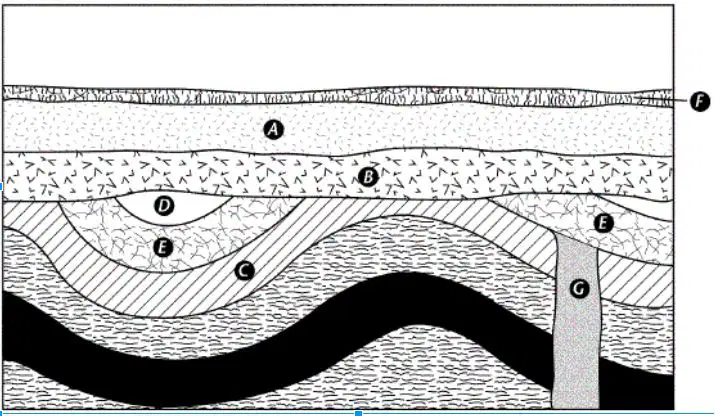
9 How do layers B and D compare in age?
a)
B is older than D
b)
D is older than B.
c)
They are the same age.
d)
Not enough information
12.
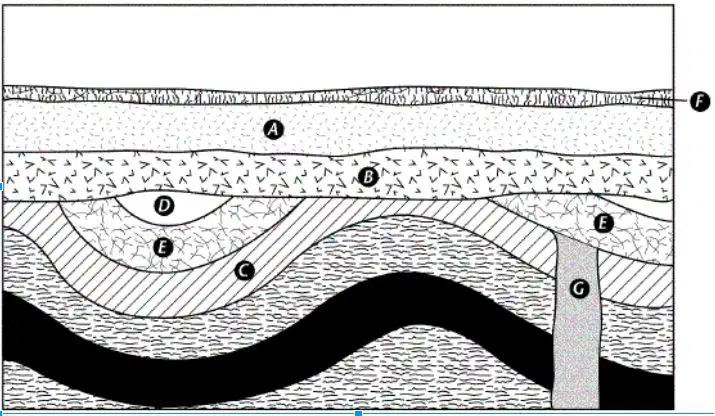
10 If rock layers between B and D have eroded away, what is the boundary between B and D called?
a)
Unconformity
b)
Fault
c)
Intrusion
d)
Extrusion
13.
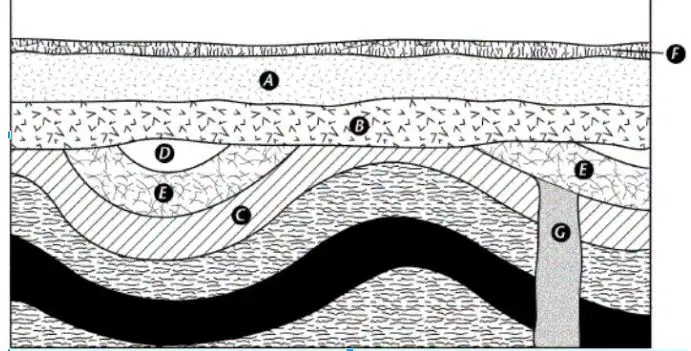
11 What type of rock would G most likely be?
a)
diamond
b)
sedimentary
c)
igneous intrusion
d)
metamorphic
14.
12 In which type of rock are fossils found?
a)
igneous
b)
metamorphic
c)
sedimentary
15.
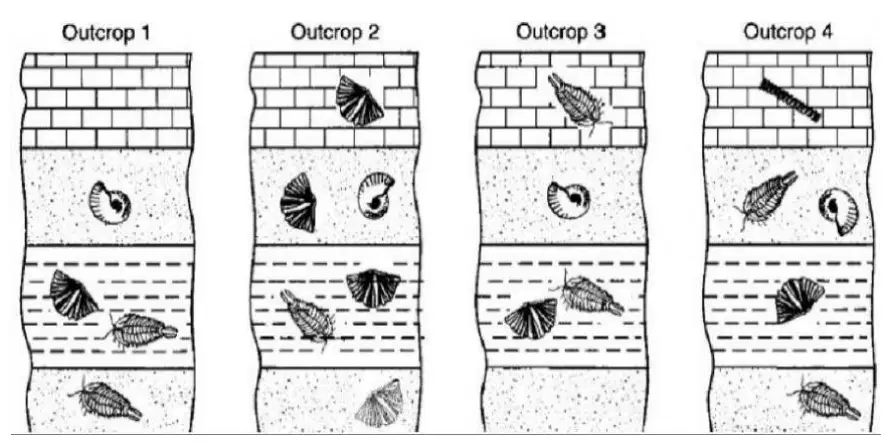
13 Rock core samples (outcrops) were taken from four different locations around the globe. Using the diagram to the right, which type fossil found would be the best option to use as an index fossil?
a)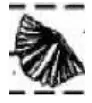
Option 1
b)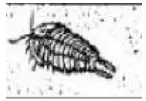
Option 2
c)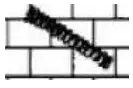
Option 3
d)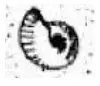
Option 4
16.
14 Scientists have found some fossils for species that have no living members. What most likely happened to the species?
a)
The species became extinct.
b)
The species never really existed.
c)
The species mutated to another species.
d)
The species had offspring of a different species.
17.
15 Which of the following best describes fossils?
a)
molds and cases for organisms that live today
b)
drawings of ancient animals and other organisms
c)
footprints or burrows of small animals that live today
d)
the preserved remains or traces of organisms that lived in the past
18.
16 What has the study of fossils allowed scientists to do
a)
describe past environments and the history of life
b)
study present ocean temperatures at different depths
c)
analyze the chemical composition of sedimentary rocks and minerals
d)
predict which organisms will become extinct in the future
19.
17 Which of the following best describes the difference between relative and absolute dating?
a)
Relative dating provides a numerical age range of a fossil and absolute dating provides the exact year of formation.
b)
Relative dating tells scientists whether a fossil is older or younger than the surrounding rock layers and absolute dating provides a numerical age range of the fossil.
c)
Absolute dating tells scientists whether a fossil is older or younger than the surrounding rock layers and relative dating provides a numerical age range of the fossil.
d)
Absolute dating tells scientists whether a fossil is older or younger than the surrounding rock layers and relative dating provides the exact year of formation.
20.
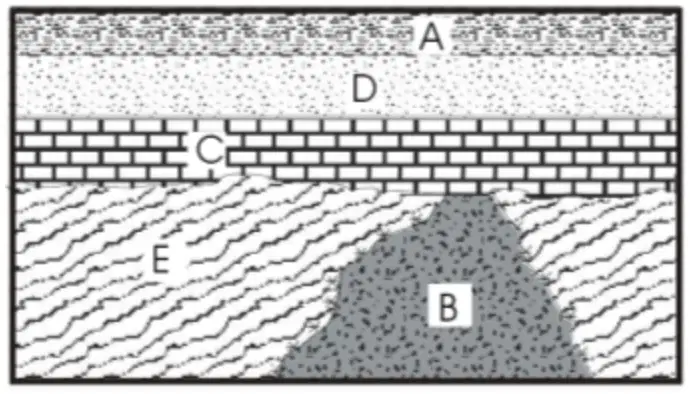
18 According to the Law of Superposition, what is the relationship between layers C and E in the picture?
a)
C is younger than E because it is on top.
b)
E is younger than C because it is on the bottom.
c)
C and E are relatively the same age.
d)
Their relative ages cannot be determined.
100 %

