
 Worksheets
C23Radioactivity
Total questions: 33
Worksheet time: 17mins
Why are beta-particles deflected more strongly than alpha-particles when they enter an electric field?
Beta-particles have less mass than alpha-particles
Beta-particles are negatively charged
Beta-particles have lower velocities than alpha-particles
Beta-particles have more ionising power than alpha-particles

The half-life of carbon-14 is 5700 years.
An object containing carbon-14 has a count rate of 100 counts/minute when it is first formed. The graph shows how the count rate decreases over time.
Which point on the graph corresponds to a time 11 400 years after the formation of the object?
A
B
C
D
A scientist needs to use a source of y-rays as safely as possible.
Which action will not reduce the total radiation that reaches the scientist?
keeping the distance between the source and the scientist as large as possible
keeping the temperature of the source as low as possible
keeping the time for which the scientist uses the source as small as possible
placing a lead screen between the scientist and the source

Which row correctly describes an example of radioactive decay?
A
B
C
D
What is the most effective precaution to reduce the risk when handling, storing or using a radioactive source that emits y-rays?
Handle the source for the least possible time.
Have a fire extinguisher nearby when using the source.
Store the source at a low temperature.
Wear plastic safety goggles when handling the source.

A detector is used to monitor the emissions from a radioactive source over several days.
The table shows the count rate from the source at different times.
What is the half-life of the source?
between 1 and 2 days
between 2 and 3 days
between 3 and 4 days
between 4 and 5 days

Radioisotope X decays to the stable isotope Y. The graph shows how the mass of Y present in a sample varies with time.
Which time interval gives the half-life of X?
t2-t1
t3-t2
t2
0.5 t3
a-particles, B-particles and y-rays are emitted by radioactive nuclei when they decay.
Which emissions can be deflected by an electric field?
a-particles, ẞ-particles and y-rays
α-particles and B-particles only
B-particles and y-rays only
y-rays and a-particles only
A scientist carries out an experiment using a sealed source which emits ẞ-particles. The range of the B-particles in the air is about 30 cm.
Which precaution is the most effective to protect the scientist from the radiation?
handling the source with long tongs
keeping the temperature of the source low
opening all windows in the laboratory
washing his hands before leaving the laboratory

The graph shows the count rate from a radioactive source over a period of time
What is the half-life of the source?
0.5 hours
1.0 hours
1.5 hours
3.0 hours
Why are some radioactive sources stored in boxes made from lead?
Lead absorbs emissions from the radioactive sources.
Lead decreases the half-life of radioactive sources.
Lead increases the half-life of radioactive sources.
Lead repels all radioactive emissions.

Which row correctly matches three radioactive sources to their uses?
A
B
C
D
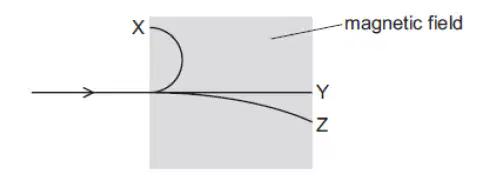
The diagram represents the paths of three types of ionising radiation, X, Y, and Z, through a magnetic field.
The three types of radiation are alpha, beta, and gamma.
Which statement about the ionising radiation is correct?
X is positively charged.
Y is negatively charged.
Z is the most strongly ionising.
X has a smaller mass than Y.
What is the safest way to store a radioactive source?
in a lead-lined box in a metal cabinet
on a shelf away from other radioactive materials
in a glass bottle containing oil
in a fume cupboard
The nuclei of the atoms in a substance are changing randomly and emitting radiation.
What is happening to the substance?
It is undergoing electromagnetic induction.
It is undergoing magnetisation.
It is undergoing solidification.
It is undergoing radioactive decay.

A radiation detector in a laboratory is measuring background radiation. Which row describes the readings and the cause?
A
B
C
D

A medical tracer is used to investigate a tumour in a patient.
The graph shows the corrected count rate from the tracer against time.
What is the half-life of the source?
2 minutes
10 minutes
5000 minutes
10000 minutes

Which type of radioactive source is suitable for use in measuring and controlling the thickness of paper in a paper-manufacturing factory?
A
B
C
D

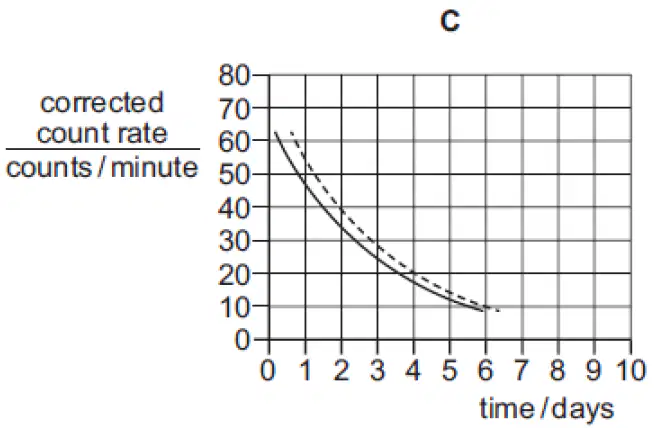
The dashed line on the graph shows the decay curve recorded from a sample of a particular radioactive isotope. The count rate includes background radiation.
Which curve shows the corrected count rate for the decay?



Radioactive waste is often mixed with liquid glass. This mixture solidifies and is stored in steel drums.
Why is this process used to store radioactive waste?
It reduces the decay rate.
It reduces the half-life of the waste.
The waste is contained in a solid block so it cannot leak out.
The glass is transparent so the waste can be seen.
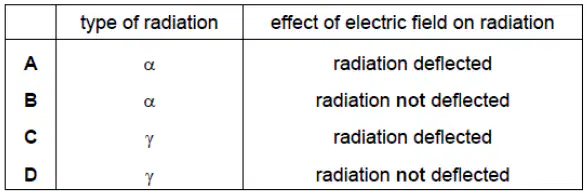
The emissions from a radioactive source pass through a sheet of lead that is 10mm thick.
Which type of radiation is emitted from the source and how is the radiation affected by an electric field?
A
B
C
D
What makes a contribution to a person's annual dose of ionising radiation?
food and drink
greenhouse gases
mobile phone masts
radio and TV transmissions
The reading on a detector placed near a radioactive material is 536 counts per second.
The background count rate is 44 counts per second.
The half-life of the radioactive material is 34 hours.
What is the reading on the detector after 68 hours?
44 counts per second
123 counts per second
134 counts per second
167 counts per second

A radioactive source is placed near a detector.
The radiation arriving at the detector from the source is measured for 10 minutes with different materials placed between the source and the detector.
Which types of radiation are emitted by the source?
a-particles and y-rays
a-particles only
B-particles and y-rays
B-particles only
A box is used for storing radioactive sources.
What is the best material to use for lining the box to prevent radiation from escaping?
aluminium
lead
paper
plastic
An isotope of radon is radioactive. It decays by emitting an α-particle.
What happens to the nucleus of a radon atom during the emission of the a-particle?
It becomes the nucleus of a different isotope of radon with fewer neutrons.
It becomes the nucleus of a different isotope of radon with more neutrons.
It becomes the nucleus of an element with a higher proton number.
It becomes the nucleus of an element with a lower proton number.
Which statement gives two safety precautions to take when a person is working with ionising radiation?
decrease exposure time and decrease distance between the person and the source
decrease exposure time and increase distance between the person and the source
increase exposure time and decrease distance between the person and the source
increase exposure time and increase distance between the person and the source

The radioactive isotope radon (picture above) is an alpha (a) emitter.
During this radioactive decay, an isotope of polonium, Po, is produced.
How many neutrons does a nucleus of this isotope of polonium contain?
130
132
134
136
A student is investigating the count rate of a radioactive substance.
How must he adjust his reading for the background count?
Add the background count to his reading
Ignore the background count as it will not affect his reading
Subtract the background count from his reading
Take repeat readings to eliminate the background count

The diagram shows a lead-lined box used for storing a radioactive source.
Why is the inside of the box lined with lead?
It helps the source to stay radioactive for longer
It makes the box heavier
It makes the radioactive source more stable
It reduces the amount of radiation that can escape from the box
A nucleus spontaneously emits radiation and becomes a nucleus of a different element. What could the emitted radiation be?
Alpha or beta
Alpha or gamma
Beta or neutron
Gamma or neutron
Which apparatus is used to measure background radiation?
a counter, a detector and a source
a counter and a detector only
a counter and a source only
a detector and a source only

Which row correctly identifies the nature of each radioactive emission?
A
B
C
D

