

Wayground logo

Free Printable Worksheets

Font size

S
M
L
XL
Worksheets

periodic trends and element identification Assessment

Total questions: 33

Worksheet time: 23mins

Name
Class
Date
1.

Ionization energy increases

a)

from L to R and from bottom to top

b)

from L to R and from top to bottom

c)

from R to L and from bottom to top

d)

from R to L and from top to bottom

2.

Atomic radius decreases from left to right across a period because from left to right there is

a)

increasing number of valence electrons

b)

increasing shielding

c)

increasing effective nuclear charge

d)

increasing number of protons in the nucleus

3.
Which of the following will have a lower ionization energy than Scandium (Sc)?
a)
Helium (He)
b)
Titanium (Ti)
c)
Calcium (Ca)
d)
Magnesium (Mg)
4.
As atoms of elements in group 16 are considered in order from top to bottom, the electronegativity of each successive element....
a)
decreases
b)
increases
c)
remains the same
d)
none of the above
5.
The atom with the largest atomic radius in Group 18 is - 
a)
Ar
b)
He
c)
Kr
d)
Rn
6.

The element with the highest electronegativity is -

a)

At

b)

F

c)

Cl

d)

Br

7.

The ionization energy of Na is larger than Cs because...

a)

Na has a greater effective nuclear charge

b)

Na has fewer energy levels and less shielding

c)

Cs has a greater effective nuclear charge than Na

d)

Cs has more valence electrons than Na
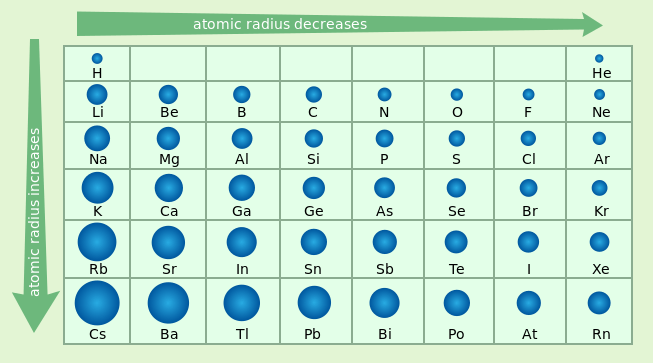
8.
As you move down the periodic table atoms get bigger.  This is because ____________.
a)
The atoms have more mass.
b)
The atoms have more protons.
c)
The atoms have more energy levels
d)
The atoms have more nuetrons
9.
As you move across the periodic table atoms tend to get smaller because, ______________.
a)
the atoms have more mass.
b)
the atoms have less mass
c)
the atoms have more protons.
d)
the atoms have less electrons.
10.
Which atom has the largest atomic radius?
a)
potassium
b)
rubidium 
c)
francium
d)
cesium
11.
Which of the following will have a lower ionization energy than Scandium (Sc)?
a)
Helium (He)
b)
Titanium (Ti)
c)
Calcium (Ca)
d)
Magnesium (Mg)
12.
Which of the following will have a higher ionization energy than arsenic (As)?
a)
Gallium (Ga)
b)
Neon (Ne)
c)
Antimony (Sb)
d)
Germanium (Ge)
13.
Electronegativity is...
a)
how good an atom is at attracting electrons
b)
the ability of an atom to lose electrons
c)
the energy required to remove an electron from a specific atom
d)
how easy it is to make friends. 
14.
What term is used to describe "an atom's tendency to attract electrons to itself when is is chemically combined with another element"
a)
electronation
b)
electron affinity
c)
electronegativity
d)
electrolysis
15.
Francium (Fr) has the lowest ionization energy in Group 1 because - 
a)
it has the smallest number of valence electrons
b)
it has the greatest atomic mass
c)
it has the greatest number of protons, so it attracts its electrons the strongest
d)
its 1 valence electron is very far from the nucleus, so little energy is needed to remove it
16.
Which element has the atomic symbol Pt?
a)
Potonium
b)
Platinum
c)
Protactinium
d)
Actinium
17.
What is the atomic number of Bromine?
a)
8
b)
14
c)
35
d)
108
18.
What is the atomic mass of Nitrogen?
a)
14.01
b)
7
c)
11.32
d)
15
19.
Which of the following is the correct atomic symbol for Sodium?
a)
Na
b)
NA
c)
na
d)
So
20.
Which of the following elements has an atomic number of 27?
a)
Cobalt
b)
Bismuth
c)
Lead
d)
Carbon
21.
Which of the two elements are the most similar?
a)
Boron and Florine
b)
Potassium and Lithium
c)
Florine and Sulfur
d)
Helium and Beryllium
22.
Which of the following is the correct atomic number for Aluminum?
a)
13
b)
33
c)
203.25
d)
47.88
23.
Which of the following is the correct atomic symbol for Iodine?
a)
I
b)
Io
c)
Id
d)
Ie
24.
What of the following elements has an atomic number of 19?
a)
P
b)
K
c)
F
d)
C
25.
What is the atomic number of Mercury?
a)
80
b)
42
c)
88
d)
86
26.
Which of the following elements has an atomic symbol of Cu?
a)
Cuppernium
b)
Copper
c)
Carbon
d)
Radon
27.

What is the symbol for Oxygen on the periodic table?

a)

O

b)

Ox

c)

Og

d)

On

28.

What is the symbol for Gold?

a)

Gd

b)

Ga

c)

Au

d)

Ag

29.

Which element has the symbol "Na"?

a)

Nitrogen

b)

Sodium

c)

Neon

d)

Nickel

30.

What is the symbol for Iron on the periodic table?

a)

Ir

b)

Fe

c)

In

d)

I

31.

Which element has the atomic number 17?

a)

Chlorine

b)

Carbon

c)

Calcium

d)

Chromium

32.

What is the symbol for Potassium?

a)

P

b)

Pt

c)

K

d)

Po

33.

Which of the following elements is an Alkali Metal?

a)

Fluorine

b)

Uranium

c)

Lithium

d)

Bromine
