Worksheets
Evolution Review
Total questions: 50
Worksheet time: 30mins

According to the diagram, which organism is LEAST related to the others?
5
4
3
2

Which best describes punctuated equilibrium?
Speciation occurs due to natural selection
Speciation occurs due to isolation
Speciation occurs slowly in geologic time, followed by long periods with very fast evolutionary change.
Speciation occurs suddenly and rapidly in geologic time, followed by long periods with little evolutionary change.

What is the common ancestor of Letters A, B, C, D, E?
1
2
3
4


Select the best answer based on the image.
Gene Flow
Genetic Drift
Genetic diversity is decreased through this process.
Gene Flow
Genetic Drift
Genetic Diversity is increased through this process.
Gene Flow
Genetic Drift

Select the best answer based on the image.
Gene Flow
Genetic Drift

A population of flowers on one side of a river transports pollen to flowers on the other side of the river
Gene Flow
Genetic Drift
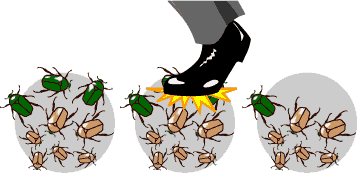
Someone steps on some bugs and randomly removes their alleles from the population. This is an example of
gene flow
genetic drift
speciation
allele frequency

Which group on the cladogram arose FIRST?
Theropods
Allosaurus
Robin
Velociraptor

According to the diagram, what is the common ancestor of ALL organisms on the phylogenetic tree?
B
C
D
E

Which letter represents the most recent common ancestor of sponges and mushrooms?
A
B
C
D
E
Which is an example of evolution by genetic drift, and NOT by natural selection?
A female frog lays hundreds of eggs in a clutch, but only a few of the eggs hatch and develop into adult frogs
A small population of bark beetles is carried in driftwood to a new island, where the members reproduce rapidly
A population of lizards develops longer tongues when their food sources change
The bright red feathers of a male cardinal help attract mates
Charles Darwin realized that
the birds on the Galapagos Islands were identical.
all life is related and descended from a common ancestor
all life is not related and did not descended from a common ancestor.
the oldest layer in the fossil record is located on the top.
Reindeer from a rancher in Alaska escape from their pen during an enormous snow storm. After their escape, they mate with wild caribou that are migrating across the land. The offspring of these have traits for short legs and have tame behavior.
Gene Flow
Genetic Drift
Non-Random Mating
Natural Selection
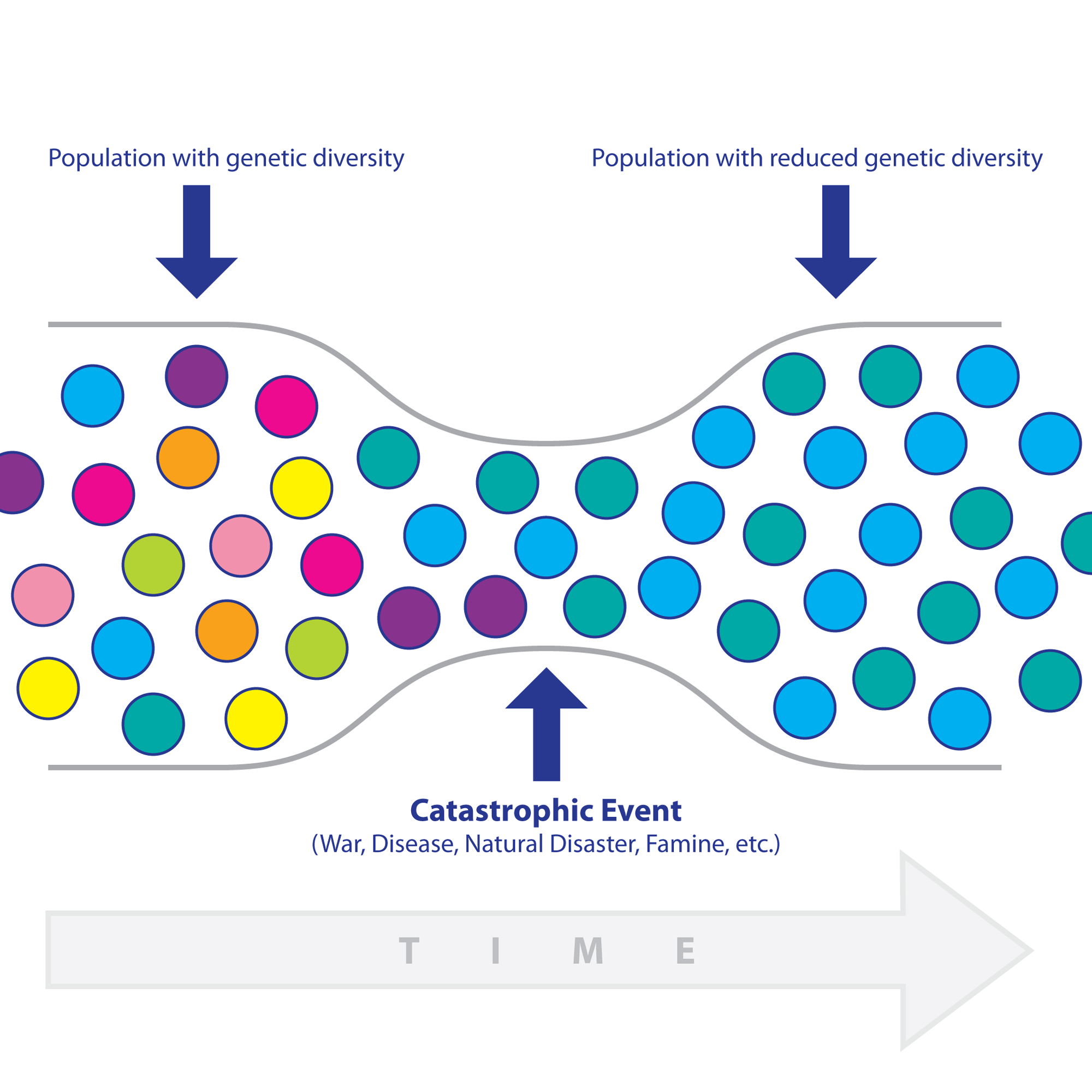
A drastic reduction in the size of a population that can change allele frequencies is called
the bottleneck effect
the founder effect
the gene flow effect
the Thanos effect
The Amish have a higher frequency of polydactyly (extra fingers) in their community than the general population. This is due to the allele for extra fingers being present in the group that started the Amish community.
The difference in allele frequency is due to genetic flow.
The difference in allele frequency is due to the founder effect.
The difference in allele frequency is due to a bottleneck.
The difference in allele frequency is due to speciation.

What number is the common ancestor of C and D
1
2
3
4
What is the common ancestor of Letters A, B, C, D, E?
1
2
3
4
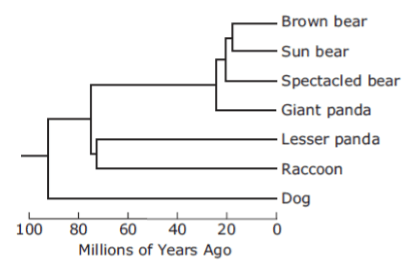
Who is the closest relative to the brown bear?
Giant panda
Dog
Lesser panda
Sun bear

Which organism is the most distantly related to all the others?
Raccoon
Dog
Giant Panda
Sun Bear
On a phylogenetic tree, what do the branch lengths represent?
The age of the organisms
amount of genetic change since divergence
amount of genetic change since convergence
The age of divergence

Cytochrome c is a protein made up of 104 amino acids. It is found in the mitochondria and aides in the electron transport chain during cellular respiration. The data table represents the number of amino acid differences in cytochrome c between organisms A, B, C, and D.
The phylogenetic trees represent possible interpretations of the data in the chart.
Which two phylogenetic trees represent the data most accurately? (choose 2)


The phylogenetic tree was constructed using derived traits of organisms A, B, C, D, and E. Based on the tree, which two organisms share the most derived traits?
C and D because they share one common branch.
C and D because they are closest to the end of the tree next to each other.
A and B because they share the most branch points.
A and B because they are the pair closest to the center.

What is the best inference about biochemical relationships that could be made from this model?
The amino acid sequences of a lancelet and a tuna are more similar than that of a tuna and a salamander. This is due to the lancelet and the tuna both residing entirely in water while the salamander can survive on land.
The amino acid sequences of a salamander and a turtle are less similar than that of a turtle and a leopard. This is due to the turtle and the salamander both being adapted to life in water or land.
The amino acid sequences of a lancelet and a tuna are less similar than that of a tuna and a salamander. This is due to the lancelet and the tuna splitting from a common ancestor longer ago.
The amino acid sequences of a salamander and a turtle are more similar than that of a turtle and a leopard. This is due to the turtle and the salamander both being adapted to life in water or land.

Which number(s) do species B and D have in common?
1
2
3
4
Which number(s) do species C and D have in common?
1
2
3
4



Which is the sequence by which natural selection works?
selection → adaptation → variation
selection → variation → adaptation
variation → adaptation → selection
variation → selection → adaptation
As a population recovers from reduction due to the bottleneck effect, the population will experience -
a loss of genetic dicversity.
migration.
no change to allele frequency.
genetic regulation.
What is the primary purpose of meiosis in relation to inheritable genetic variations?
To produce genetically identical cells
To create new genetic combinations
To repair errors in DNA replication
To generate energy for the cell
Why is genetic diversity important for the survival of a species?
A. It allows individuals to adapt to changing environments.
B. It ensures that all individuals are identical.
C. It reduces the chances of mutations.
D. It increases the likelihood of extinction