wayground logo

Free Printable Worksheets

NEW

Font size

S
M
L
XL
Worksheets

Light Waves Critical Juncture 3.4 Quiz

Total questions: 17

Worksheet time: 9mins

Name
Class
Date
1.
If a car sits out in the sun every day for a long time, can light from the sun damage the car’s paint?
a)
Yes. The paint can take in energy from the light, causing it to be damaged.
b)
No. Light can only change things by warming them up, so it cannot damage the cars paint.
c)
No. Light is not a physical thing, so it cannot change physical things like paint.
d)
Yes. Light from the sun can pull energy out of the paint, causing it to be damaged.
2.
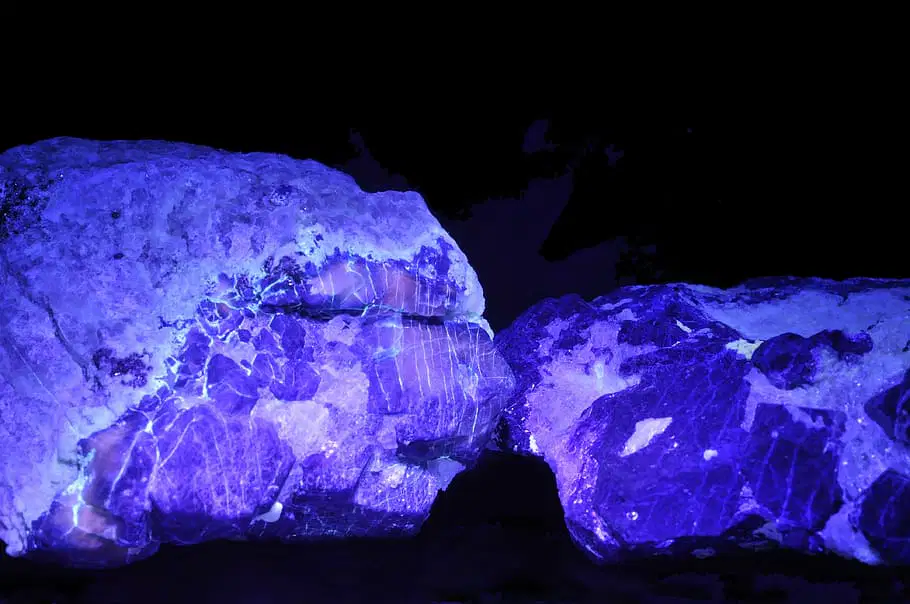
Alex has a type of rock called calcite, which sometimes glows. He puts the calcite under a desk lamp but the calcite does not glow. Then he puts it under an ultraviolet lamp and the calcite glows. Why does ultraviolet light make the calcite glow when light from the desk lamp does not?
a)
Because ultraviolet light carries energy, and light from the desk lamp does not.
b)
Because ultraviolet light pulls energy out of the calcite, and light from the desk lamp does not.
c)
Because calcite can take in energy from ultraviolet light but not from the light from the desk lamp.
d)
Because ultraviolet light carries glowing molecules, and light from the desk lamp does not.
3.
Shonda is learning about a new kind of material that might be used to make new satellites, and she wonders if light can damage the material. The table below shows what happens when different types of light hit the material. Based on this information, which type of light is more likely to damage the material?
a)
The gamma ray light is more likely to damage the material because the gamma ray light can pull energy out of the material when it passes through the material.
b)
The X-ray light is more likely to damage the material because the X-ray light bounces off of the material, which means that it has more energy.
c)
There is no way to know because they are two different types of light, and different types of light can change a material in different ways.
d)
Neither type of light is likely to damage the material because the material does not take in energy from either the X-ray light or the gamma ray light.
4.
Your friend says that she heard about a special type of ink that is only visible when it is out in the sun. Can light from the sun cause this ink to become visible?
a)
No. Light can only change things by warming them up, so it cannot make the ink become visible.
b)
No. Light is not a physical thing, so it cannot change physical things like ink.
c)
Yes. The ink can take in energy from the light, causing it to become visible.
d)
Yes. Light from the sun can pull energy out of the ink, causing it to become visible.
5.
Alina notices that when she shines a desk lamp on a mirror, nothing happens. When she shines an infrared lamp on the mirror, the mirror starts to get warmer. Why does light from the infrared lamp warm the mirror when light from the desk lamp does not?
a)
Because the mirror can take in energy from infrared light but not from the light from the desk lamp.
b)
Because infrared light carries energy, and light from the desk lamp does not.
c)
Because infrared light carries heat molecules, and light from the desk lamp does not.
d)
Because infrared light pulls energy out of the mirror, and light from the desk lamp does not.
6.
Omar has a piece of rock called quartz. He wonders whether light can cause the quartz to become warm. The table below shows what happens when different types of light hit the quartz. Based on this information, which type of light is more likely to cause the quartz to become warm?
a)
The visible light can casue the quartz to become warm because the visible light can pull energy out of the quartz when it passes through the quartz.
b)
The infrared light can cause the quartz to become warm because the infrared light bounces off the quartz, which means that it has more energy.
c)
There is no way to know because they are two different types of light, and different types of light can change a material in different ways.
d)
Neither type of light can cause the quartz to become warm because the quartz does not take in energy from either the infrared light or the visible light.
7.
Your friend shows you a special kind of paper that can change color. He says that it will change color if it is out in the sun. Can light from the sun cause the paper to change color?
a)
Yes. Light from the sun can pull energy out of the paper, causing it to change color.
b)
Yes. The paper can take in energy from the light, causing it to change color.
c)
No. Light is not a physical thing, so it cannot change physical things like paper.
d)
No. Light can only change things by warming them up, so it cannot cause the paper to change color
8.
Khaled has a red toy that is painted with a special kind of paint. When he puts the toy under a desk lamp, it stays red. When he puts the under an infrared lamp, it turns blue. Why does the infrared light cause the toy to turn blue when the light from the desk lamp does not?
a)
Because infrared light pulls energy out of the paint, and light from the desk lamp does not.
b)
Because infrared light carries colored molecules, and light from the desk lamp does not.
c)
Because the paint can take in energy from infrared light but not from the light from the desk lamp
d)
Because infrared light carries energy, and light from the desk lamp does not.
9.
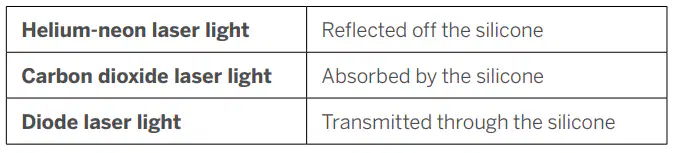
Kayla wonders if lasers will be able to cut a hole in a piece of silicone, which is a change that requires energy. The table below shows what happens when different types light from lasers hit the silicone. Based on this information, which type of laser light can cut a hole in the silicone?
a)
The helium-neon laser can cut a hole in the silicone.
b)
The carbon dioxide laser can cut a hole in the silicone.
c)
The diode laser can cut a hole in the silicone.
d)
Any of these types of light can cut a hole in the silicone, because all light carries energy that can cause materials to change.
10.
Your friend says that there is a kind of glue that only dries when it is exposed to a special type of light. Can light cause glue to dry?
a)
No. Light can only change things by warming them up, so it cannot cause glue to dry.
b)
Yes. The glue can take in energy from the light, causing it to dry.
c)
Yes. Light can pull energy out of the glue, causing it to dry.
d)
No. Light is not a physical thing, so it cannot change physical things like glue.
11.
Santiago’s teacher showed him a kind of cloth that changes color if it is placed out in the sun, but does not change color if it is placed under a desk lamp. Why will light from the sun change the color of the cloth when the light from the desk lamp does not?
a)
Because light from the sun carries colored molecules, and light from the desk lamp does not.
b)
Because light from the sun pulls energy out of the cloth, and light from the desk lamp does not.
c)
Because the sun gives off a type of light that carries energy, and light from the desk lamp does not.
d)
Because the cloth can take in energy from the light from the sun but not from the light from the desk lamp.
12.
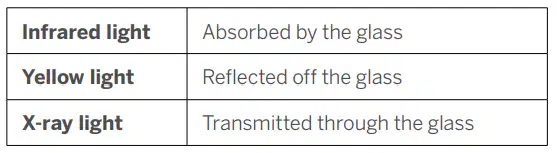
Pedro has a special type of glass that he wants to melt down to make some models. He wonders if light can cause the glass to melt. The table below shows what happens when different types of light hit the glass. Based on this information, which type of light might cause the glass to melt?
a)
The infrared light can cause the glass to melt.
b)
The yellow light can cause the glass to melt.
c)
The X-ray light can cause the glass to melt.
d)
Any of these types of light can cause the glass to melt, because all light carries energy that can cause materials to change.
13.
To take in
a)
Absorb
b)
Transmit
c)
Reflect
14.

To bounce off, to send it back

a)
Absorb
b)
Transmit
c)
Reflect
15.
To pass through without causing damage:
a)
Absorb
b)
Transmit
c)
Reflect
16.

Sierra has a special kind of liquid rubber material. She knows that ultraviolet light is absorbed by the rubber, X-ray light is transmitted through, and blue light is reflected off the rubber. Sierra wonders if the liquid rubber material will become solid if she shines the lights on it.

Can light cause the rubber to become solid? Why or why not? Does it matter what type of light she shines on the rubber?

a)
yes because light can cause materials to change if the lights energy can be ABSORBED.
b)

yes because light can cause materials to change if the lights energy can be REFLECTED.

c)

yes because light can cause materials to change if the lights energy can be TRANSMITTED

d)

No because light can not cause materials to change, just old age or weather can change the materials.

17.

Will is learning about a new kind of plastic used to make models. He learns that infrared light is absorbed by the plastic, X-ray light is transmitted through the plastic, and visible light is reflected off the plastic. Will wonders if the plastic will melt if he shines the lights on it.

Can light cause the plastic to melt? Why or why not? Does it matter what type of light he shines on the plastic?

a)

Light carries energy that causes change. If the object can reflect some types of light meaning it takes in energy it will cause it to melt.

b)

Light carries energy that causes change. If the object can reflect some types of light meaning it bounces the energy back, this energy will then cause it to melt.

c)

Light carries energy that causes change. Some material can absorb some types of light by taking in energy when absorbed other lights are reflected or transmitted, releasing the energy.

d)

Light can carry energy that causes change. Some materials can transmit the energy, causing the material to melt.