
NEW
Font size
 Worksheets
Density Chapter Test Study Guide/Extra Credit
Total questions: 30
Worksheet time: 33mins
Astronauts on the Apollo 17 mission to the moon in 1972 brought back samples of moon rocks to Earth. Which statement accurately describes the properties of the moon rocks on both the moon and on Earth?
The moon rocks had the same mass on the moon as they did on Earth, but they weighed more on Earth.
The moon rocks had the same weight on the moon as they did on Earth, but they had a greater mass on Earth.
The weight and mass of the moon rocks was greater on Earth than on the moon, and the rocks had no weight or mass during the trip when gravity was zero.
The weight, but not the mass, of the moon rocks was greater on Earth than on the moon, and the rocks had no weight or mass during the trip when gravity was zero.
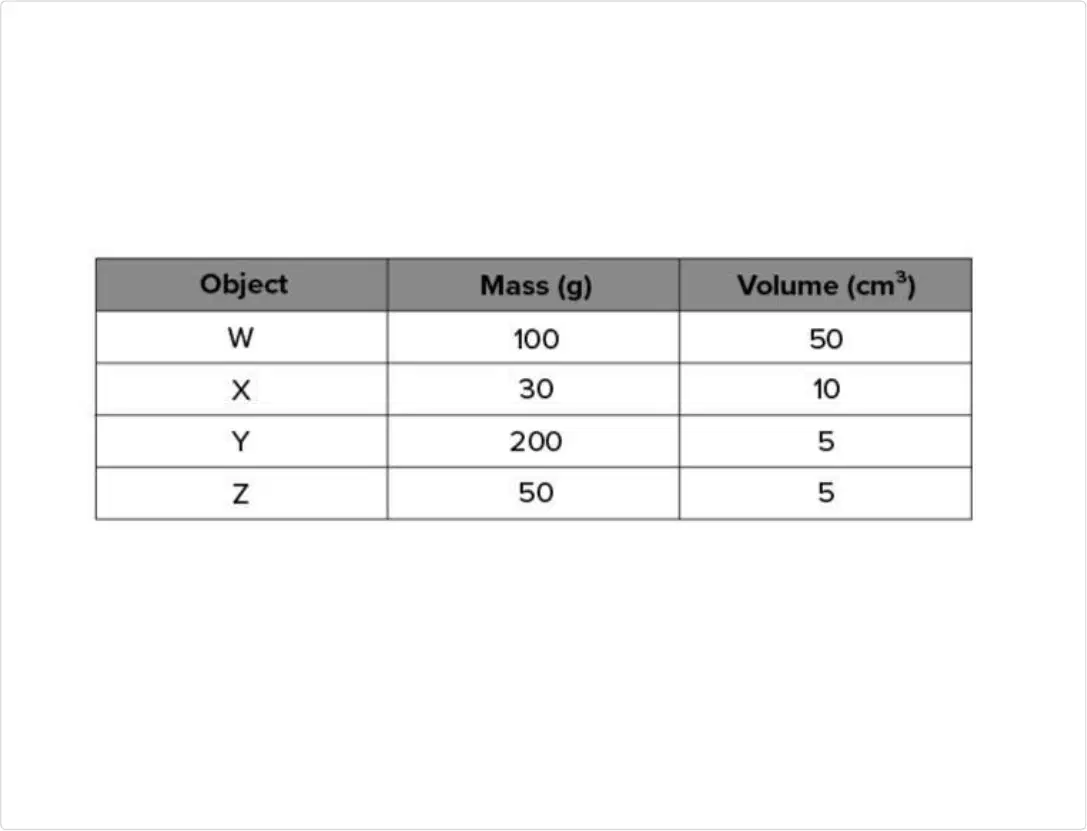
A student measured the volume and mass of four different objects. Which option orders the objects from least dense to most dense?
W, X, Z, Y
X, W, Z, Y
X, Z, W, Y
Z, X, W, Y
A student measures some physical properties of different substances. The student’s observations are listed. - Substance G starts to become a liquid at 0°C. - Substance H has a mass of 28 g and a volume of 14 mL. - Substance I is a liquid that begins to change to a gas at 100°C. - Substance J floats in water at both 50 g and 30 g. Which properties is the student using to classify the substances?
G and H: boiling and melting point; I and J: density
G and I: boiling and melting point; H and J: density
I and J: boiling and melting point; G and H: density
H and J: boiling and melting point; G and I: density

This question has two parts. First, answer Part A. Then, answer Part B. Part A: A scientist has a sample of four different substances. Data about the substances are listed in the table. Which sample is most likely to be water?
Sample W
Sample X
Sample Y
Sample Z

Based on the data in the table, which property is shared by all the samples?
All are magnetic.
All are nonmagnetic.
All are insoluble in water.
All have the same boiling point.
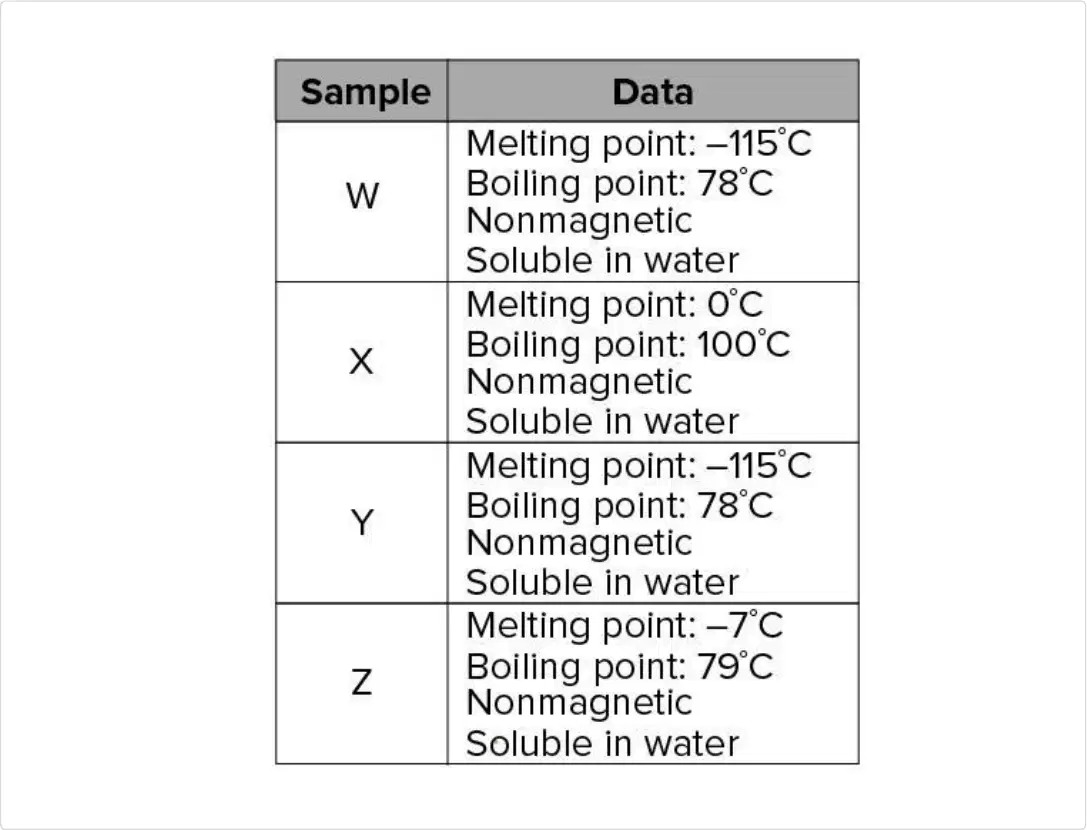
Part B: Which statement supports the answer to "Which samples are mostly likely the same substance"?
W and Y have the same properties.
All four substances are non-magnetic.
Y and Z both have negative melting points.
All four substances are soluble in water.
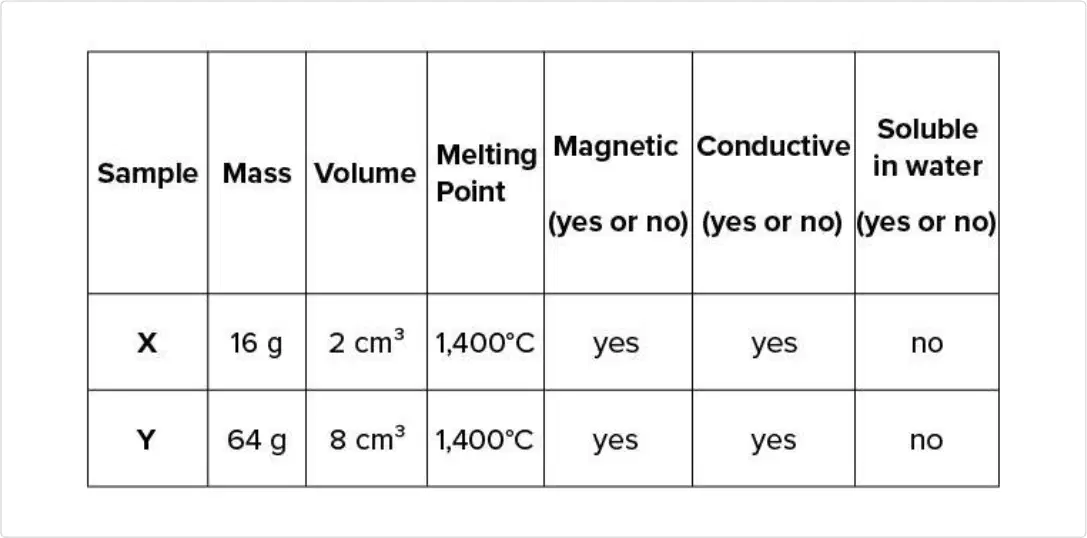
Luci and Kaleb collect data about two samples in the classroom. Luci states that the two samples are the same substance. Kaleb states that they cannot be the same substance. Which student is correct and why?
Kaleb, because the samples have different masses
Kaleb, because the samples have different volumes
Luci, because the samples have the same melting point
Luci, because all the samples have identical properties including density


303.4 g
370.4 g
373.0 g
373.4 g
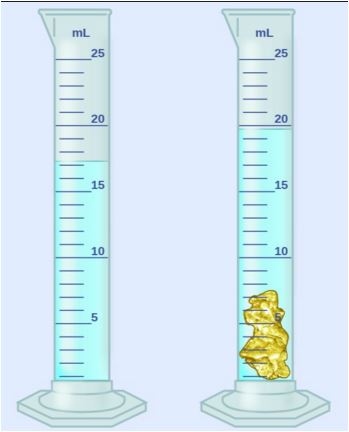
When you put an object in a graduated cylinder of water and measure how much the water level changed what is this process called?
Relative Density
Displacement
Density

10.0 ml
15.0 ml
20.0 ml
25.0 ml
In a density column, is the substance with the highest density on the bottom or the top?
Bottom
Top
Which of the following is the correct definition of density?
The amount of stuff in an object
The amount of space an object takes up
A measure of the force of gravity on an object
The amount of matter (mass) packed into a space (object)

Which object has the highest density in this picture?
A
B
C
Does 1cup or 6cups of water have a higher density?
1 cup
6 cups
They have the same density

Which substance is the most dense in this picture?
Vegetable Oil
Dish Soap
Honey
Corn Syrup

You calculated the density of an unknown substance to be 5.7g/cm3. According to the chart, which of the substances do you most likely have?
Aluminum
Iron
Tin
Zinc

