
 Worksheets
The Solar System Review
Total questions: 12
Worksheet time: 6mins
Name
Class
Date
1.
Which solar system object is the largest?
a)
Jupiter
b)
Saturn
c)
the Sun
d)
Neptune
2.
Which best describes the astroid belt?
a)
another name for the Oort cloud
b)
the region where comets originate
c)
large chuncks of gas, dust, and ice
d)
millions of small rocky objects
3.
Which describes a planet's speed as it orbits the Sun?
a)
it constantly decreases
b)
it constantly increases
c)
it does not change
d)
it increases then decreases
4.
The diagram below shows a planet's orbit around the Sun. What does the blue arrow represent?
a)
the gravitational pull of the Sun.
b)
the planet's orbital path.
c)
the planet's path if the Sun did not exist.
d)
the planet's speed.
5.

Which describes the greenhouse effect?
a)
effect of gravity on temperature
b)
energy emitted by the Sun
c)
energy trapped by atmosphere
d)
reflection of light from a planet
6.
How are the terrestrial planets similar?
a)
similar densities
b)
similar diameters
c)
similar period of rotation
d)
similar rocky surfaces
7.
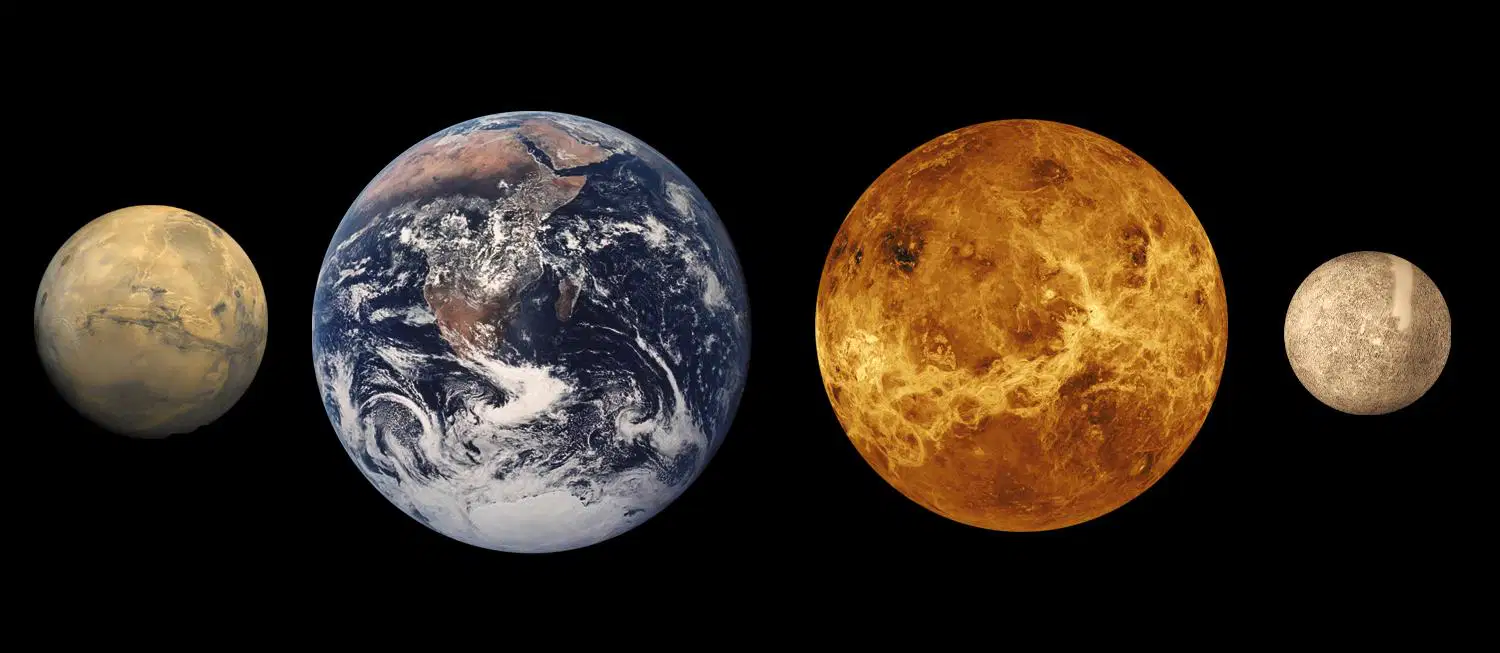
Which inner planet is the hottest?
a)
Mercury
b)
Venus
c)
Earth
d)
Mars
8.
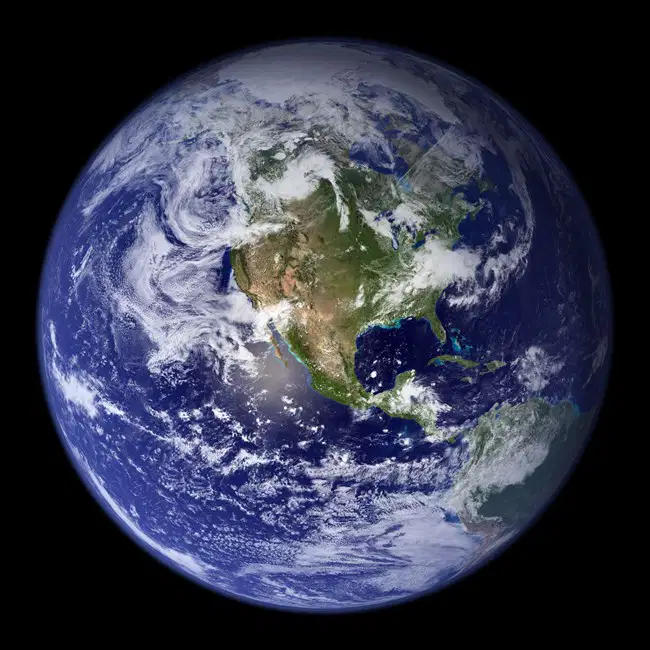
The photograph shows how Earth appears from space. how does Earth differ from other inner planets?
a)
Its atmosphere contains large amounts of methane.
b)
Its period of revolution is much greater.
c)
Its surface is covered by large amounts of liquid water.
d)
Its surface temperature is higher.
9.
Which two gases make up most of the outer planets?
a)
ammonia and helium
b)
ammonia and hydrogen
c)
hydrogen and helium
d)
methane and hydrogen
10.
Which is true of the dwarf planets?
a)
more massive than nearby objects
b)
never have moons
c)
orbit near the Sun
d)
spherically shaped
11.
Which is a bright streak of light in Earth's atmosphere?
a)
comet
b)
meteor
c)
meteorite
d)
meteoroid
12.
Which best describes an asteroid?
a)
icy
b)
rocky
c)
round
d)
wet
100 %

