
 Worksheets
ACP Chemistry Midterm Review
Total questions: 123
Worksheet time: 3hrs 19mins

.000457
How close a measurement is to the accepted value is called:
Accuracy
Precision
Error
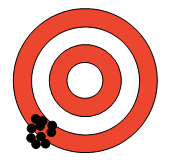
This targeting shows:
This term describes how close data values are to EACH OTHER
Students measured length during a science experiment and got 12 cm. But the actual measurement was 14.25 cm. What was the percent error?
15.79%
18.75%
2.25%
18%
How many kilograms of calcium are there in 173 pounds of calcium? (1 pound = 454 grams; 1 kg = 1000 g)
1.10 kg
78.5 kg
110 kg
78500 kg
These kind of observation use your senses to observe results.
Qualitative
Quantitative

Which of the following choices best represents the length reading from the metric ruler pictured?
87 mm
87.4 mm
87.40 mm
87.400 mm

Which of the following choices best represents the length reading from the metric ruler pictured?
8.5 cm
8.45 cm
8.450 cm
8 cm

The state of matter that has no definite size or shape is
Solid
Liquid
Gas

Definite shape and definite volume
Solid
Liquid
Gas

Has a definite volume but not a definite shape
Solid
Liquid
Gas
In which state of matter will there be the LARGEST space between molecules?
solid
liquid
gas
very low energy
solid
liquid
gas

What is the density of the object depicted in the graph?
0.2 g/cm3
5.0 g
2 g
5.0 g/cm3
What is a physical property?
Characteristics of a substance that cannot be observed with the senses
Characteristic of a substance that can be seen but cannot be heard or smelled
Characteristics of a substance that can be observed with the senses
Characteristic of a substance that can only be seen during a chemical reaction
What is a chemical property?
Characteristic of a substance that cannot be seen
Characteristic of a substance that can be observed with the senses
Characteristic of a substance that can be seen but nor heard or smelled
Characteristic of a substance that can only be seen during a chemical reaction
What is a chemical change?
A chemical reaction that is irreversible and changes the identity (chemical formula) of a substance
A chemical reaction that does not change the substance at all
A reversible change
A change that only changes the density or color of a substance
What is a physical change?
A change that produces gasses or a change in color
A change that is irreversible and creates a new substance
A change that only reduces the size of a substance
A reversible change that does NOT change the identity (chemical formula) of a substance
Which of the following are physical properties
flammability
density
solubility
reactivity
evaporation

Melting ice is a _________ change
Chemical
Physical

Which box shows an compound?
A
B
C
D
Which boxes show an mixture? (Multiple select)
A
B
C
D

How would you classify a solid Aluminum (Al) pop tabs?
Element
Compound
Homogeneous Mixture
Heterogeneous Mixture

How would you classify a chocolate chip granola bar?
Element
Compound
Homogeneous Mixture
Heterogeneous Mixture

How would you classify Chalk (CaCO3)
Element
Compound
Homogeneous Mixture
Heterogeneous Mixture

How would you classify air, which includes gases like oxygen, nitrogen, water vapor, etc.?
Element
Compound
Homogeneous Mixture
Heterogeneous Mixture

How would you classify helium (He)
Element
Compound
Homogeneous Mixture
Heterogeneous Mixture

Which scientist was the first person responsible for proposing the idea of atoms?
Democritus
John Dalton
Ernest Rutherford
J.J. Thomson
Niels Bohr

Which scientist was the first person responsible for proposing the discovery of the electron?
Democritus
John Dalton
Ernest Rutherford
J.J. Thomson
Niels Bohr

Which scientist was the first person responsible for proposing the discovery of the nucleus?
Democritus
John Dalton
Ernest Rutherford
J.J. Thomson
Niels Bohr

Which scientist claimed that the atom was a small, dense, solid sphere?
Democritus
John Dalton
Ernest Rutherford
J.J. Thomson
Niels Bohr

Which scientist's model is referred to as the Planetary model?
Democritus
John Dalton
Ernest Rutherford
J.J. Thomson
Niels Bohr
What particle(s) are located in the nucleus?
protons only
neutrons only
electrons only
protons and neutrons
protons and electrons
What particle(s) have a charge?
protons only
electrons only
protons and electrons
electrons and neutrons
(challenge) An atom has 10 protons and 10 electrons. What happens to the charge if you add 1 more electron?
It becomes a negative ion
It becomes a positive ion
nothing changes
It becomes a different element
An atom of HELIUM has 2 protons. If you add 1 more proton, what happens?
It becomes an ion
It becomes a different kind of element
Nothing
Challenge: what is the mass of an atom with 2 protons, 2 neutrons, and 2 electrons?
mass = 2
mass = 4
mass = 6
mass = 8
Challenge: What is the charge of an atom with 3 protons and 2 electrons?
0 (neutral)
+1
-1
Why do most elements create chemical bonds?
To gain electrons, so that each element has more electrons.
To equal the number of protons and electrons.
To stop radioactive decay.
To reach eight valence electrons, which makes them stable.
What is the net charge of an ionic compound?
Four
Zero
One
Eight
If an element gains one electrons, what charge will it have as an ion?
+1
-1
Zero
-2
Why are ions attracted to each other?
Cations and Anions have opposite charges.
Cations think Anions are cool.
The fact that both are metals allows them to mix.
The ions change their electrons again.
An element gains two electrons. This element is:
An anion with a +2 charge
A cation with a +2 charge
An anion with a -2 charge
A cation with a -2 charge.
An elements loses one electron to become a cation. This element is a:
Alkaline Earth Metal
Halogen
Alkali Metal
Metalloid


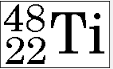
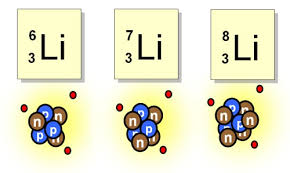
If X is the symbol for an element, which of the following two symbols represent isotopes of the same element?
I. 7735X II. 7733X III. 8137X IV. 8135 X
I and II
III and IV
I and IV
I and III

146C --> 0-1e + ________

Complete the nuclear reaction
42He
0-1 e
00γ
178O
Nuclear fission is where...
two smaller atom nuclei fuse into one larger atom nucleus
two larger atom nuclei fuse into one smaller atom nucleus
one larger atom nucleus decays and breaks into two or more smaller atom nuclei
one smaller atom nucleus decays and breaks into two or more larger atom nuclei
Calculate the wavelength of the yellow light emitted by the street light, if the frequency of the radiation is 5.10x10¹⁴Hz.
5.12 x 10⁻⁷m
5.88 x 10⁻⁷ m
4.20 x 10¹⁴m
3.0 x 10⁸m
Energy is measured in........
Wavelength
Meters
Joules
Frequency
Which color in the visible spectrum of light has the longest wavelength?
Indigo
Red
Blue
Violet
The unit of measure for frequency is?
Seconds
Meters
Hertz
Liters
What does energy have to do with wavelength and frequency?
The higher the frequency the less energy the wave has.
The lower the frequency the more energy the wave has.
The shorter the wavelength the more energy the wave has.
The longer the wavelength the more energy the wave has.
What is the frequency of a light that has the Energy of 2.84x10⁻¹⁹.
4.30x10¹⁴Hz
4.30x10⁻¹⁴Hz
4.30x10-54Hz
4.30x1054Hz
The energy for a quantum of light is 2.84x10⁻¹⁹J. What is the wavelength.
6.97x10-45m
6.97x1045m
6.97x10⁻⁷m
6.97x10⁷m

Which EM waves are have the lowest frequency?
radio
none
infrared
x-rays
Which EM waves have the shortest wavelength?
radio
x-rays
ultraviolet
gamma rays
1s22s22p63s23p64s23d10
What atom matches this electron configuration?
[Xe] 6s24f145d9
Mercury
Gold
Platinum
Thallium
Each row on the periodic table represents:
an energy level
a sublevel
an electron
an orbital
Is the following electron configuration correct? Why or why not?
1s22s22p63s23p64s24d104p65s1
No. 4p6 should be after 5s1.
No. It should be 3d10 not 4d10
Yes. All electrons are represented properly.
Yes.

The electron configuration 1s2 2s22p6 3s23p6 represents which noble gas?
neon
argon
helium
krypton
What are valence electrons?
Any of an atom's electrons
Electrons located on the first energy level
Electrons not attached to any atom
electrons located on the outer energy level
What is the ionic charge of Phosphorus (P)?
+5
-3
+3
-5
Why are halogens so reactive?
They want to get rid of their only valance electron
They only need one more electron
They are non reactive, they have a full shell

Which color on the image of the periodic table corresponds with the metalloids.
bright yellow
gold
teal
light blue
The periodic table is mostly comprised of what type of element?
Metals
Nonmetals
Metalloids

Which elements are to the LEFT of the zigzag?
metals
nonmetals
metalloids
Xenon is an example of
Alkali Metal
Alkali Earth Metal
Halogen
Noble Gase
MgI2
Magnesium Iodine
Monomagnesium di-iodide
Magnesium iodide
Magnesium tetraiodide
Name the following: NO2
Nitrogen oxide
Mononitrogen dioxide
Nitrogen dioxide
Nitrogen (II) oxide
Name the following: CF4
Carbon fluoride
Monocarbon tetrafluoride
Carbon tetrafluoride
Carbon fluorate
Name the following: N2O5
Nitrogen oxide
Dinitrogen pentoxide
Nitrous oxide
Nitrogen pentoxide
Name the following: CuO
Copper oxide
Copper (II) oxide
Monocopper monoxide
Copper monoxide
Is the following compound ionic or covalent?
PBr5
Ionic
Covalent
Cr3+ O2-
What is the name of the following compound: K2SO4
potassium sulfur
potassium sulfate
potassium(I) sulfate
potassium(II) sulfide
What does electronegativity do as you go across a period?
decrease
no pattern
stay the same
increase
Electronegativity is the ability of an atom to attract electrons in a physical bond.
false
true

Which is the correct order of electronegativity from lowest to highest?
Zinc, Nickel, Iron, Scandium
Iron, Nickel, Zinc, Scandium
Scandium, Iron, Nickel, Zinc
Scandium, Iron, Zinc, Nickel
Which bond involves an unequal sharing of electrons?
Ionic bond
Nonpolar covalent bond
Polar covalent bond
Metallic bond
__________ bonds involve an unequal sharing of electrons, while __________ bonds involve an equal sharing of electrons.
Nonpolar, polar
Polar, metallic
Metallic, nonpolar
Polar, nonpolar
True or False: The smaller the difference in electronegativity, the more polar the bond
True
False



