
 Worksheets
Computer Organization and Architecture Test 1
Total questions: 70
Worksheet time: 53mins
The _________ controls the I/O devices and transfer of data to and from the primary storage.
LU
AU
ALU
CU
____________ enables the processor to access data quickly whenever they are needed.
CU
Cache
Memory
Register
The set of wires, which carry information in a controlled manner, is called
System bus
Public bus
Private bus
None of these
The ALU works on the instructions and data held in the _______________
Notebook
Registers
Copy Pad
I/O devices
The fastest memory in the computer system is _____________
ROM
RAM
Cache
None of these
A register that keeps track of the next instruction to be executed is called a _____________
Program Counter
Instruction Register
Accumulator
Data Register
A processor only operates on binary data, that is, data composed of 1s and 0s.
True
False
The address bus informs the CPU about the location of of the data residing in the memory.


_______________ is a large multilayered printed circuit board inside a computer that contains CPU,BIOS,ROM chip and the CMOS setup information.
Motherboard
RAM
ROM
Cache
The ___________ informs the CPU about the location of the data residing in the memory.
Data bus
Address bus
Cache
Control line
In a classroom, Rahul is trying to understand the role of the Program Counter (PC) in a computer. What is the primary function of the Program Counter (PC)?
To keep track of the next instruction to be executed
To store the current instruction
To hold data temporarily
To perform arithmetic operations
In a classroom, Asher is trying to understand which component of a computer is responsible for executing arithmetic and logic operations.
Instruction Register (IR)
Arithmetic Logic Unit (ALU)
Memory Data Register (MDR)
Memory Address Register (MAR)
The main components (or basic units) of a computer system are
Input/Output unit
Central Process Unit (CPU)
Memory unit (Storage unit)
All the above
The device used to fetch (or bring) instructions and data into a computer system is called
ALU
Control Unit
Input Device
Output Device
______ translates the logical address into a physical address.
MMU
Translator
Compiler
Linker
The small extremely fast RAM is called as ___________.
Heap
Stack
Cache
Accumulator
__________ is generally used to increase the apparent size of physical memory.
Secondary memory
Virtual memory
Hard Disks
Disks
The address of the address of the operand is specified in _______________ addressing mode.
immediate
direct
indirect
relative
To get the physical address from the logical address generated by the CPU, __________ is used.
MAR
MMU
TLB
Overlays
In Register Transfer Language, ____________ is used to denote "Add the numbers in A and B and place the sum in A".
B ← A+B
A+B←A
A ← A+B
A+B → B
The output of an exclusive-NOR gate is 1,Which input combination is correct?
A = 1 B = 0
A = 0 B = 1
A = 0 B = 0
none of the above
How many AND gates are required to implement the Boolean expression?
1
2
3
4
OR gate with schematic "bubbles" on its inputs performs the same functions as___gate.
NOT
EX-OR
NAND
NOR
In Boolean algebra A.A is equal to
A
A²
2A
1
Create a Logic circuit for the given Boolean Expression.
1.) Y= (A+B')C'


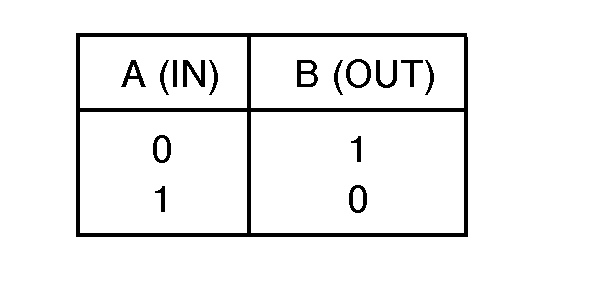
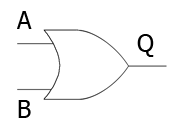
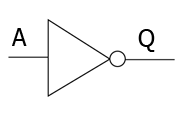

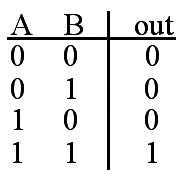
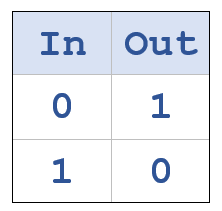
This is the truth table for which logic gate?
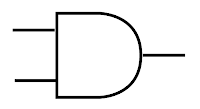
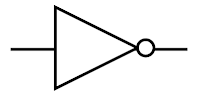
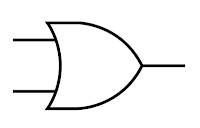
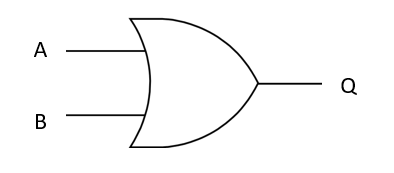
In this logic circuit, if A = 0 and Q = 1, what is B?
0
We can't say
1
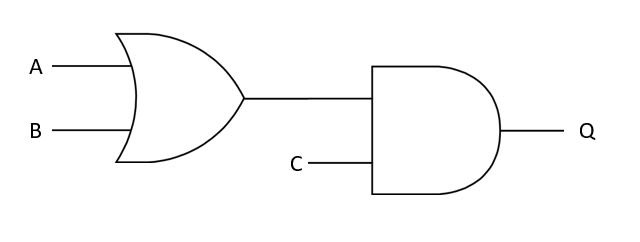
In this logic circuit, what is Q if the inputs are: A=0, B=1, C=0?
0
We can't say
1

What is the output?
0
1
2
ERROR
What is the name of the Logic Gate that converts inputs of 0 to 1 and inputs of 1 to 0
AND
OR
NAND
NOT
Find the 1's complement of 1011
1011
1100
0100
1111
What is 1+1?
Carry 1 Sum 0
Carry 0 Sum 0
Carry 1 Sum 1
Carry 0 Sum 0
Find the 2's complement of 0101.
1010
1101
1111
1011
What are binary codes?
1&0
Group of symbols of 0’s and 1’s representing some data
Group of decimal numbers
Binary equivalent of decimal
BCD 8421 is a
Weighted code
Non Weighted code
Alphanumeric code
Error control code
What is the primary purpose of a flip-flop in digital circuits?
To perform arithmetic operations
To store binary data
To amplify signals
To convert analog signals to digital
Which of the following describes a D flip-flop?
Stores data on the rising edge of the clock
Stores data on the falling edge of the clock
Does not have a clock input
Is used for asynchronous operations
Which of the following best describes a register in digital electronics?
A device that stores multiple bits of data
A circuit that performs logical operations
A component that generates clock signals
A type of memory that is non-volatile
What is the primary function of a counter in digital electronics?
To count the number of clock pulses
To store data temporarily
To perform logical operations
To convert analog signals to digital
What is the function of a binary adder in digital circuits?
To add two binary numbers
To store binary data
To perform logical comparisons
To convert binary to decimal
Which of the following is not a numbering system?
Binary system
Octal system
Hexadecimal system
Ternary system
What is the binary equivalent of 7 in decimal system?
001
111
101
110
What is the decimal equivalent of the binary number 101?
2
3
5
1
Is it possible to convert from one numbering system to another?
Yes
No
The parameter through which 16 distinct values can be represented is known as
Bit
Byte
Word
Nibble
What is the base of the binary number system?
3
10
8
2
How do you convert the decimal number 10 to binary?
1010
1000
1100
1011
What is the hexadecimal representation of the decimal number 255?
FF0
F0
FE
FF
What is the base of the octal number system?
10
12
6
8
Name one application of number systems in computer science.
Octal number system for file permissions.
Hexadecimal number system for color representation.
Binary number system for data representation.
Decimal number system for user input validation.
According to Boolean Law, A+1=?
1
A
0
A'
In boolean algebra, the OR operation is performed by which properties?
Associative properties
Commutative properties
Distributive properties
All of the above
DeMorgan's theorem states that
(AB)'=A'+B'
(A+B)'=A'*B
A'+B'=A'B'
(AB)'=A'+B
(A+B) (A'*B') = ?
1
0
AB
AB'
Complement of the expression a'b + cd' is
(A' + B) (C' +D)
(A+B') (C'+D)
(A' + B) (C' +D)
(A + B') (C+D')
Simplify Y = AB' + (A' +B)C
AB' + C
AB + AC
A'B +AC'
AB +A
The boolean function A + BC is a reduced form of
AB + BC
(A +B) (A+C)
A'B +AB'C
(A + C)B
How does a NOT gate function?
Inverts the output
Outputs the opposite of its input
Amplifies the input
Generates random output
Describe the working principle of an XOR gate.
XOR gate is a gate that outputs 1 when both inputs are 0.
XOR gate is a gate that outputs 0 when both inputs are 1.
XOR gate is a digital logic gate that gives a high output (1) only when the number of true inputs is odd.
XOR gate is a digital logic gate that gives a high output (1) only when the number of true inputs is even.
What is the significance of a logic gate in digital electronics?
Logic gates are only used for entertainment purposes in digital electronics.
Logic gates are significant in digital electronics because they control the weather.
Logic gates are used for cooking recipes in digital electronics.
Logic gates are significant in digital electronics because they perform basic logical functions and are used to design complex digital circuits.
Differentiate between a half adder and a full adder.
A half adder is used for subtraction, while a full adder is used for addition.
A full adder adds two single-bit binary numbers.
A half adder adds two single-bit binary numbers, while a full adder adds three single-bit binary numbers.
A half adder adds three single-bit binary numbers.
Which of the following is not a logic gate?
AND
OR
IF
NOT
What is the Truth Table?
It is a table representing what output will one get for a given input.
It is a table representing what input and output will be given by a given boolean operator.
Both of these
None of these

