
 Worksheets
Geometry: Topic 6 (Quadrilaterals & Other Polygons)
Total questions: 56
Worksheet time: 2hrs 35mins
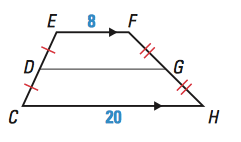

FEDC is an isosceles trapezoid. Find the missing angle.
180°
140°
120°
60°


Find the measure of one interior angle in each regular polygon. Round your answer to the
nearest tenth if necessary.
A
B
C
D

If JL = 18, NK = 12, and ML = 10, find the perimeter of JKLM.
A. 42
B. 45
C. 50
D. 56

If ABCD is a parallelogram, find m∠D.
127
112
132
146

Find m∠P.
107
123
142
128

Find the measure of angle T.
116
121
126
111

If BD = 8x - 27 and EC = 2x + 33, find the length of BD.
53
61
63
56

Find WX.
29
31
22
26

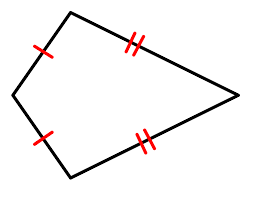
If QRST is a kite, find the measure of angle QRS.
137
141
124
122
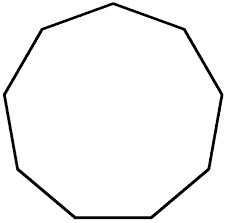
Find the angle SUM of the interior angles of the polygon.
720°
900°
1080°
1260°

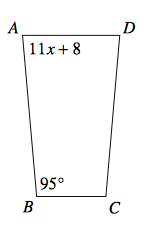
Given trapezoid ABCD, Find the value of x.
7
8
85
None of these



In parallelogram ABCD, ∠DAB ≅ ?
∠DAC
∠DCB
∠ABC
∠ADC

Find the measure of the angle indicated in the following parallelogram.
95
90
81
86

Find the measure of the angle indicated in the following parallelogram.
105
36
45
135

Find values of x and y for which ABCD must be a parallelogram. The diagram is not to
scale.
x = 10, y = 13
x = 5, y = 10
x = 10, y = 21
x = 10, y = 5

If ACFG is a parallelogram with m∠CAG=(8a+13)° and m∠ACF(4a+23)° , find m∠ACF .
109°
12°
33°
71°

In the parallelogram, AX=4y+3 and XF=2y+7 , find the value of y.
5
2
2/3
11
The measure of the bases of a trapezoid are 14 and 20. What is the measure of the median (midsegment) of the trapezoid?
(a)

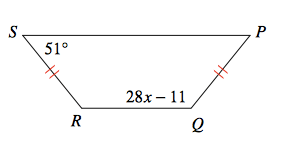
WXYZ is an isosceles trapezoid with WX parallel to ZY. If m∠WZY=(2a−24)°
and m∠XYZ=(a+37)° , find m∠XYZ .
98°
55.7°
102.7°
61°
Two consecutive angles of a parallelogram measures (x + 30) and 2(x-30) respectively. What is the value of x?
40
50
60
70
Two consecutive angles of a parallelogram measures (x+30) and 2(x-30) respectively. What is the measure of the smaller angle?
20
40
60
80

(a)

(a)

(a)

A
B
C
D

A
B
C
D

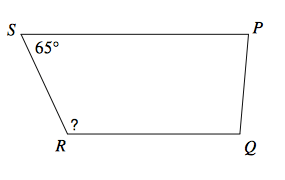
Use the properties of isosceles trapezoids to solve for angle R.
130 degrees
50 degrees
25 degrees
Can't tell


If you wanted to prove that Quadrilateral ABCD is a rhombus, what would be the best piece of evidence to use?
The length of each side is √(34), therefore all sides are congruent.
The length of each side 8, therefore all sides are congruent.
The slope of AC and BD is 5/3, therefore AC and BD are parallel.
The slopes of the sides are opposite reciprocals, therefore opposite sides are parallel.

If you want to prove that Quadrilateral ABCD is a rectangle, what is the best piece of evidence to use?
The lengths of AC and BD are the same, therefore AC and BD are congruent
The slopes of AC and BD are the same, therefore AC and BD are congruent
The slopes of AB and BD are the same, therefore AC is perpendicular to BD
The slopes of AB and BD are opposite reciprocals, therefore AC is perpendicular to BD.

What is the length of Side AC?
5/2
5
29
√(29)

Fill in the missing reason for the proof.
If alternate interior angles are congruent, then the lines are parallel.
Definition of parallelogram
Definition of parallel lines
Opposite sides of a parallelogram are congruent.
Fill in the missing reason for the proof.
If alternate interior angles are congruent, then the lines are parallel.
Definition of parallelogram
Definition of parallel lines
Opposite sides of a parallelogram are congruent.

Which theorem can be used to prove the quadrilateral is a parallelogram?
Parallelogram Opposite Sides Converse Theorem
Parallelogram Opposite Angles Converse Theorem
Opposite Sides Parallel and Congruent Theorem
Parallelogram Diagonals Converse Theorem

The missing reason is the same for steps 2 and 4. What is the missing reason?
If alternate interior angles are congruent, then the lines are parallel.
If vertical angles are congruent, then the lines are parallel.
Definition of parallelogram
Alternate interior angles formed by parallel lines are congruent.

Choose the correct missing reasons for the proof.
4) CPCTC; 6)All quads are parallelograms
4) Alternate Interior Angles are congruent; 6) Definition of paralelogram
4)CPCTC; 6)Definition of parallelogram
4) Alternate Interior Angles are congruent; 6) All quads are parallelograms

Which theorem can be used to prove the quadrilateral is a parallelogram?
Parallelogram Opposite Sides Converse Theorem
Parallelogram Opposite Angles Converse Theorem
Opposite Sides Parallel and Congruent Theorem
Parallelogram Diagonals Converse Theorem

Which theorem can be used to prove the quadrilateral is a parallelogram?
Parallelogram Opposite Sides Converse Theorem
Parallelogram Opposite Angles Converse Theorem
Opposite Sides Parallel and Congruent Theorem
Parallelogram Diagonals Converse Theorem

Why is this not a rhombus?
Opposite sides are not congruent
Angles are not all 90
Diagonals don't meet at 90
Same side angles don't add to 180

Which method will NOT prove the quadrilateral is a parallelogram.
Show that a pair of sides are congruent and parallel.
Show that both pairs of opposite sides are congruent
Show that both pairs of opposite sides are parallel
Show that a pair of sides are parallel
The missing reason is the same for steps 2 and 4. What is the missing reason?
If alternate interior angles are congruent, then the lines are parallel.
If vertical angles are congruent, then the lines are parallel.
Definition of parallelogram
Alternate interior angles formed by parallel lines are congruent.
Choose the correct missing reasons for the proof.
4) CPCTC; 6)All quads are parallelograms
4) Alternate Interior Angles are congruent; 6) Definition of paralelogram
4)CPCTC; 6)Definition of parallelogram
4) Alternate Interior Angles are congruent; 6) All quads are parallelograms
If you want to prove that Quadrilateral ABCD is a rectangle, what is the best piece of evidence to use?
The lengths of AC and BD are the same, therefore AC and BD are congruent
The slopes of AC and BD are the same, therefore AC and BD are congruent
The slopes of AB and BD are the same, therefore AC is perpendicular to BD
The slopes of AB and BD are opposite reciprocals, therefore AC is perpendicular to BD.
If you wanted to prove that Quadrilateral ABCD is a rhombus, what would be the best piece of evidence to use?
The length of each side is √(34), therefore all sides are congruent.
The length of each side 8, therefore all sides are congruent.
The slope of AC and BD is 5/3, therefore AC and BD are parallel.
The slopes of the sides are opposite reciprocals, therefore opposite sides are parallel.
If you wanted to prove that Quadrilateral ABCD is a Parallelogram, what would be the best piece of evidence to use?
Length of AC = Length of BD, therefore Side AC is congruent to Side BD
Length of AC = Length of BD, therefore Side AC is parallel to Side BD
Slope of AC = Slope of BD, therefore Side AC is parallel to Side BD
The Slopes of AC and BD are opposite reciprocals, therefore Side AC is parallel to Side BD

