Wayground logo

Free Printable Worksheets

Font size

S
M
L
XL
Worksheets

Unit 7 Taxonomy Test Corrections

Total questions: 30

Worksheet time: 45mins

Name
Class
Date
1.
A scientific name consists of 
a)
Genus and Order
b)
Genus and Domain
c)
Genus and species
d)
Kingdon and Phylum
2.
The most specific of the classifications is?
a)
class 
b)
order 
c)
genus 
d)
species
3.
The 2 kingdoms that make up Prokaryotes are?
a)
Animals and Plants 
b)
Protists and Fungi
c)

Archaebacteria and Bacteria

4.
The 8 levels of classification, most broad to most specific.
a)
Domain, Genus, Family, Order, Class, Phylum, Kingdom, Species
b)
Domain, Species, Kingdom, Genus, Phylum, Family, Class, Order
c)
Domain, Kingdom, Phylum, Class, Order, Family, Genus, Species
d)
Order, Kingdom, Species, Domain, Phylum, Family, Class, Genus
5.
Which organisms are most closely related?
a)
Equus caballas (Horse) & Equus burchellii (Zebra)
b)
Cyanea artica (Jellyfish) &
Ctenodiscus crispatus (Mud Starfish)
c)
Naja naja (cobra) & Glycine max (soya bean)
d)
Ophiocomina nigra (black brittle star) & Brassica nigra (black mustard)
6.
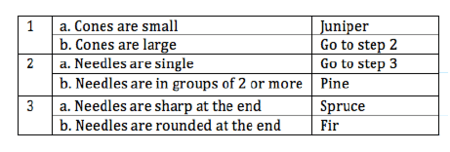
A dichotomous key for trees is provided. Hikers found a tree that has large brown cones and single sharp needles. What species of tree have the hikers found?
a)
Juniper
b)
Pine
c)
Spruce
d)
Fir
7.
A tool used by a taxonomist to identify an unknown organism is known as a __________.
a)
dichotomous key
b)
binomial nomenclature
c)
scientific name
d)
binomial key
8.
Which organisms pictured on the cladogram have hair?
a)
prosimians only
b)
prosimians and humans
c)
humans only
d)
prosimians and birds
9.

Kingdom with the following characteristics: eukaryotic cells, multicellular, and heterotrophic 

a)
Fungi
b)
Animal
c)
Protoctista
d)
Monera
10.

Kingdom with the following characteristics: eukaryotic cells, unicellular or multicellular and decomposers

a)
Protoctista
b)
Fungi
c)
Animal
d)
Plant
11.
What do protists, plants, fungi, and animals have in common?
a)
Multicellular
b)
Eukaryotic
c)
Prokaryotic
d)
Consumers
12.

Which taxonomic category is directly above 'Genus'?

a)

Family

b)

Order

c)

Class

d)

Species

13.

What is the purpose of a cladogram?

a)

To show the physical characteristics of organisms

b)

To depict evolutionary relationships among species

c)

To classify organisms based on habitat

d)

To list the scientific names of organisms

14.

Which taxonomic category is directly below 'Class'?

a)

Order

b)

Family

c)

Genus

d)

Species

15.

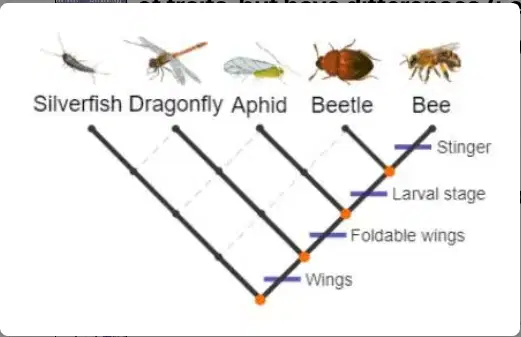
What trait(s) does a beetle share with a dragonfly?

a)

Larval stage, foldable wings & wings

b)

Stinger

c)

Wings

d)

Foldable Wings & Wings

16.

Which trait(s) do conifers have?

a)

vascular tissue only

b)

vascular tissue and seeds

c)

vascular tissue, seeds and flowers

d)

seeds only

17.
What is the study of classification called?
a)
Taxonomy
b)
Geology
c)
Anatomy
d)
Geometry
18.
Kim is studying two types of chimpanzees: Pan troglodytes and Pan paniscus. Based on their names, Kim can conclude that the two types of chimpanzees belong to
a)
Different genera (genera = plural for genus)
b)
Different species 
c)
Different kingdoms 
d)
The same species 
19.
Which of the following organisms are MOST closely related?
a)
organisms that share a domain
b)
organisms that share a family 
c)
organisms that share a genus 
d)
organisms that share an order  
20.

What is level contains the most organisms?

a)

Kingdom

b)

Domain

c)

Species

d)

Genus

21.

Organisms that cannot make their own food and must get energy from consuming nutrients from outside sources are classified as ________:

a)

Autotrophs

b)

Producers

c)

Heterotrophs

d)

Self-feeding

22.

Which of the following is a characteristic of Kingdom Archaebacteria?

a)

multicellular

b)

undergo photosynthesis

c)

membrane-bound organelles

d)

able to tolerate extreme conditions

23.
Unicellular means...
a)
An organism is made of many cells
b)
An organism is made of one cell
c)
An organism is made of no cells
24.
Autotroph is when..
a)
An organism makes it's own food
b)
An organism has to eat other things
25.

HOW MANY KINGDOMS ARE THERE?

a)

4

b)

5

c)

6

d)

7

26.

Examples are mushrooms and mold

a)

Fungi

b)

Protista

Protista

c)

Plantae

d)

Animalia

27.
Examples are tomato plants and oak trees
a)
Fungi
b)
Plantae
c)
Protista
d)
Animalia
28.

Unicellular, prokaryotic organisms that can be either helpful or harmful (such as the helpful ones in this yogurt) are part of which Kingdom?

a)

archaebacteria

b)

bacteria

c)

Plantae

d)

Animalia

29.

The word multicellular means?

a)

having only one cell

b)

having more than one cell

c)

DNA is not in a nucleus

d)

DNA is in a nucleus

30.

What are the two kingdoms that are prokaryotic?

a)

Archaebacteria and Bacteria

b)

Protista and Eubacteria

c)

Bacteria and Fungi

d)

Fungi and Animalia