wayground logo

Free Printable Worksheets

Font size

S
M
L
XL
Worksheets

Numerical Pattern

Total questions: 150

Worksheet time: 13hrs 30mins

Name
Class
Date
1.
What are the missing numbers in this pattern?
23, 33, ___, 53, ___, 73
a)
32, 62
b)
42, 63
c)
43, 63
d)
42, 62
2.
What are the missing numbers in this pattern?
22, 29, 36, ___, 50, ___
a)
35, 55
b)
40, 57
c)
41, 56
d)
43, 57
3.
How would you describe this pattern's rule?
4, 11, 18, 25, 32, 39
a)
Add 8
b)
Add 6
c)
Subtract 8
d)
Add 7
4.
How would you describe this pattern's rule?
65, 62, 59, 56, 53, 50
a)
Subtract 2
b)
Subtract 3
c)
Subtract 4
d)
Add 3
5.
How would you describe this pattern's rule?
23, 29, 35, 41
a)
Subtract 6
b)
Add 6
c)
Subtract 5
d)
Add 4
6.
How would you describe this pattern's rule?
16, 11, 6, 1
a)
Add 5
b)
Subtract 3
c)
Subtract 5
d)
Subtract 6
7.
How many counters would come next?
a)
5
b)
7
c)
9
d)
11
8.
What rule could be used to find each Output number?
a)
Add 2 to the Input number.
b)
Add 15 to the Input number.
c)
Multiply the Input number by 4.
d)
Multiply the Input number by 6.
9.
What is the pattern of the following numbers
1, 2, 3, 1, 2, 3, 1, 2, 3
a)
Growing 
b)
Repeating
10.
A B C A B C A B C __
a)
A
b)
B
c)
C
11.
Is this a growing or repeating pattern?
a)
growing
b)
repeating
12.
How many cubes would be in the next shape?
a)
15
b)
16
c)
17
d)
18
13.
If you extended the pattern, how many dots would come next?
a)
16
b)
20
c)
25
d)
30
14.
1,  2,  5,  1,  2,  5,  __
What number comes next?
a)
2
b)
1
c)
5
15.
What is the Pattern?
a)
The next term will have 16 blocks
b)
The next term will have 15 blocks.
c)
The next term will have 14 blocks.
d)
This is the end of the pattern.
16.
Brian used the same rule on each Input number to create the Output numbers in the table below.
a)
Add 10
b)
Add 30
c)
Subtract 10
d)
Subtract 20
17.
A B C A B C A B __
a)
A
b)
B
c)
C
18.
What is the rule for this in and out table?
a)
add 3
b)
add 2
c)
add 1
d)
add 4
19.
What is the rule for this in and out table?
a)
add 10
b)
add 8
c)
add 7
d)
add 6
20.
What number goes in the empty box?
a)
10
b)
11
c)
6
d)
12
21.
320, 340, 360, 
What is the next number in the pattern?
a)
54
b)
400
c)
380
d)
370
22.

5, 10, 15, 20, 25, ____, ____, ____

a)

30, 35, 40

b)

65, 35, 116

c)

26, 27, 28

d)

20, 15, 10

23.
How many cookies will be on 5 plates?
a)
8
b)
15
c)
12
d)
7
24.
What number belongs in the missing box?
a)
24
b)
14
c)
32
d)
35
25.
a)
3
b)
16
c)
14
d)
13
26.
Based on the rate of change, how many circles would come next?
a)
5
b)
7
c)
9
d)
11
27.
Given the following tile pattern, how many tiles would be in the 5th shape?
a)
b = 8
b)
b = 11
c)
b = 7
d)
b = 9
28.
What comes next in this pattern
110, 100, 90, ____, ____, ____
a)
90, 80, 70
b)
85, 80,75
c)
80, 70, 60
d)
100, 110, 120
29.
What is the pattern for the following numbers?
10, 8, 6, 4, 2
a)
+2
b)
-2
c)
+5
d)
-5
30.
What is the pattern for the following numbers?
30, 40, 50, 60, 70 
a)
+10
b)
-10
c)
+2
d)
-2
31.
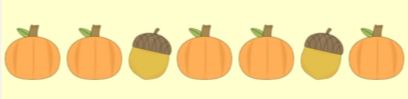
What comes next in the pattern?
a)
acorn
b)
pumpkin
32.
What is the rule?
a)
Multiply by 2
b)
Multiply by 3
c)
Add 3
d)
Add 4
33.
What are the missing numbers in the table?
a)
1, 2, 10
b)
4, 5, 12
c)
5, 6, 14
d)
2, 6, 4
34.
Identify the common difference.
97, 86, 75, 64, ...
a)
8
b)
11
c)
-11
d)
-8
35.
The next term of the sequence 2,4,8,16 are
a)
64
b)
32
c)
108
d)
20
36.
The next two terms of the sequence 4,7,10,13 are
a)
16 and 19
b)
15 and 19
c)
16 and 18
d)
15 and 18
37.

What is the rule for this pattern?

32,36,40,44

a)

add 4

b)

multiply 2

c)

subtract 4

d)

divide by 2

38.

What number belongs in the blank?

18,24,___,36,42

a)

28

b)

31

c)

30

d)

35

39.

What rule could be used to find each Output number?

a)

Add 2 to the Input number.

b)

Add 15 to the Input number.

c)

Multiply the Input number by 4.

d)

Multiply the Input number by 6.

40.

How many counters would come next?

a)

5

b)

7

c)

9

d)

11

41.

How many cubes would be in the next shape?

a)

15

b)

16

c)

17

d)

18

42.
a)

The pattern rule is start with 4 dice and add 4 every time.

b)

The pattern rule is start at 4 and add 3 every time.

c)

The pattern rule is start with 3 white dice and add two every time.

d)

The pattern rule is start with 4 and add 2 every time.

43.

Which pattern follows the rule below? Rule: Start with 4 and multiply by 3 each time until there are 4 numbers.

a)

4, 12, 36, 108

b)

4, 12, 38, 114

c)

4, 7, 10, 13

d)

4, 7, 11, 14

44.

Brian used the same rule on each Input number to create the Output numbers in the table below.

a)

Add 10

b)

Add 30

c)

Subtract 10

d)

Subtract 20

45.

How many line segments will be added in the fifth term?

a)

4

b)

3

c)

7

d)

1

46.

What is the value of the missing output?

a)

8

b)

6

c)

4

d)

12

47.

What is the value of the missing input?

a)

25

b)

30

c)

74

d)

26

48.

Sam wanted to keep track of the points he earned in his new racing video game. He created a function table to track his points and his laps around the track. How many laps did Sam make around the track if he earned 9 points?

a)

9

b)

20

c)

18

d)

15

49.

What is the rule for this pattern?

32,36,40,44

a)

add 4

b)

multiply 2

c)

subtract 4

d)

divide by 2

50.

Which rule can be used to find the next number in this increasing pattern?

a)

Add 7 to 24

b)

Add 6 to 24

c)

Add 5 to 24

d)

Add 3 to 24

51.
What is the pattern rule for this pattern? 
2, 4, 8, 16, 32, 
a)
Start at 2. Add 2 each time. 
b)
Start at 2. Add 2 more each time. 
c)
Start at 2. Double the number each time. 
d)
Start at 2. Add 16 each time. 
52.
a)

38

b)

34

c)

20

d)

9

53.

Brian used the same rule on each Input number to create the Output numbers in the table below.

a)

Add 10

b)

Add 30

c)

Subtract 10

d)

Subtract 20

54.

What rule could be used to find each Output number?

a)

Add 2 to the Input number.

b)

Add 15 to the Input number.

c)

Multiply the Input number by 4.

d)

Multiply the Input number by 6.

55.

What is the rule or pattern shown in this in-out (Function) table?

a)

Divide by 9

b)

Multiply by 2

c)

Divide by 2

d)

Add by 3

56.

What is the rule?

a)

Multiply 3

b)

Add 3

c)

Subtract 3

d)

Divide 3

57.
What is the rule for this in and out table?
a)
add 4
b)
add 3
c)
add 1
d)
add 2
58.
Find the next number in the number pattern
2, 5, 11, 23, 47….
a)
85
b)
67
c)
95
d)
101
59.
Find the Rule in the Pattern
2, 4, 8, 16, 32
a)
Multiply 2
b)
Divide 3
c)
Multiply 4
d)
Divide 2
60.
Find the next number in the number pattern
3, 6, 12, 24….
a)
36
b)
48
c)
50
d)
65
61.
Find the Rule in the pattern
3, 9, 27, 81….
a)
Multiply 2
b)
Divide 2
c)
Multiply 4
d)
Multiply 3
62.
Find the Rule in the pattern
11, 22, 33, 44, 55
a)
Multiply 2
b)
Add 11
c)
Add 10
d)
Divide 2
63.
True or False? The Rule in the pattern is Divide by 3
135, 45, 15, 5
a)
True
b)
False
64.
What is the rule in the pattern?
500, 100, 20, 4
a)
Subtract 200
b)
Divide 6
c)
Subtract 100
d)
Divide 5
65.
Find the Rule in the pattern
56, 40, 24, 8
a)
Subtract 15
b)
Divide 2
c)
Subtract 16
d)
Multiply half
66.
Find the rule of the number pattern
.5, 3, 5.5, 8, 10.5
a)
Add 2
b)
Add 2.5
c)
Multiply 2
d)
None of the Above
67.
Find the Next number in the pattern
3, 3, 6, 6, 12, 12, 24….
a)
3
b)
26
c)
48
d)
24
68.
True or False:
The rule in this number pattern is divide by 2
48, 24, 12, 6, 3
a)
True
b)
False
69.
True or False:
The rule of this number pattern is multiply by half
48, 24, 12, 6, 3
a)
False
b)
True
70.
What is the rule for the Magic Box?
a)
Add 4
b)
Add 6
c)
Multiply by 2
d)
Multiply by 3
71.
What is the missing value from the table?
a)
25
b)
27
c)
29
d)
39
72.
Which rule describes how to find the output values from the input values?
a)
Multiply the input by 5, then subtract 6
b)
Multiply the input by 4, then add 25
c)
Multiply the input by 6, then subtract 5
d)
Multiply the input by 3, then add 40
73.
After 5 hours, how many tires will be needed?
a)
40
b)
60
c)
75
d)
90
74.
How would you describe this pattern's rule?
4, 11, 18, 25, 32, 39
a)
Add 8
b)
Add 6
c)
Subtract 8
d)
Add 7
75.
What number goes in the empty box?
a)
10
b)
11
c)
6
d)
12
76.
The terms in the number sequence 5, 8, 11, 14, ...are generated by:
a)
adding 2 to make a new term
b)
adding 3 to make a new term
c)
multiplying by 2 to make a new term
d)
multiplying by 3 to make a new term
77.
The terms in the number sequence 3, 6, 12, 24 ...are generated by:
a)
multiplying by 3 
b)
adding 3
c)
subtracting 3
d)
multiplying by 2
78.
The terms in the number sequence 128, 64, 32, 16, ...are generated by:
a)
multiplying by 2
b)
multiplying by 1/2
c)
dividing by 6
d)
subtracting 64
79.
The terms in the number sequence 38, 34, 30, 26, ...are generated by:
a)
adding 4 to the next term
b)
multiplying by 4 to get the next term
c)
subtracting 4 to get the next term
d)
multiplying by 2 and adding 1 to get the next term
80.
The terms in the number sequence 1, 2, 3, 5, ...are generated by:
a)
adding the previous two terms
b)
adding 1
c)
adding 1 and 2
d)
the sequence does not fit a pattern
81.
The next two terms in the sequence 3, -6, 12, -24, .... are 
a)
48 and 96
b)
-48 and -96
c)
-48 and 96
d)
48 and -96
82.
The next two terms in the sequence 19, 28, 37, 46 , .... are 
a)
59 and 68
b)
57 and 66
c)
55 and 65
d)
54 and 63
83.
For the sequence 6, 10, 14, 18, .... the t1 and t4 are
a)
6 and 24
b)
6 and 14
c)
6 and 18
d)
6 and 22
84.
For the sequence 29, 22, 15 , 8, .... t2 and t5  are
a)
29 and 8
b)
22 and 1
c)
22 and 0
d)
29 and 15
85.
For the sequence 2, 8, 32, 128, .... the 5th term will be
a)
128
b)
232
c)
412
d)
512
86.
What is the rule?
5,10,15,20,25
a)
add 6
b)
add 5
c)
add 4
d)
add 7
87.
What number belongs in the blank?
18,24,___,36,42
a)
28
b)
31
c)
30
d)
35
88.
What is the rule for this pattern?
32,36,40,44
a)
add 4
b)
multiply 2
c)
subtract 4
d)
divide by 2
89.
How many blocks will be in the 4th term?
a)
The next term will have 16 blocks
b)
The next term will have 15 blocks.
c)
The next term will have 14 blocks.
d)
This is the end of the pattern.
90.
What are the missing numbers in this pattern?
12, 15, ___, 21, ____, 27
a)
18,23
b)
18, 24
c)
17, 25
d)
17, 24
91.
How would you describe this pattern's rule?
4, 11, 18, 25, 32, 39
a)
Add 8
b)
Add 6
c)
Subtract 8
d)
Add 7
92.

Sasha is organizing her books and puttinng them on shelves. She put 2 books on the first shelf, 4 books on the second shelf, 8 books on the third shelf, and 14 books on the fourth shelf. If this pattern continues,how many books will Sasha put on the fifth shelf?

a)

21

b)

32

c)

22

d)

12

93.

Beginning with 1, complete the following sequence of numbers by multiplying the previous number by 3. 1, __,___,__,___

a)

1,3,6,9,12

b)

1,4,7,10,13

c)

1,3,9,12,15

d)

1,3, 9, 27, 81

94.

Beginning with 1, complete the following sequence of numbers by multiplying the previous number by 4. 1,__,__,__,__

a)

1,4,8,12,16

b)

1,16,64,256

c)

1,5,9,13,17

d)

1,16,20,24,28

95.

While sorting some beads, Dalton put 72 beads in the first jar, 84 beads in the second jar, 96 beads in the third jar, 108 beads in the fourth jar, and 120 beads in the fifth jar. If this pattern continues, how many beads will Dalton put in the sixth jar?

a)

141

b)

144

c)

132

d)

127

96.

Hannah went out to her garden and cut 4 roses from the first rose bush, 6 roses from the second rose bush, 9 roses from the third rose bush, 13 roses from the fourth rose bush, and 18 roses from the fifth rose bush. If this pattern continues, how many roses will Hannah cut from the sixth rose bush?

a)

27

b)

24

c)

23

d)

26

97.

While sorting some change into piggy banks, Eddie put 1 coin in the first piggy bank, 5 coins in the second piggy bank, 25 coins in the third piggy bank, and 125 coins in the fourth piggy bank. If this pattern continues, how many coins will Eddie put in the fifth piggy bank?

a)

625

b)

465

c)

355

d)

130

98.

Farmer Suzuki has a plot of tomato plants. There are 2 tomato plants in the first row, 4 tomato plants in the second row, 8 tomato plants in the third row, 16 tomato plants in the fourth row, and 32 tomato plants in the fifth row. If this pattern continues, how many tomato plants will there be in the sixth row?

a)

128

b)

97

c)

64

d)

119

99.

Nina is putting stickers in a sticker book. She put 43 stickers on the first page, 53 stickers on the second page, 63 stickers on the third page, and 73 stickers on the fourth page. If this pattern continues, how many stickers will Nina put on the fifth page?

a)

93

b)

13

c)

83

d)

84

100.

The teacher gave 2 gold stickers to the first student, 6 gold stickers to the second student, 18 gold stickers to the third student, 54 gold stickers to the fourth student, and 162 gold stickers to the fifth student. If this pattern continues, how many gold stickers will the teacher give to the sixth student?

a)

354

b)

168

c)

1,254

d)

486

101.
How would you describe this pattern's rule?
65, 62, 59, 56, 53, 50
a)
Subtract 2
b)
Subtract 3
c)
Subtract 4
d)
Add 3
102.
What comes next?
4, 6, 8, 10, ____
a)
12
b)
13
c)
11
d)
20
103.
What changes in this pattern?
a)
size
b)
shape
c)
color
d)
location
104.
What changes in this pattern?
a)
size
b)
shape
c)
color
d)
location
105.
What changes in this pattern?
a)
size
b)
shape
c)
color and shape
d)
size and color
106.
What comes next in the pattern?
a)
acorn
b)
pumpkin
107.
How many blocks will the next term have?
a)
The next term will have 16 blocks
b)
The next term will have 15 blocks.
c)
The next term will have 14 blocks.
d)
This is the end of the pattern.
108.
∆∇∆∇∆∇∆∇__
a)
b)
109.
+ - + - + - + - ___
a)
+
b)
-
110.
Find the next number in the pattern.
18, 22, 26, 30, 34, ________
a)
38
b)
42
c)
40
d)
36
111.
What is the pattern rule for this pattern? 
50, 45, 40, 35, 30, 25
a)
Start at 25. Add 5 each time. 
b)
Start at 50. Subtract 5 each time. 
c)
Start at 25. Add 10 each time. 
d)
Start at 50. Add 5 each time. 
112.
Write the next three numbers in this pattern: 
45, 40, 35, 30, ....
a)
29, 28, 27 
b)
20, 10, 0. 
c)
25, 20, 15. 
d)
45, 40, 35
113.
How many cubes would be in the next shape?
a)
15
b)
16
c)
17
d)
18
114.
If you extended the pattern, how many dots would come next?
a)
16
b)
20
c)
25
d)
30
115.
How many counters would come next?
a)
5
b)
7
c)
9
d)
11
116.
∎∆∆∎ΔΔ__
a)
b)
Δ
117.
O o O o O o O o __
a)
O
b)
o
118.

What comes next in the sequence?

a)
b)
c)
d)
119.

How many cubes are in the 4th arrangement?

a)

8 cubes

b)

10 cubes

c)

12 cubes

120.

How many tiles are in Arrangement 4?

a)

6 tiles

b)

7 tiles

c)

8 tiles

121.

How many tiles are in Arrangement 4?

a)

12 tiles

b)

13 tiles

c)

14 tiles

122.

What number is missing from this sequence?

a)

36

b)

42

c)

46

123.

What number is missing from this sequence?

a)

2

b)

3

c)

4

d)

5

124.

What number is missing from this sequence?

a)

8

b)

9

c)

10

d)

12

125.

What number is missing from this sequence?

a)

24

b)

26

c)

28

d)

30

126.
The next two terms of the sequence 12,17,22,27 are
a)
28 and 33
b)
29 and 34
c)
32 and 37
d)
30 and 35
127.
The pattern followed by the sequence 3,6,9,12 is...
a)
+3
b)
+4
c)
-4
d)
+6
128.
Find the 8th term in the sequence
3, 5, 7, 9, 11, ...
a)
12
b)
14
c)
16
d)
18
129.
What is the 6th term in the following sequence?
11, 15, 19, 23, ___, _?_
a)
30
b)
27
c)
31
d)
32
130.
Find the next term in the sequence
-4, -1, 2, 5, 8, ...
a)
11
b)
10
c)
6
d)
24
131.
How would you describe this pattern's rule?
65, 62, 59, 56, 53, 50
a)
Subtract 2
b)
Subtract 3
c)
Subtract 4
d)
Add 3
132.
Find the missing numbers.
520, ____, 560, 580, ____
a)
540, 590
b)
540, 600
c)
525, 590
d)
510, 590
133.
11, 9, 7, 5, ..
a)
7
b)
4
c)
3
d)
2
134.
What is the Pattern?
a)
The next term will have 16 blocks
b)
The next term will have 15 blocks.
c)
The next term will have 14 blocks.
d)
This is the end of the pattern.
135.
Find the rule for the table.
a)
Add 4
b)
Multiply by 2
c)
Multiply by 4
d)
Divide by 6
136.
What is the rule?
a)
Multiply by 2
b)
Multiply by 3
c)
Add 3
d)
Add 4
137.
Mrs. Hunt wrote the following number pattern: 37, 30, 23, 16, 
What number would come next if the pattern continued?
a)
15
b)
5
c)
9
d)
10
138.
How would you describe this pattern's rule?
99, 97, 95, 93, 91
a)
Subtract 1
b)
Add 2
c)
Subtract 2
d)
Add 3
139.
Which number is missing in this pattern? 
4, 6, 9, 13, 18 ___, 31, 39
a)
20
b)
24
c)
25
d)
I don't know
140.
The terms in the number sequence 5, 8, 11, 14, ...are generated by:
a)
adding 2 to make a new term
b)
adding 3 to make a new term
c)
multiplying by 2 to make a new term
d)
multiplying by 3 to make a new term
141.
The terms in the number sequence 3, 6, 12, 24 ...are generated by:
a)
multiplying by 3 
b)
adding 3
c)
subtracting 3
d)
multiplying by 2
142.

Pattern for 3, 6, 12, 24 is ..... from previous number.

a)

adding 2

b)

multiplying 2

c)

divide by 2

d)

subtract 2

143.

Rule for 2, 5, 8, 22 is adding 3 from ......

a)

previous number

b)

previous previous

c)

number previous

d)

number number

144.

8, 11, 14, 17 is ..... from previous number

a)

subtract 3

b)

adding 3

c)

subtract 4

d)

adding 4

145.

What is the next two terms for the sequence of 2, 20, 200, 2000, ...?

a)

200, 2000

b)

220, 2200

c)

2000, 20000

d)

20000, 200000

146.

What is the next 2 terms for the sequence of 5, 10, 20, 40...?

a)

50, 60

b)

400, 4000

c)

80, 160

d)

20, 40

147.

What is the rule for the sequence of 3, 6, 9, 12 ....?

a)

Multiply by 2 from previous number

b)

Adding 3 from previous number

c)

Multiply by 2

d)

Adding 3

148.

Find the next 2 terms from the Fibonacci Numbers sequence as below.

4, 5, 9, ....

a)

10, 11

b)

14, 23

c)

15, 25

d)

20, 31

149.

Complete the number sequence below.

0, 1, 1, ...., ......, ....., 8, 13

a)

2, 3, 4

b)

2, 4, 6

c)

2, 3, 5

d)

2, 6, 7

150.

Complete the number sequence based on the given pattern.

Pattern: Add 7 from previous number

42, ..., ...., ...., ...., ....

a)

49, 56, 63, 70

b)

51, 60, 69, 78

c)

49, 56, 63

d)

50, 60, 70, 80