
 Worksheets
Geometric Constructions Intro
Total questions: 25
Worksheet time: 2hrs 1mins
Name
Class
Date
1.

Jenny used a compass and a straight edge to make this construction. Which statement best describes her construction?
a)
She is constructing a parallel line to PQ.
b)
She is copying line segment PQ.
c)
She is constructing the perpendicular bisector to PQ.
d)
She is constructing an angle bisector.
2.
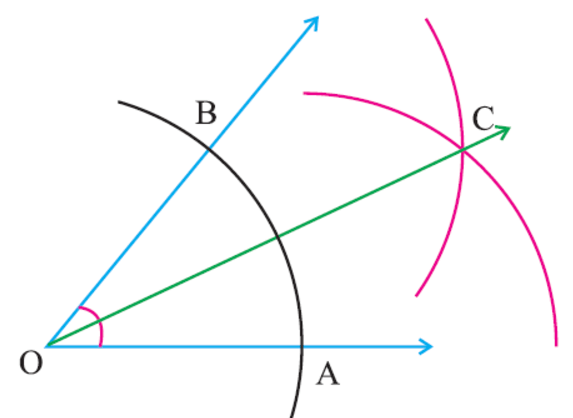
Which of the following best describes the construction?
a)
Ray OC trisects angle BOA.
b)
Ray OC is parallel to ray OA.
c)
Ray OC is parallel to both rays OA and OB.
d)
Ray OC bisects angle BOA.
3.

What is Aaron constructing in the diagram?
a)
An angle bisector to angle RJQ.
b)
A line parallel to PQ, through R.
c)
A line perpendicular to PQ, through R.
d)
A perpendicular bisector to PQ.
4.

Nate is constructing angle bisector to angle ABC. Where did he position his compass to create the two arcs that intersect at the interior of the angle?
a)
He fixed his compass on B and drew both arcs.
b)
He fixed his compass on points A and C.
c)
He fixed his compass on points D and E.
d)
He fixed his compass on points B and E.
5.

What kind of construction is in the diagram?
a)
Angle Bisector
b)
Perpendicular Bisector
c)
Parallel Lines
d)
Perpendicular LInes
6.

What type of construction is shown in the diagram?
a)
Angle Bisector
b)
Parallel Lines
c)
Angle Copying
d)
Perpendicular Bisector
7.

Select the best answer choice.
a)
F
b)
G
c)
H
d)
J
8.

Select the best answer choice.
a)
A
b)
B
c)
C
d)
D
9.
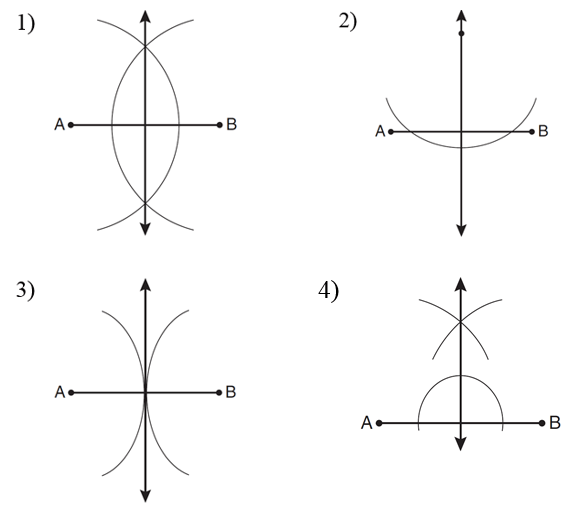
Take a guess! Which one is the correct construction for a perpendicular bisector?
a)
1
b)
2
c)
3
d)
4
10.

Take a guess! Which one is the correct construction for a perpendicular bisector?
a)
1
b)
2
c)
3
d)
4
11.

Select the best answer choice.
a)
F
b)
G
c)
H
d)
J
12.
Select the best answer choice.
a)
A
b)
B
c)
C
d)
D
13.

Suppose we wish to construct a perpendicular bisector of line segment EF. We can correctly begin by placing the compass point on E and marking off the distance to which point?
a)
A
b)
B
c)
C
d)
D
14.
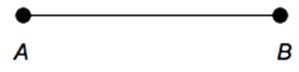
When copying line segment AB using a straight edge and a compass, the compass should be used to:
a)
Draw an arc above point A
b)
Measure the length of segment AB
c)
Draw an arc between point A and point B
d)
Measure half the length of line segment AB
15.
To inscribe a hexagon inside a circle, which length should you set your compass to?
a)
The radius
b)
The diameter
c)
Half of the radius
d)
It depends on the size of the circle
16.
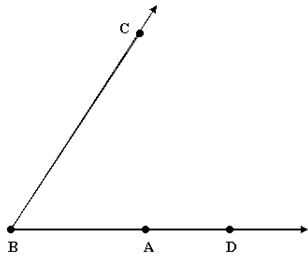
Suppose we wish to construct angle EFG congruent to angle DBC using a compass and straightedge. Which step would be correct to do first?
a)
Place the compass point at B
b)
Place the compass point at C
c)
Place the straightedge along A and C
d)
Place the straightedge along C and D
17.
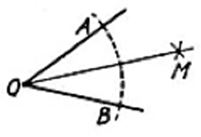
When bisecting an angle, the straightedge should be used to:
a)
Mark the point M
b)
Measure the angle AOB
c)
Copy the angle with an arc
d)
Connect point M and vertex O
18.
To inscribe a square inside a circle, first you must draw a diameter anywhere across the circle. What should your next step be?
a)
Construct a perpendicular bisector
b)
Draw a second diameter to the circle
c)
Construct a line tangent to the circle
d)
Set your compass the length of the radius.
19.
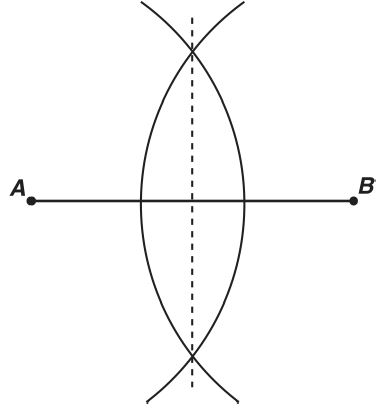
What geometric construction is shown in the diagram below?
a)
an angle bisector
b)
a line parallel to a given line
c)
an angle congruent to a given angle
d)
a perpendicular bisector of a segment
20.

a)
1
b)
2
c)
3
d)
4
21.

This construction forms a __________.
a)
Perpendicular Bisector
b)
Perpendicular Line
c)
A lowercase "t" flipped to the side
d)
Line Segment
22.
When constructing a line parallel to a given line, you will be
a)
copying a segment
b)
bisecting a segment
c)
copying an angle
d)
constructing a perpendicular
23.

Name the construction.
a)
Angle bisector
b)
Perpendicular line to a point not on a line
c)
Angle median
d)
Perpendicular bisector of a line segment
24.

Name the construction.
a)
Angle bisector
b)
Di-sect an angle
c)
Copy an angle
d)
Vertical angles
25.

What type of construction do you see?
a)
midpoint
b)
angle bisector
c)
perpendicular bisector
d)
altitude
100 %

