
NEW
Font size
 Worksheets
Parallelogram Proofs
Total questions: 22
Worksheet time: 11mins

Which theorem shows that the quadrilateral is a parallelogram?
Parallelogram Diagonals Converse
Parallelogram Opposite Sides Converse
Parallelogram Opposite Angles Converse
Opposite Sides Parallel and Congruent Theorem

Which theorem shows that the quadrilateral is a parallelogram?
Parallelogram Diagonals Converse
Parallelogram Opposite Sides Converse
Parallelogram Opposite Angles Converse
Opposite Sides Parallel and Congruent Theorem

Which theorem shows that the quadrilateral is a parallelogram?
Parallelogram Diagonals Converse
Parallelogram Opposite Sides Converse
Parallelogram Opposite Angles Converse
Opposite Sides Parallel and Congruent Theorem

Find the values of x and y that make the quadrilateral a parallelogram.
x = 3, y = 2
x = 25, y = 15
x = 15, y = 25
x = 113, y = 67

Find the values of x and y that make the quadrilateral a parallelogram.
x = 4, y = 3
x = 3, y = -2
x = 1, y = 4
x = 3, y = 4

Find the value of x that makes the quadrilateral a parallelogram.
x = -4
x = 1
x = 8
x = 34

Find the value of x that makes the quadrilateral a parallelogram.
x = 26
x = 7
x = 2
x = -2
Parallelograms are ...
triangles
quadrilaterals
pentagons
hexagons


Is there enough information to determine that this quadrilateral is a parallelogram?
yes, all opposite sides are congruent
yes, opposite angles are congruent
yes, opposite sides are parallel
yes, consecutive interior angles are supplementary
The opposite sides and opposite angles of a parallelogram are...
congruent
supplementary
perpendicular
not congruent


Is there enough information to determine that this quadrilateral is a parallelogram?
yes, opposite sides are congruent
yes, opposite sides are parallel
no, not all pairs of opposite sides are congruent
no, it is not a quadrilateral
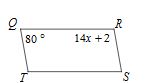
Solve for x.

State which method we can use to show that the quadrilateral is a parallelogram.
Both pairs of opposite angles are congruent.
Both pairs of opposite sides are congruent.
The diagonals bisect each other.
Both pairs of opposite sides are parallel.

Polygon ABCD is a Quadrilateral which of the following pieces of information would prove that ABCD is a parallelogram?
DB=AC
DA=BC
DA||BC
DA||BC, DA=BC

Is the quadrilateral a parallelogram?
Yes; one pair of opposite sides are parallel
Yes; one pair of opposite sides are congruent
Yes; one pair of opposite sides are parallel and congruent
No; only one pair of sides are parallel
No; only one pair of sides are congruent
If you can prove that one pair of opposite sides of a parallelogram are the same length and have the same slope, you can prove that it is a parallelogram.
Always
Sometimes
Never

