
 Worksheets
Earth's Interior Weekly Quiz#1
Total questions: 16
Worksheet time: 16mins
The solid layer that is somewhat flexible in the upper mantle that is located just below the lithosphere; lithospheric plates "float" and move on this layer.
outer core
asthenosphere
inner core
crust
The Earth is divided into different layers based on various physical properties. Which layer is a hot, thick layer where convection occurs?
crust
inner core
outer core
mantle
Which of the following statements describe the pressure from one layer to the next?
Pressure increases as the weight of the layers above increases.
Pressure increases with depth in the Earth, but it only applies to the mantle.
Pressure between layers remains constant regardless of depth or material composition.
Pressure decreases as you go deeper into the Earth, because the weight of the layers above becomes less significant.
Which layer heats the material in the mantle to form a convection current?
crust
core
lithosphere
mantle
The Earth is divided into different layers based on various physical properties. Which layer is a thin, rigid outermost layer that we live on?
Crust
Inner core
Outer core
Mantle

Which of the following statements accurately describes a convection current?
Heat is transferred through direct contact between the core and the crust.
Less dense, hot magma rises to the surface and denser cooler magma sinks.
More dense, hot magma rises to the surface and less dense cooler magma sinks.
Convection currents can only occur in solids, as they require rigid structures to transfer heat.
Metamorphic rock most often forms from sedimentary rock. Which of the following would be needed for this to happen?
Heat and pressure
Melting
Erosion and deposition
Weathering
Granite is a sturdy rock used for countertops. It forms from slowly cooling magma. What type of rock is granite?
Igneous rock
Sedimentary rock
Metamorphic rock
Molten rock that is inside the Earth is called ________, but molten rock that erupts onto the Earth’s surface is called _________.
magma/lava
lava/magma
rock/stone
stone/rock
Which type of rock is formed from particles of other rocks that are deposited in layers and compacted and cemented together?
Igneous rock
Sedimentary rock
Metamorphic rock

Earth’s rock is continually cycling through the rock cycle. The diagram below shows there are two labels missing from the rock cycle. Which of these two processes in the rock cycle could be happening at the stage labeled #2?
Folding and mountain building
Changes due to heat and pressure
Compacting and cementing of weathered sediments
Weathering and erosion
Weathering is a process in the rock cycle. How does weathering contribute to the formation of rocks?
It increases the temperature and creates metamorphic rock.
It breaks down rock into smaller pieces that can become sedimentary rock.
It causes lava to cool and harden into igneous rock.
It deposits sediment and forms sedimentary rock.
Which of the following statements accurately describes the difference between the independent variable and the dependent variable in a controlled experiment?
The independent variable is the variable that is measured in a controlled experiment and the dependent variable is the variable that is tested.
The independent variable is the variable that is tested in a controlled experiment and the dependent variable is the variable that is being measured.
The independent variable and dependent variable are both measured in a controlled experiment.
The independent variable is the variable that is being measured and the dependent variable is the variable that is tested.

Which layer of the Earth is liquid Iron and Nickle?
Crust
Mantle
Outer Core
Inner Core

What is the thickest layer of the Earth?
Crust
Mantle
Outer Core
Inner Core
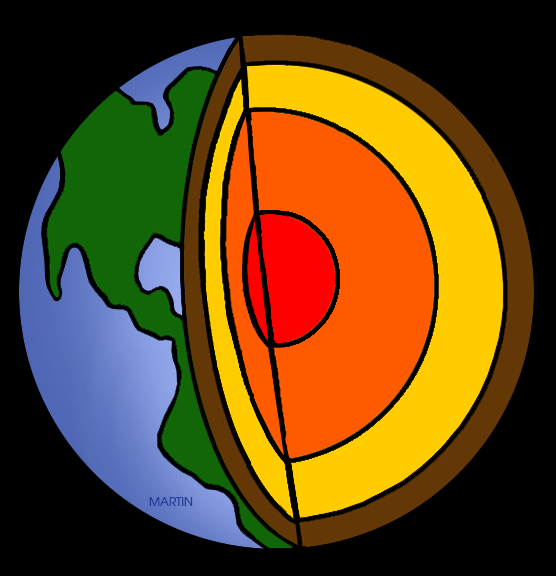
Which layer is shown in yellow?
crust
mantle
outer core
inner core

