
 Worksheets
1/27/25–Group Quiz: Synthetic and more
Total questions: 50
Worksheet time: 13hrs 30mins
(3x - 4x3 + 6x4 + 1) / (x + 3)

x - 7
x2 - 7
x + 7
x2 + 3x - 54

2x3 + 3x + (7/x-4)
2x2 + 3x + 8 + (7/x-4)
2x2 + 3x + 8
2x2 - x + 10 + (6/x-4)
Yes, (x-2) is a factor. There is a remainder.
No, (x-2) is not a factor. The remainder is zero.
Yes, (x-2) is a factor. The remainder is zero.
No, (x-2) is not a factor. There is a remainder.

x + 5 + (2/2x - 4)
x - 8
x - 5 + (3/2x - 4)
x + 5
If you are missing a term in your polynomials (both dividend and divisor), you must put a zero as a coefficient place holder for that term.
True
False
Only for the dividend
Only for the divisor
(3x - 4x3 + 6x4 + 1) / (x + 3)
X intercepts are also called....
More than one answer
Solutions
Parabolas
Roots
Puppies
Given a graph, how can you find the "solutions" to a quadratic?
Copy off neighbor
Plug into calculator
Solutions are where the quadratic crosses the x axis
Magic 8 Ball
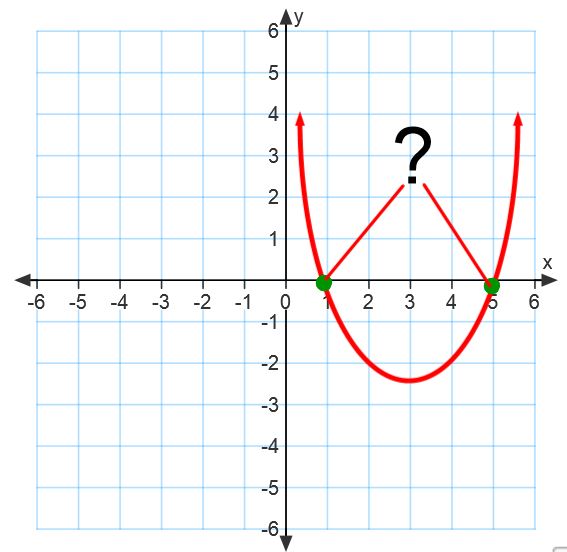
What are the green dots called?
roots
vertex
solutions
x intercepts

What are the x- intercepts?
(0,0) and (0,4)
(0,0) and (4,0)
y= 0
x= 2
Determine the values of a, b, and c for the quadratic equation:
4x2 – 8x = 3
a = 4, b = -8, c = 3
a = 4, b =-8, c =-3
a = 4, b = 8, c = 3
a = 4, b = 8, c = -3
8x3-27
xy(x−1)
x2y2−xy
x2y−1
x2y−xy
xy2−xy
(x−1)(2x+1)
2x2−1
2x2−x+1
2x2−x−1
2x2+x−1
(2x−y)(x−y)
2x2−3xy+y2
2x−3xy+y
2x2−3xy−y2
2x+3xy−y
4y(2x2−3x+4)
8x2y2−12xy+16y
8xy2+12xy+16y
8x2y−12xy+16y
4xy+16y
-3x2( 7x2 - x + 4)
How many terms does it have?
Is there a GCF?
What strategy should I use?
Why do I have to learn this?!?!?!
Factor completely:
5n³-10n²+3n-6
(5n²+3)(n-2)
(5n²-3)(n-2)
(5n³+3)(n-2)
10n(n²-6)
Factor completely:
81m2 - 1
not factorable
(m-9)(m+9)
9m(9m-1)
(9m-1)(9m+1)
Factor completely:
3x2 + 18x +15
Hint: Factor GCF first.
3(x2 + 6x + 5)
(x + 5)(x + 1)
3(x + 5)(x + 1)
Cannot be factored
Factor completely:
x4-9x2
Hint: Factor GCF first.
x2(x+3)(x-3)
(x2+3x)(x2-3x)
(x2+9)(x-3)(x+3)
x2(x2-9)
Factor completely:
3x² - 7x + 2
(x - 1) (3x + 2)
(x - 2) (3x -1)
(x - 1) (3x - 2)
(x + 2) (3x + 1)
Factor completely:
8x3-27
(2x+3)(4x2-6x+9)
(2x-3)(4x2+6x+9)
(2x-3)(4x2+6x-9)
(2x-3)(2x2+6x+9)
Factor completely:
4h² - 12h + 9
(2h - 3)²
4(h + 9)(h + 1)
(2h - 3)(2h + 3)
(h - 9)(4h - 1)
Factor completely:
25x2-81
(5x-9)2
(5x+9)(5x-9)
25(x-9)2
(9x+5)(9x-5)
Factor completely:
64x3+125
(4x+5)(16x2-20x+25)
(4x-5)(16x2+20x+25)
(4x-5)(4x2+20x-25)
(4x-5)(4x2+20x+25)
(4x2+ x) - (x2+ 2x)
3x2 - x
4x2 + 2x
3x2 + 3x
3x2 + 2x
-4(9 + 3x) - 4(x - 2)
(4n4 - 8n + 4) - (8n2 + 4n4 + 1)
(6b3 + 6 - b4) - (8b3 - 6b4 + 2)
If f(x) = 2x + 1, find f(1).
f(1) = 1
f(1) = 4
f(1) = 0
f(1) = 3
Subtract: (13a2−6a5−2a)−(−10a2−11a5+9a)
−17a5−23a2−11a
15a5−23a2+11a
27a7−11a
5a5+23a2−11a
(4 – 3i)(-7 – 2i)
(5-2i) + (-7+8i)
(2-5i)(2+5i)
What does i2 = ?
-1
−1
1
−1
(4 + 3i)(4 − 3i)
Simplify −45
3i5
−3i5
−i45
45i
If the standard form of a complex number is written as a+bi , which is the imaginary part?
a
bi
a+bi
x2

