
Font size
 Worksheets
CHPT 5 REVIEW
Total questions: 18
Worksheet time: 11mins
Which of the following is an achievement associated with Inca civilization?
The use of the iron plow
The domestication of livestock
The development of oating gardens
The terracing of mountains for farming
Which of the following was a trait shared by the ancient Maya, Aztec, and Inca civilizations?
A government comprised of elected representatives
A focus on the use of diplomacy in place of warfare
Political and economic isolationist policies
Rituals designed to satisfy divine beings
The Maya, Aztec, and Inca had which of the following in common?
They developed new ideas surrounding agriculture, irrigation, and science
They developed new ideas surrounding astronomy, agriculture, and manufacturing.
They developed new ideas surrounding agriculture and ranching
They developed new ideas surrounding astronomy, mathematics, and engineering.
Which environmental condition aided the Spanish in their conquest of Mexico?
The Aztecs succumbed to diseases brought by the Europeans.
The Mayans moved to arid regions unattractive to the Europeans.
The Aztecs relocated to remote areas unfamiliar to the Europeans.
The Mayans died from consuming foreign foods avoided by the Europeans.
During the 16th century, why were European countries eager to find new sea routes to Asia?
To explore new cultures
To acquire more land
To trade for spices
To capture slaves
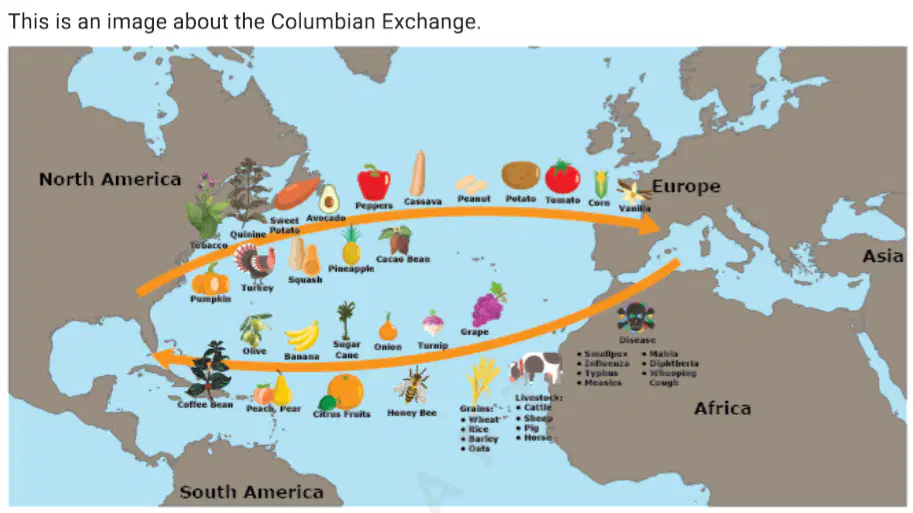
Which of the following were adverse outcomes of the Columbian Exchange?
decline of native species
spread of diseases like smallpox
spread of diseases like rickets
high mortality among Europeans in the Americas
high mortality among Native Americans
What religion did the Spanish attempt to spread among the Aztecs upon their arrival in present-day Mexico?
Hinduism.
Catholicism.
Buddhism.
Protestantism.
The following is a map of the world.
The Triangular Trade involved the Old World and the New World. One part of the Triangular
Trade was called the Middle Passage. In what part of the world did the Middle Passage
originate?
Select the correct area on the map.
Which statement about the triangular trade in the 1700s is INCORRECT?
A. The triangular trade involved the exchange of goods, slaves, and raw materials between Europe, Africa, and the Americas.
B. European goods were traded for African slaves, who were then sold in the Americas.
C. The Americas exported raw materials like sugar and cotton to Europe, where they were processed into finished goods.
D. Slaves were primarily transported from Europe to the Caribbean and the Americas.
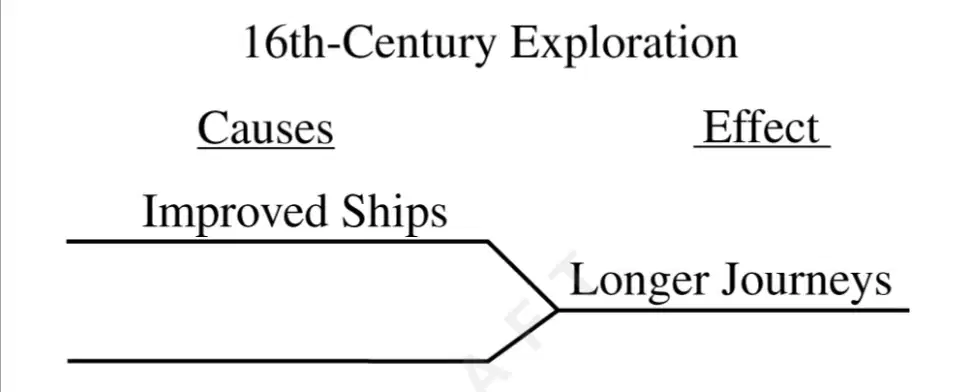
Which of the following inferences best completes the diagram?
better weather prediction
new ideas about democracy
invention of the printing press
new navigational instruments
What role did colonies play in supporting European mercantilist policies?
They provided financial backing for naval warfare.
They offered a source of raw materials for European industries.
They expanded the European agricultural base.
They facilitated the spread of European culture.
Select the TWO groups that were the most NEGATIVELY impacted by the Columbian Exchange.
Native Americans
Asians
Africans
Europeans
Determine whether each statement describes the Portuguese, Spanish, or Dutch explorers. Select the correct answer in each row.
Spanish
the first to discover a sea route to India
Dutch
the first to explore the East Indies
Portuguese
the first to conquer the Americas
How did new ideas AND technologies contribute to European exploration during the Age of Discovery?
They led to the development of new trade routes and navigation techniques.
They caused a decline in European exploration activities.
They had no significant impact on European exploration.
They only affected the cultural aspects of European societies.
The triangular trade was a complex trading network between (a) , (b) , and the (c) . (d) , raw materials, and (e) goods were traded across the Atlantic Ocean.
The civil service system of Ming China was based on —
the teachings of Buddhism.
the religion of Shinto.
the principles of Confucianism.
the work of the scholar Sun Tzu.
The list below is of three events associated with a particular period in history.
• The overthrow of foreign rulers
• The expeditions of Zheng He
• The reinstatement of civil service exams
These events occurred during which of the following periods?
During the Spring of Nations in Europe
During the rule of the Ming dynasty in China
During the rule of the Umayyad dynasty in Iberia
During the Opium Wars between Britain and China
On what did the Ottoman Empire's ability to expand its borders depend?
Its strategic location between Asia and Europe
Resources acquired through trade with the Americas
The military assistance of Western European nations
Political alliances that were formed during World War I

