
 Worksheets
Total and Lateral Surface Area of Prisms and Cylinders
Total questions: 19
Worksheet time: 19mins
What is the surface area formula for a prism?
S = 2πrh +2πr2
S = Ph + 2B
S = πrl + πr2
S = ½Pl + B
What is the surface area formula for a cylinder?
S = 2πrh +2πr2
S = Ph + 2B
S = πrl + πr2
S = ½Pl + B

What is the Lateral Surface Area of the tent?
150 in2
12,000 in2
4000 in2
14,000 in2

Find the surface area of the triangular prism.
624 cm2
672 cm2
698 cm2
708 cm2
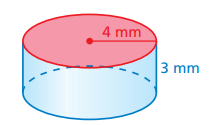
Find the surface area of a cylinder with a radius of 4 and a height of 3. Use 3.14 for π
175.84 mm2
709.89 mm2
75.36 mm2
100.48 mm2
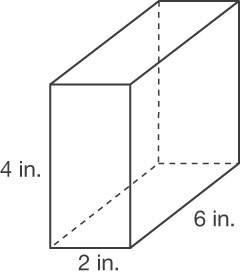
Find the total surface area of the prism.
48 square inches
64 square inches
88 square inches
76 square inches
Find the surface area of a prism with a length of 2 inches, width of 7 inches, and height of 5 inches.
118 in2
70 in2
14 in2
140 in2

Triangular Prism with base lengths 3 m, 4 m, 5 m, and a height of 6m. What is the surface area?
84 m2
92 m2
102 m2
96 m2

Find the lateral surface area of the prism.
12 square inches
48 square inches
64 square inches
76 square inches
Campbell Soup is creating a new soup label. If a can has a height of 6 in and a diameter of 4 in, how much material does Campbell need for each soup label? Is this looking for Lateral or Total surface area?
Lateral
Total
Campbell Soup is creating a new soup label. If a can has a height of 6 in and a diameter of 4 in, how much material does Campbell need for each soup label? Which formula can be used to find the surface area of the label?
SA=2πrh+2r2
SA=2πrh
SA=Ph+2B
V=Bh
What formula can be used to find the lateral surface area of a prism?
S=Ph + 2B
S=Ph + B
S=Ph
S=2Ph

When calculating the surface area of the figure, to find the area of the base you should use...
bh
1/2bh
πr2
r2

Which could be used to find the perimeter of the base for total surface area?
2(6+5)
6+6+5+5
2(11+5)
All of thse are correct

Find the lateral surface area of the following shape:
144
96
288
480

Find the lateral surface area of the following shape:
132
220
64
165
What is lateral surface area?
The area of all of the sides (including bases or top and bottom).
The area of only the sides (not including the bases or top and bottom).
The perimeter of the base.
The area of the base.
What is total surface area?
The area of all of the sides (including bases or top and bottom).
The area of only the sides (not including the bases or top and bottom).
The perimeter of the base.
The area of the base.
What is the difference between lateral and total surface area?
Total surface area solves for perimeter of all the sides where lateral solves for area.
Total surface area is the sum of the area of all the sides where lateral surface area is the sum of the area of only the sides. (Not including the bases or top and bottom).
Total surface area can only be used for prisms and lateral surface area can only be used for cylinders and cones.
None of the above.

