
 Worksheets
Unit 5 Quiz Review
Total questions: 70
Worksheet time: 6hrs 50mins

Describe the type of polynomial shown.
Even degree, negative leading coefficient
Odd degree, positive leading coefficient
Odd degree, negative leading coefficient
Even degree, positive leading coefficient
Which of the following is NOT a zero to f(x)=3x(x-8)(x+1)2?
0
-1
1
8
Determine the end behavior of the following function.
Up and Up
Up and Down
Down and Down
Down and Up
Determine the end behavior for the following polynomial.
***be careful***
Up and Up
Up and Down
Down and Down
Down and Up
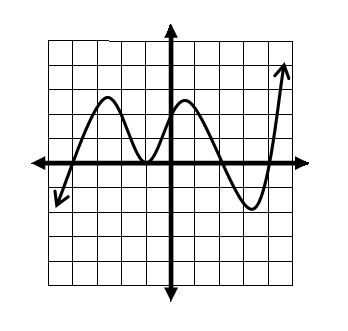

Use the end behavior determined from the equation f(x) = x3 + x2 - 4x -4 and the zeros from the equation f(x) = (x+1)(x-2)(x+2) to find the graph of the function (these equations are the same in different forms).
A (up down) (zeros: -2 & 2)
B (down up) (zeros: 0)
C (down up) (zeros: -2, -1, & 2)
D (up up) (zeros: -1 & 5)
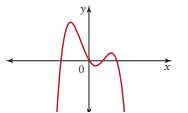
The function shown has:
Degree two with positive leading coefficient.
Degree three with negative leading coefficient.
Degree four with negative leading coefficient.
Degree four with positive leading coefficient.
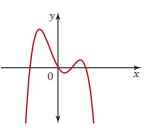
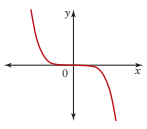
Select all the graphs which show even degree functions.
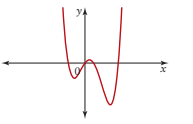
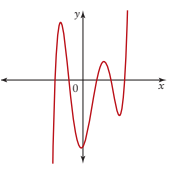
What is another way to say "where a function crosses the x-axis"?
x-intercept
zero
all of these.

Pick all statements that apply to this polynomial.
It is an odd degree function.
It is an even degree function.
It has a positive leading coefficient.
It has a negative leading coefficient.
It has 3 zeros.

Select all statements that apply to this polynomial.
This is an odd degree function.
This is an even degree function.
The leading coefficient is positive.
The leading coefficient is negative.
zeros of the polynomial
y = 3(x + 4)(x + 1)(x - 3)?

Write an equation for a function that has the following characteristics:
*negative leading coefficient
*zero: 7
*multiplicity at zero: two
y = -(x + 7)(x - 7)
y = -(x - 7)2
y = -(x + 7)2
y = -(x - 7)4

Which equations best represents the graph?
f(x)= (2−x)(x−2)2
g(x)= (x+2)2(x−1)
h(x)= −(x−4)2(x+2)
k(x)= (x+2)(x2−1)
The largest exponent found in the polynomial
Term
Degree
Constant
Leading Coefficient
The coefficient of the first term of a polynomial written in standard form
Term
Degree
Constant
Leading Coefficient
Standard form is arranging the terms of a polynomial in what order?
highest to lowest coefficient
highest to lowest degree
lowest to highest coefficient
lowest to highest degree
Identify the degree of the polynomial
3x4 + 2x2 - 7
1st degree
2nd degree
3rd degree
4th degree
Identify the degree of the polynomial
5x4 - 3x2 + 2x6 - x + 7
2nd degree
4th degree
5th degree
6th degree
Which of the following polynomials is written in standard form?
9 + 8x - 2x2
10x + x3 - 4x2 - 11
x4 + 5x3 - 6x +1
4x3 + 3x4 + 2x + 1
What is the leading coefficient in the polynomial 3x2 - 2x + 5?
3
2
5
0
Which of these is in Standard Form (Check ALL that apply)?
4x2+12x−13x3
5−3x
2x4−12x2+5x−9
5x5+4x4+12x3−23x+15


f(x) = -5x4 - 2x2 + 8
Right side: Rises
Right side: Falls
Right side: Rises
Right side: Falls
*a positive leading coefficient
*zeros: 9, 3, -2, 0
- Leading Coeff.
+ Leading Coeff.
- Leading Coeff.
+ Leading Coeff.


f(x) = -x4 + x3 + 5x2 + x + 6
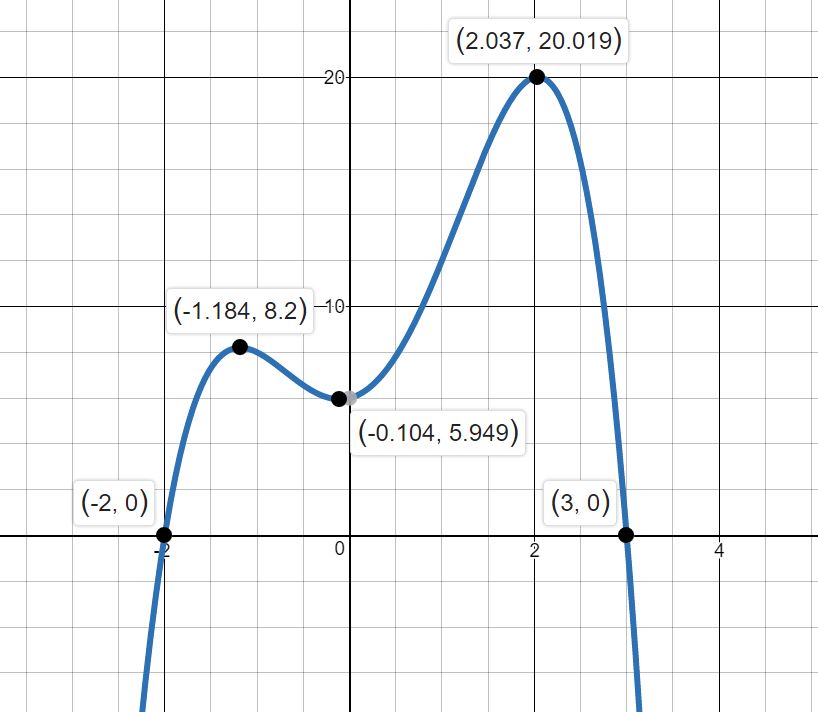

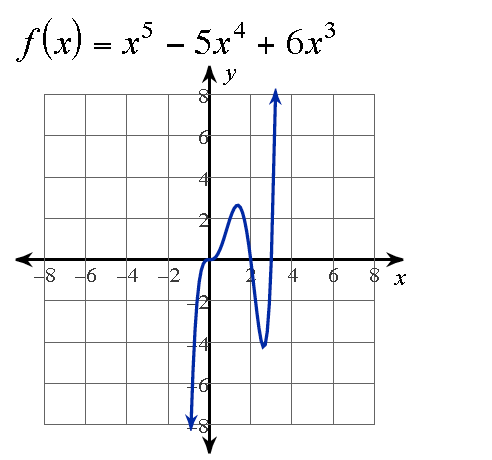
For each function, determine the real zeros and state the multiplicity of any repeated zeros.
{0 mult. 3, 5, 2}
{−2 mult. 3, 3, 1}
{0 mult. 3, 3, 2}
{2 mult. 3, 3, 3}

Even or Odd degree?
even
odd

Which function is graphed?
(x - 4)(x + 2)(x - 8)=y
(x - 4)(x - 2)(x + 8)=y
(x - 4)(x + 2)(x + 8)=y
(x + 4)(x + 2)(x + 8)=y
f(x) = (x+2)(x-3)2(x-4)
Which choice best describes the zeros?
-2, 3 (multiplicity 2), 4
-2 (multiplicity 2), 3, 4
2, -3 (multiplicity 2), -4
2 (multiplicity 2), -3, -4
Zeros: – 5(multiplicity of 3), 9(multiplicity of 2), – 2, 4.

How many zeros do you see that "bounce off" the x-axis?
1
2
3
4

What degree is most likely represents the graph?
linear
quadratic
cubic
quartic
What are the zeros?
x = - 4
There are none
x = - 1.5 & 1.5
x = - 3.5 and 3.5
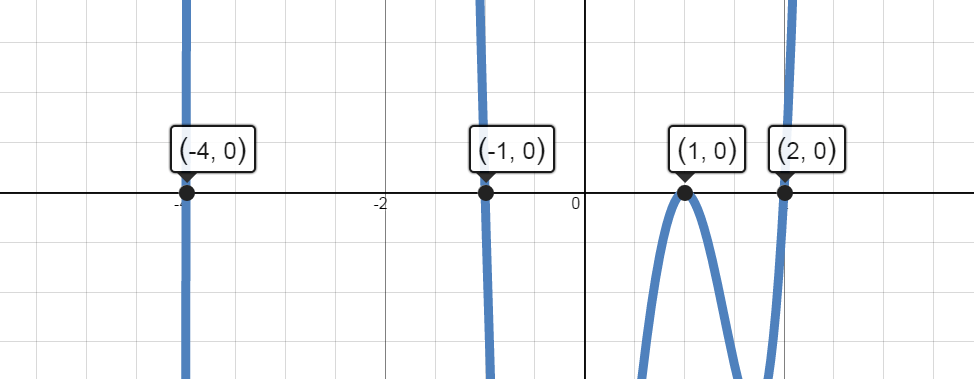
What are the zeros of the function shown?
{-2, 1, 2}
{-3, 1, 2}
{-4, 2, 5}
{-4, 3, 4}


What are the zeros of the function?
4, 1
-3, -1, 2, 5
-3, -1, 30, 2, 5
3, 1, -2, -5

(3x - 4x3 + 6x4 + 1) / (x + 3)

What is the proper way to write the answer for the following problem?
2x3-x2-25x+12
2x4-x3-25x2-12x+0
2x3-x2-25x-12
2x4-x3-25x2-12x-0
Using Synthetic Division; (2x3+6x2−6)÷(x+3) , specifically, which answer is the remainder correctly represented below?
2x+6
2x-6
2x2+x+36
2x2−x+36
(2x3 - 5x2 + 3x + 7) ÷ (x - 2)
2x3 - x2 + x + 9
2x2 - x + 1
2x2−x+1+x−29
2x2−9x−15−x−223
3x² + 5x - 12
Using synthetic division, find the remaining factors of
(x3 +x2 -17x +15) if (x -1) is a factor?
*FACTOR COMPLETELY*
(x + 5)(x - 3)
(x + 5)(x + 3)
(x - 5)(x + 3)
(x - 5)(x - 3)
f(x) = 2x3 - 19x2 + 38x + 24 given that x-4 is a factor.
x3-12x2+47x-60=0 when 5 is a root.
f(x) = x3-3x2-x+3; 3
f(x) = x3-5x2-2x+24; -2
(x - 5) is one factor.
Find all zeroes given a factor of (x+3).
f(x) = 2x3 + 5x2 - 6x - 9
-1,-3,-3
-1,-3,3/2
3,3,3
-3,2/3,-1
Find all solutions, one factor has been given.
f(x) =x3-3x2-25x+75; (x-5)
5,-3,5
5,5,5
3,-5,5
1,1,1

