
NEW
Font size
 Worksheets
Exponential Functions Review
Total questions: 15
Worksheet time: 15mins

Based on the graph, which statement does not appear to be true?
The company opened 400 stores by the end of 1992
Every year the number of stores opened increased by 25%
The company opened 100 stores in 1 year
Since 1992, the company has opened 250 stores each year

Which value is closest to the amount of land the toads will occupy after 40 years?
800,000 km2
550,000 km2
600,000 km2
1,250,000 km2

Which best describes the graph given?
Exponential Decay, asymptote at y = -1
Exponential Growth, asymptote at y = 0
Exponential Growth, asymptote at y = -1
Exponential Decay, asymptote at y = 0

What is the constant ratio of the table?
3
31
6
1
What type of pattern do exponential functions have?
Adds or subtracts by the same number every time
Multiplies or divides by the same number every time
Square roots all the inputs
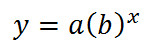
In an exponential function, what does the 'a' represent?
Input
Rate of change
Y-intercept/Initial value
Output

Which equation is represented by the table?
y = 40(2)x
y = 40(1/2)x
y = 40 - 2x
y = 40 - 1/2x

Write the function for the following table:
f(x) = 5x + .08
f(x)= 5x + 2
f(x) = .08(5)x
f(x)= 2(5)x
Suppose the population of a species of insects doubles every year. The function gives the number of insects after x years. How many insects will there be after 3 years?
9600
12,800
200
8000
In an exponential function, what does the 'b' represent?
Input
Rate of change
Y-intercept
Output

Write the function for the following table:
f(x)= 1(2)x
f(x)= 2(1)x
f(x) = 2x+1
f(x)= x+2

Which table represents the following equation?


Write an equations that models the data shown.
y=3x+6
y=3⋅2x
y=2x+3
Suppose the population of a species of insects doubles every year. There are 1600 insects initially. The function for the scenario would be?
f(x)=2x+1600
f(x)=1600×2
f(x)=1600⋅2x
The function f(x)=1600⋅2x gives the number of insects after x years. How many insects were there initially?
1600
2
There is not enough information to tell.

