
NEW
Font size
S
M
L
XL
 Worksheets
Astro 10 Chapter 3
Total questions: 14
Worksheet time: 9mins
Name
Class
Date
1.
Which astronomer of antiquity first applied a telescope to astronomical observation?
a)
Ptolemy
b)
Galileo Galilei
c)
Tycho Brahe
d)
Copernicus
2.
Ancient Greeks believed, the earth to be the centr of the universe. What do we call this model?
a)
Ptolemic System
b)
Geocentric Universe
c)
Heliocentric Universe
d)
Copernican Model
3.
Ancient astronomers used 'epicycles' to explain...?
a)
Retrograde Motion
b)
Constellation Movement
c)
Moon's Phases
d)
Planetary Transits
4.
Tycho Brahe's biggest contribution to astronomy was...?
a)
Accurate Observations of the stars and planets
b)
His telescopic observations
c)
Heliocentric Universe
d)
His Silver Nose
5.
Astronomer Johannes Kepler...
a)
Published Almagest
b)
Invented the first Radio Telescope
c)
Suggested elliptical orbits for the planets
d)
Was made head astronomer for the Church
6.
Copernicus is attributed with coming up with what model of the solar system?
a)
geocentric
b)
heliocentric
c)
geo-heliocentric
7.
Who came up with three laws explaining planetary motion?
a)
Isaac Newton
b)
Galileo Galilei
c)
Tycho Brahe
d)
Johannes Kepler
8.
Planets orbit the Sun in a shape called a(n)
a)
circle
b)
ellipse
c)
focus
d)
perihelion
9.
An ellipse is drawn around two points called
a)
aphelion
b)
perihelion
c)
foci
d)
axis
10.

Complete the following statement: The farther away two planets are the _______ the gravitational force between them.
a)
greater
b)
same
c)
zero
d)
less
11.
What does Kepler's 1st Law state?
a)
all planets move in elliptical shaped orbits around the sun
b)
all ellipses have foci
c)
not all ellipses have the same eccentricity
d)
the sun is located at one of the foci
12.
What is a PUSH or a PULL of an object?
a)
Motion
b)
Friction
c)
Force
d)
Gravity
13.
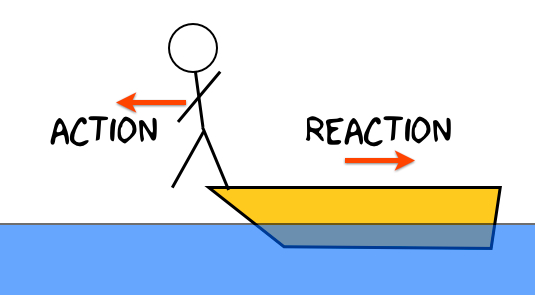
What law of motion does this picture represent?
a)
Newtons 1st law
b)
Newtons 4th law
c)
Newtons 3rd law
d)
Newtons 2nd law
14.
If an object has a small mass, it wouldn't need as strong of a force to accelerate it. Which law does this describe?
a)
Newton's 1st Law
b)
Newton's 2nd Law
c)
Newton's 3rd Law
d)
Newton's 4th Law
Reset

