
 Worksheets
Test Review: Culture and History of Africa
Total questions: 35
Worksheet time: 7mins
A group of people who share a belief system in a God or gods with a set of rituals and sacred text is called a/an _______.
ethnic group
cultural group
political group
A group of people who share ancestry, language, and cultural ideas that have been part of a community for generations is called a/an _______.
social group
political group
ethnic group
religious group
Which of the following is NOT a major ethnic group in Africa?
Bantu
Arab
Traditional
Swahili
Which ethnic group is predominantly found in North Africa?
Arabs
Bantu
Ashanti
Swahili
Which ethnic group is found in East Africa and practices a mix of Islamic and traditional religious practices?
Arabs
Bantu
Ashanti
Swahili
Which ethnic group follows a traditional religion and believes plants and animals have souls?
Arabs
Bantu
Ashanti
Swahili
Two-thirds of the population of people in North Africa live in _______ areas.
the Lake Victoria
academic
rural
urban
The forced control of another nation or territory by another country is called _______.
Civil War
Revolution
Colonialism
Coup
The process through which a country controls another country is called _______.
Coup
Imperialism
Nationalism
Apartheid
How many African leaders were invited to the Berlin Conference?
One
Several
Zero
All
The competition between European countries to gain colonies in Africa is called the _______.
Congo Scramble
Scramble for Africa
Scrambled Egg
Grand Slam Scramble
A person sent to promote their religious faith in a foreign land is called a _______.
bishop
Christian
peace-keeper
Which two countries in Africa were not colonized?
Choose TWO!!!
Ethiopia
South Africa
Liberia
Egypt
Choose 3 reasons European countries wanted to colonize Africa.
CHOOSE THREE !
New markets
Resources such as gold and ivory
Cheap labor
Access to sand and water
Which country took over mostly desert land in Algeria and West Africa to spread their culture and trade slaves, palm oil, and timber?
France
Belgium
Germany
Portugal
Which country purchased land in the Congo area that was larger than the size of their own country?
France
Belgium
Germany
Portugal
Africans wanted independence from the Europeans but could not defeat them because Europeans had better _______ and _______.
technology and weapons
roads and bridges
universities and military uniforms
food and music
The movement that called for a stronger bond between nations and people of African descent around the world to think of Africa as the homeland.
Colonialism
Pan Africanism
Apartheid
Imperialism
Why did Africans desire independence from European control?
They wanted to colonize Germany and France
They wanted better schools and infrastructure
They felt the Europeans exploited their land and resources and treated them as second-class citizens
They wanted to wage war on the Middle East and did not want European assistance
Who inspired the Pan African Movement?
F W de Klerk
Nelson Mandela
Jomo Kenyatta
Marcus Garvey
What three colors are used on the Pan African flag?
red, green, white
red, green, black
white, black, red
black, blue, green
Separateness; System of segregation
Imperialism
Famine
Apartheid
ANC
Ten areas of South Africa where most black Africans were forced to live
Cape Town
Homelands
Apartheid
Johannesburg
Under the laws of apartheid, black Africans were not allowed to _______
travel freely or wear hats
vote, travel freely, or own land
vote or listen to music
vote, use white facilities, or drive
President of South Africa who ended apartheid and freed Nelson Mandela from prison
Marcus Garvey
Jomo Kenyatta
F W de Klerk
Barack Obama
Nelson Mandela was part of the ANC. What does ANC stand for?
African National Committee
African National Congress
African Nigerian Conference
African Nut Corporation
Nelson Mandela was elected the first black South African president in 1994 and was awarded the ______
Nobel Peace Prize
Olympic Gold Medal
Oscar for best actor in a motion picture
Simpson Eagle Award
Which group began an uprising in Kenya in order to gain independence from the British?
Kenyatta Camp
ANC
Mau Mau
Darfur army
Who was elected as the first president in Kenya in 1963?
Jomo Kenyatta
F W de Klerk
Marcus Garvey
Nelson Mandela
Which country chose to gain independence peacefully from Great Britain by using
political pressure rather than violence?
Kenya
South Africa
Nigeria
Sudan
Area in west Sudan where civil war, famine, and mass genocide are occurring
Goma
Darfur
Cape Town
Khartoum
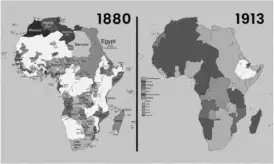
This map represents what event in African history?
Trans-Atlantic Slave Trade
End of Apartheid
Mau Mau Rebellion
Scramble for Africa
A large population of people live in small villages or _______ areas in Sub-Saharan Africa.
Urban
Rural
Desert
Homeland
European powers met at the Berlin Conference in 1884 to discuss the colonization of Africa. During this meeting the leaders divided/cut-up Africa like a _________
pizza
cake
loaf of bread
lasagna
European powers met at the _________________ in 1884 to discuss the colonization of Africa.
SEC Conference
ANC Conference
Geneva Conference
Berlin Conference

