
 Worksheets
Pedigrees & Mutations
Total questions: 23
Worksheet time: 35mins
Mutations can benefit humans because they can:
Cause illness
Make an organism more suited to live in its environment.
Make organisms live shorter lives
Cause organisms to grow extra limbs.
A mutation is defined as:
A change in the cell's structure
Anything that changes in an embryo
Any change in the physical features of a human
A change in the DNA sequence
ATTTGAGCC- Original
ATTGAGCC - Mutated
The example above is an example of a
Insertion
Point mutation
Deletion
Substitution
Mutations are a source of genetic diversity.
True
False
The survival of a species depends on its ability to adapt to changes in the environment. Which statement correctly describes a way that mutations increase the likelihood that a species will survive in a changing environment?
Mutations are a source of variation in the species
Mutations are the cause of disease in the species
Mutations are not harmful when they occur in somatic cells
Mutations are always passed on to subsequent generations
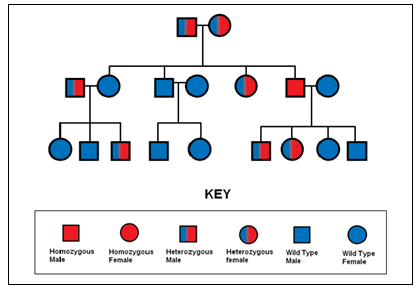
In a pedigree, which shape represents a male?
circle
square

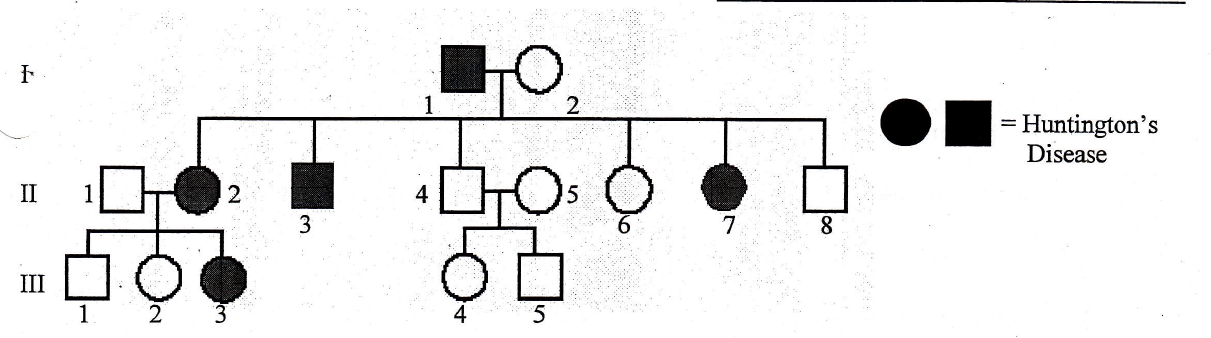
How many individuals are there in the 3rd generation?
1
2
4
6

How are individuals III-2 and II-4 related?
Brother and sister
Dad and daughter
Uncle and niece
Grandfather and granddaughter

The trait this pedigree traces is recessive because it skips a generation and individuals can be carriers. What is the most likely genotype for person III-3?
GG
Gg
gg

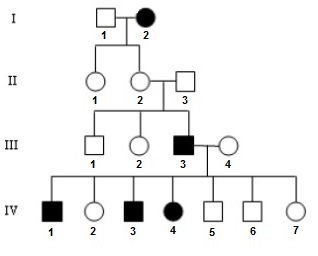

What is the correct genotype for individual I-2?


Generation 2 individuals 5 and 6 are
brother and sister.
cousins.
married.
not related.

The karyotype diagram below represents a human female with the genetic disorder known as Turner syndrome. Chromosomal analysis of this karyotype reveals the mutation is a result of
a missing X chromosome
a missing Y chromosome
an extra 21 chromosome
missing chromosome #9

The karyotype diagram below represents a human male. Chromosomal analysis of this karyotype reveals the abnormality in this karyotype is:
a missing X chromosome
a missing Y chromosome
an extra 21 chromosome
missing chromosome #9

Homologous pairs:
(select all that apply)
Have the same genes on them
May have different alleles
Each comes from one parent
Combine to give you your genotypes
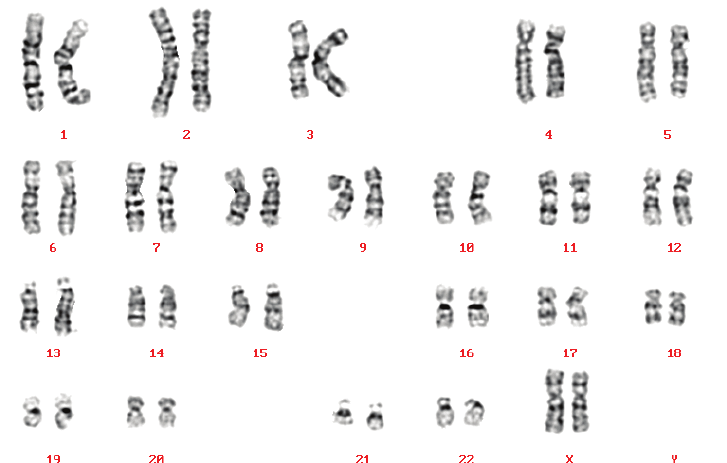
By looking at the chromosomes how can you tell that this person is biologically female?
Because there are two X chromosomes
Because there are more chromosomes than in a male
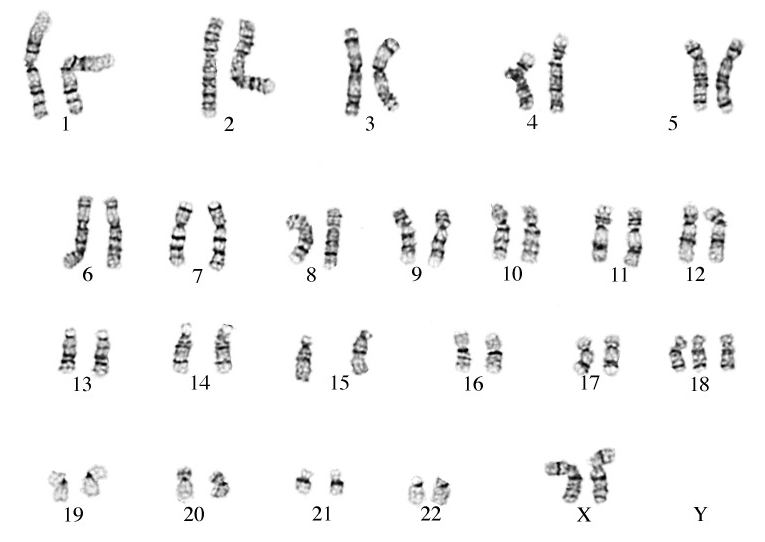
This is known as Edwards Syndrome, can you identify the chromosomal mutation?
Chromosomes 1 and 2 are bent
There is no Y chromosome
This persons chromosomes are normal
There are 3 of chromosomes 18

