
 Worksheets
Renewable Energy
Total questions: 30
Worksheet time: 22mins
Why are fossil fuels considered nonrenewable resources if they are still forming beneath the surface today?
They are being formed as a type of methane which we cannot use.
They are being formed too far beneath the surface.
The fossil fuels are being broken down by a natural process.
We are depleting the fossil fuels much faster than they can form.
Renewable energy resources produce less_____________ than fossil fuels.
energy
light
pollution
wind
Energy produced by burning organic matter such as wood, food scraps, and animal matter is called______________ energy.
Solar
Biomass
Thermal energy
Wind
Which renewable energy does not require spinning a turbine?
hydroelectric
tidal
wind
photovoltaic cells

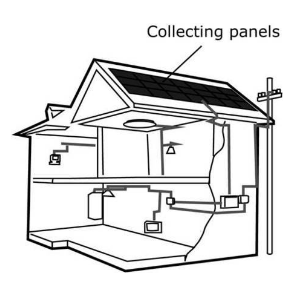
Which alternative energy source does this house use?
Which location would be best for solar energy?


Which renewable energy resource would be the most ideal for use in the Southern African region?
Hydro (water) energy
Solar energy
Wind energy
Geothermal energy (Earth's heat)

Biomass is different than fossil fuels because:
Biomass is made of different organic matter.
Biomass and fossil fuels use the same organic matter (plants and dead animals) but biomass hasn't laid around for millions of years or long enough to turn to coal.
They are not different.
Biomass and fossil fuels use the same organic matter (plants and dead animals) but biomass takes longer to form than fossil fuels and can't be replaced as quickly.
Which location would be best for geothermal energy?


Which location would be best for wind energy?


Fossil Fuels (choose ALL that apply)
considered nonrenewable resources
cause pollution in the atmosphere
are renewable resources
oil, coal and natural gas
Electric generators work by
converts mechanical energy to electrical energy (electricity)
converting oil into electricity
turning fossil fuels into uranium
rubbing copper against a substance does not conduct electricity
How is electrical energy generated in a nuclear power plant?
The uranium is heated, which heats the air. The hot air rises and turns the electric generator’s turbine.
The energy/heat generated from bombarding uranium with neutrons boils water into steam, which turns a turbine, thus running the electric generator.
The uranium is superheated and vaporized. The radioactive waste is distilled and powers the electric generator.
The turbine breaks down the uranium into neutrons that powers the electric generator, thus producing an electric current.
A disadvantage(s) of wind energy is/are that
Wind is intermittent (inconsistent availability) and may not be enough at certain times/locations.
Large amounts of land are needed for the turbines, which can cause habitat loss.
They produce almost no carbon emissions, except when being built.
Both (a) and (b).
How does biomass reduce our carbon footprint by producing less CO2 than fossil fuels?
Plants absorb the same amount of CO2 that is released when it is burned.
Plants remove CO2 from the atmosphere and put it permanently into the ground.
Biomass filters CO2 to make it more environmentally stable.
Biomass doesn't release any CO2 when burned.
Why is developing renewable energy important to life on Earth?
Renewable energy can last forever
Other energy sources will be used up and gone forever
Renewable energy produces less pollution
We will run out of energy
All of the above
What is the definition of Renewable Energy?
Renewable Energy is energy that comes from non-renewable sources like fossil fuels, natural gas, and coal.
Renewable Energy is energy obtained from sources that only last for a limited time, such as nuclear power.
Renewable Energy is energy generated from sources that have a negative impact on the environment, such as oil and gas.
Renewable Energy refers to energy derived from naturally occurring, replenishable sources that are environmentally friendly and can be harnessed without depleting them over time.
Which of the following is correct?
Kinetic Energy > Potential Energy > Electrical Energy
Kinetic Energy > Mechanical Energy > Electrical Energy
Electrical Energy > Mechanical Energy > Kinetic Energy
Mechanical Energy > Potential Energy > Electrical Energy
Statement: Should India immediately stop digging coal from its mines?
Arguments:
i) Yes. The present stock of coal will not last long if we continue mining at the present rate.
ii)No. We do not have alternate energy source of sufficient quantity.
iii)No. This will put millions of people at a disadvantage and their lives will get adversely affected and also the industry.
Only i) and ii) are strong
Only ii) and iii) are strong
All are strong
None is strong

An efficient energy network would allow us to transport power from where it is __________ to where it is needed.
advanced
generated
required
enabled
Which among the following locations are strategic sites to put up a solar power system?
Areas far away from grid
Areas with wide open space
Areas with no tall trees
Areas with no other potential sources
How does a turbine-generator work in a hydropower plant?
Water flows over the turbine, causing it to spin and generate electricity.
Water is heated to produce steam, which spins the turbine.
Water is used to cool the generator, increasing efficiency.
Water is stored in batteries for later use.

Which of the following best describes the carbon cycle's role in global warming?
The carbon cycle removes all carbon dioxide from the atmosphere.
The carbon cycle absorbs CO2 into the earth to produce geothermal and biomass energy.
The carbon cycle involves the release and absorption of CO2. When the cycle is balanced, the earth temperature stays stable.
The carbon cycle is unrelated to global warming.

